

— TRAVEL TIPS · BERLIN
Visiting Berlin on your own: the practical guide
Berlin is an easy city to cover alone and a hard one to understand alone. The transport is exemplary, most memorials are free and permanently open. But the history is often invisible: a double row of cobbles in the asphalt, an empty lot, a façade that looks too new.
Sophie Dorval, Germany specialist · September 8, 2026 · 8 min read

Berlin is vast — nine times the area of Paris — but the essentials cluster on a few axes: Mitte for history and museums, Kreuzberg and Neukölln for neighbourhood life, Prenzlauer Berg for cafés and courtyards.
Almost all the memorial heritage is free and permanently accessible: the Holocaust Memorial, the East Side Gallery, the Topography of Terror, the Wall memorial on Bernauer Strasse.
Only two bookings matter: the Reichstag dome, free but requiring registration, and the Pergamon or any Museum Island museum in high season.
What nobody tells you before you go alone
Berlin cannot be walked end to end. The U-Bahn and S-Bahn cover everything, run through the night at weekends, and a day ticket costs less than a coffee in some capitals. Buy one straight away.
The line of the Wall is marked in the ground by a double row of cobbles. You will walk over it dozens of times without seeing it unless someone points it out — the best example of what makes Berlin illegible on your own.
Many museums close on Mondays, and the Reichstag dome requires online registration with ID, several days ahead. It is free, but it cannot be improvised.
What to see, and how to approach each one alone
For each: what is free, what needs booking, and what the place does not say about itself.
The Brandenburg Gate
Free, always accessible. It ended up inside the no man's land between 1961 and 1989: unreachable from either side, it became the symbol of division before becoming the symbol of reunification.
The Holocaust Memorial
Two thousand seven hundred and eleven slabs, no inscription, no explanation: the choice is deliberate. The underground information centre, free, gives the names and the stories the field of slabs deliberately withholds.
The Reichstag and its dome
Free, but online registration with ID is compulsory, often a week ahead. The glass dome puts visitors literally above the members of parliament — a political metaphor the architect fully intended.
The East Side Gallery
One and a third kilometres of the Wall, preserved and painted in 1990. Free, outdoors. Note: this is the EAST face of the Wall, the one East Berliners could not approach — so every painting on it postdates the fall.
The Wall Memorial, Bernauer Strasse
The only place where the full apparatus is reconstructed: outer wall, death strip, patrol road, watchtower. Free, outdoors, and infinitely more eloquent than the East Side Gallery.
The Topography of Terror
On the site of the Gestapo and SS headquarters. Free, documented in English. It is the place that best explains how a state apparatus is turned to the service of terror.
Museum Island
Five museums, including the Pergamon — partly closed for long-running works: check before you come. The Neues Museum and the bust of Nefertiti remain open.
Kreuzberg and Neukölln
Free by definition. This is where present-day Berlin plays out: Turkish immigration from the 1960s, squats in the 1980s, today's gentrification. None of it is explained anywhere; it is all read off the façades.
Alongside those: Checkpoint Charlie, now an attraction of little historical value, Charlottenburg Palace, the courtyards of Hackescher Markt, and the countless Stolpersteine, brass cobbles set outside the last homes of victims of Nazism.
How to organise yourself, in practice
Register for the Reichstag before you leave
It is the one thing that books far ahead, and it is free. Slots go quickly in summer. Do it the day you book your flight.
One day per district
Mitte, then Kreuzberg, then Prenzlauer Berg or Charlottenburg. Berlin punishes anyone trying to do everything in one area on one day: the distances are real.
Alternate memorial and living city
Three memory sites in one day is crushing. Break it up with a market, a park — Tempelhof, the former airport turned public park, is unique in Europe — or a long coffee.
Guidebook, guided tour or audio guide: what to choose on your own?
In Berlin the problem is not finding the places: they are signposted and well served. The problem is that half of what matters is gone. An empty lot, a row of cobbles, a rebuilt block — with no commentary, you walk straight past.
A paper guidebook
Solid on museums, but useless in front of an empty space whose vanished contents are precisely what needs explaining.
A guided tour
Berlin is Europe's free-tour capital, and many are good — but in a group, at fixed times, and always along the same Mitte route.
A location-aware audio guide
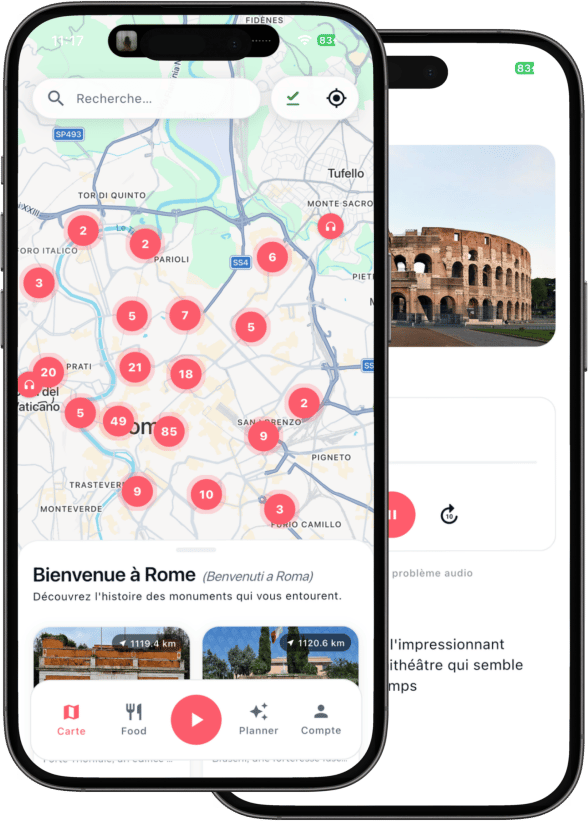
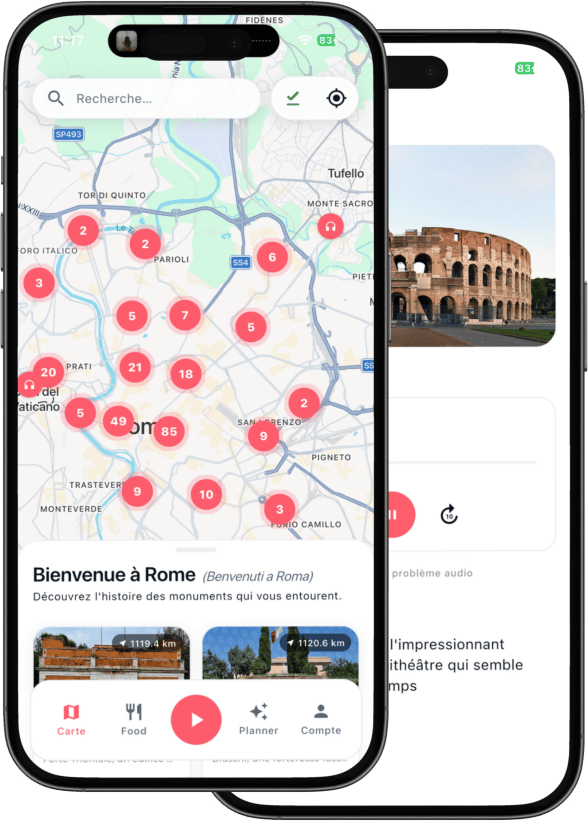
The commentary starts on its own at each memorial, each stretch of Wall, each square — including where there is nothing left to see, which in Berlin is exactly the most useful case. It all works offline.
A typical day in Berlin, without a guide
An example route through Mitte, on foot and by U-Bahn.
The dome on your booked slot at opening, then the Brandenburg Gate and the Holocaust Memorial, five minutes away on foot.
Then up towards Unter den Linden and Museum Island. Plan for one museum, not three.
U-Bahn to the Wall Memorial: this is where you physically grasp what the border was. Allow an hour and a half.
End the day in a living district, with Turkish food in Kreuzberg or a beer in a Prenzlauer Berg courtyard.
— Questions fréquentes
Visiting Berlin on your own: your questions
Three full days is a minimum: the city is very spread out and the memory sites need time and breathing space. Four or five let you add Potsdam or proper neighbourhood days.
A great deal: the Holocaust Memorial, the Topography of Terror, the East Side Gallery, the Bernauer Strasse memorial, the Reichstag dome with registration, and every district. Berlin is one of the European capitals where you see most without paying.
No. Berlin is very English-speaking, museums and memorials are documented in English, and transport and café staff switch immediately. From that point of view it is one of the easiest capitals in Europe.
The network is split into zones A, B and C — an AB ticket covers all of Berlin, ABC adds Potsdam and the airport. You must validate before boarding: checks are frequent and the fine is immediate.
It combines transport with museum discounts. Since most memory sites are free, it only pays off if you stack ticketed museums — otherwise a plain transport pass is enough.
May-June and September: long days, open terraces, mild temperatures. Winter is grey and cold, but it is also when the museums are empty and the city looks most like itself.
— Pour aller plus loin
The audio guide that tells you Berlin as you walk
CityGuide turns your phone into a personal guide: you walk, and the commentary starts on its own at each memorial, each stretch of Wall, each square — including where nothing is left to see. It all works offline, and one purchase covers everyone travelling with you.
See the Berlin audio guide