

— TRAVEL TIPS · MILAN
Visiting Milan on your own: the practical guide
Milan has a reputation as a working city with little to offer visitors. That is wrong, but it has to be earned: the city puts almost nothing on display, and its finest places are either free and ignored, or bookable only months in advance.
Sophie Dorval, Italy specialist · September 8, 2026 · 8 min read

Milan is very easy to visit alone: the centre is compact, the metro covers everything else, and the city is markedly less saturated than Rome, Florence or Venice.
Only one booking is genuinely binding, but it binds hard: Leonardo's Last Supper — fifteen minutes of viewing, slots released months ahead and gone within hours.
The rest can be arranged on the spot. The Duomo terraces can be booked the same morning, the Castello Sforzesco courtyards are free, and some of the city's finest churches cost nothing.
What nobody tells you before you go alone
The Last Supper is not booked days ahead but months. Slots go online by quarter and vanish immediately. If you missed the window, guided tours resold with the ticket included remain, at a much higher price.
The Duomo terraces are the most underrated attraction in Italy: you walk literally on the roof of a Gothic cathedral, among the pinnacles. Separate ticket from the nave — take the lift option if you are hesitating.
Milan is the Italian city where aperitivo is most codified: between 6 and 9 pm, one drink gives access to a buffet. It is often the best value for dinner, and it is a local practice, not a tourist trap.
What to see, and how to approach each one alone
For each: what needs booking, what is free, and what the place does not tell you about itself.
The Duomo and its terraces
One hundred and thirty-five spires, three thousand five hundred statues, six centuries of building. The nave and the terraces have separate tickets: the terraces are well worth the supplement — nowhere else in Europe do you stroll across a Gothic roof.
Leonardo's Last Supper
At Santa Maria delle Grazie. Fifteen minutes, twenty-five people at a time, booking months ahead. Leonardo painted it dry rather than in true fresco, which is why it has been deteriorating since the sixteenth century.
The Galleria Vittorio Emanuele II
Free, open to walk through at any time. Inaugurated in 1877, it is one of the first covered shopping arcades in the world — the model every other one descends from.
The Castello Sforzesco
The courtyards and ramparts are free; only the museums are ticketed. They hold the Rondanini Pietà, Michelangelo's last work, left unfinished at his death.
San Maurizio al Monastero Maggiore
Free, and nearly empty. Every square centimetre is covered in sixteenth-century frescoes: it is called the Sistine Chapel of Milan, and plenty of Milanese have never been.
The Brera Pinacoteca
Mantegna's Dead Christ, Raphael's Marriage of the Virgin. Rarely crowded, and set in Brera, the most agreeable district in the centre at the end of the day.
The Basilica of Sant'Ambrogio
Free. Founded in the fourth century by Bishop Ambrose, it is far older than the Duomo and infinitely less visited. Its Romanesque atrium is among the finest in northern Italy.
The Navigli
Free. These canals carried the Duomo's marble from the quarries; Leonardo worked on their lock system. Today it is the aperitivo district.
Beyond those: the Monumental Cemetery, an open-air sculpture museum and entirely free, La Scala and its museum, the Porta Nuova district and its contemporary architecture, and the windows of the fashion Quadrilatero, which cost nothing to look at.
How to organise yourself, in practice
Decide about the Last Supper before anything else
If you want it, book the moment the relevant quarter opens. If it is sold out, build the trip without it rather than paying three times the price: Milan has plenty else.
Buy a day transport ticket
The metro is simple and fast, and it links everything outside the centre — Navigli, Monumental Cemetery, Porta Nuova. Walking between those points wastes hours.
Use aperitivo as dinner
Between 6 and 9 pm in the Navigli or Brera. One drink, a buffet, and an evening costing a third of a restaurant.
Guidebook, guided tour or audio guide: what to choose on your own?
Milan does not give itself away. The city was bombed in 1943, rebuilt quickly, and its past is buried behind ordinary façades. With no commentary you see an economic capital; with it, two thousand years of history.
A paper guidebook
Decent on the major monuments, but it says nothing about the anonymous façades behind which the substance hides.
A guided tour
Useful for the Last Supper, where it is sometimes the only way to get a ticket. Elsewhere it stays inside the Duomo–Galleria–Castello triangle.
A location-aware audio guide
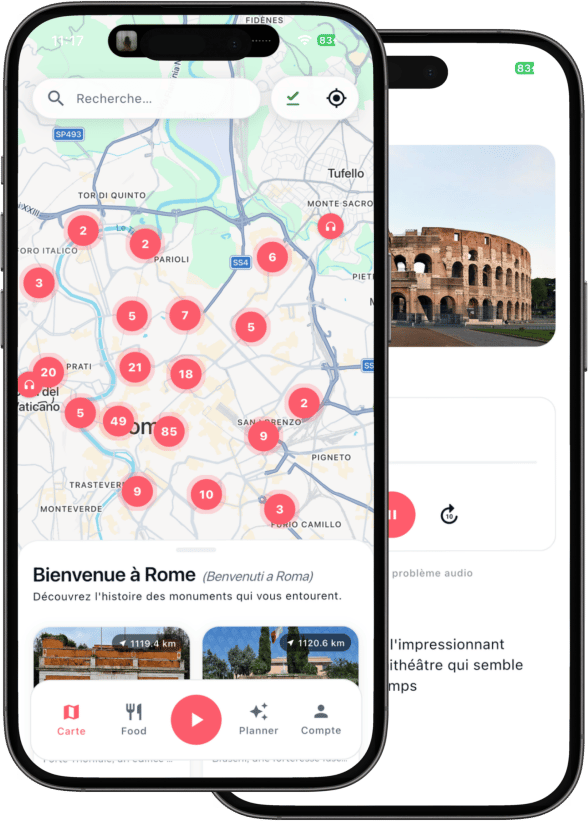
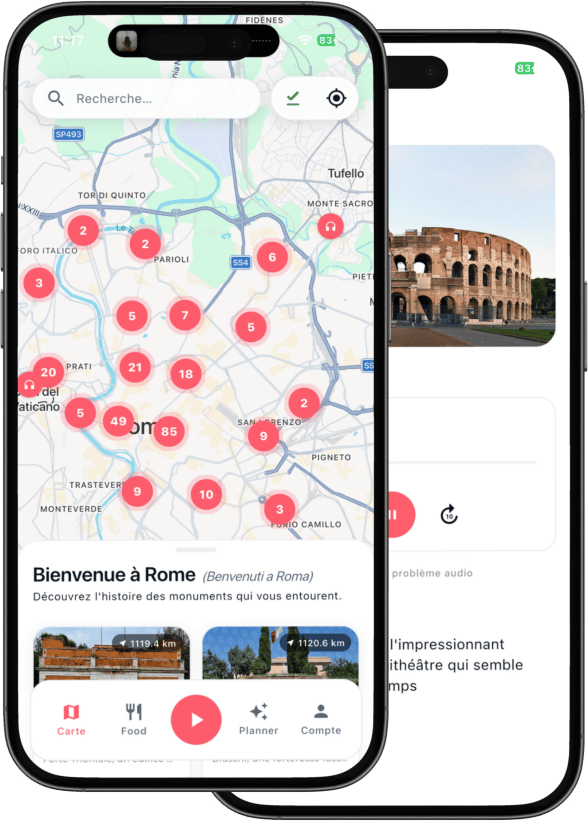
The commentary starts on its own at each church, square and canal — including the ones nobody looks at. It all works offline.
A typical day in Milan, without a guide
An example route, on foot and by metro.
At opening, with morning light on the pink Candoglia marble. Allow an hour for the terraces, one for the nave.
Through the Galleria, past Piazza della Scala, then up into Brera and its picture gallery. Lunch in the district.
Two free churches ten minutes apart, and two of the finest interiors in the city. Then the Castello Sforzesco and Sempione park.
Metro to Porta Genova, a walk along the canals and aperitivo by the water.
— Questions fréquentes
Visiting Milan on your own: your questions
Two full days are ample for the centre and two or three museums. Three allow a day trip: Lake Como is forty minutes by train, Bergamo fifty.
On the official site, the moment sales open for the relevant quarter — they go within hours. Failing that, some agencies resell guided tours including the ticket, at a considerably higher price.
The Galleria, the Castello Sforzesco courtyards, Sant'Ambrogio, San Maurizio, the Monumental Cemetery, the Navigli and most churches. Milan is far cheaper to visit than its reputation suggests.
Not compulsory, but booking a slot avoids a queue that can reach an hour in summer. Take the lift ticket if you would rather skip the two hundred and fifty steps.
Yes, provided you do not judge it on its three most touristy hours. It is the least staged of Italian cities: the best of it is invisible from Piazza del Duomo.
April-June and September-October. Avoid August, when much of the city closes, and the weeks of the furniture fair or Fashion Week, when hotels become unaffordable.
— Pour aller plus loin
The audio guide that tells you Milan as you walk
CityGuide turns your phone into a personal guide: you walk, and the commentary starts on its own at each church, square and canal — including the ones nobody looks at. It all works offline, and one purchase covers everyone travelling with you.
See the Milan audio guide