

— TRAVEL TIPS · MADRID
How to visit Madrid without a guide (and miss nothing)?
You want to explore Madrid on your own terms, at your own pace, without paying for a guided tour or shuffling along in a single-file group. Good news: it's not only possible, it's often the most beautiful way to discover the Spanish capital — with one condition.
Laura Bennett, Spain specialist · June 23, 2026 · 8 min read
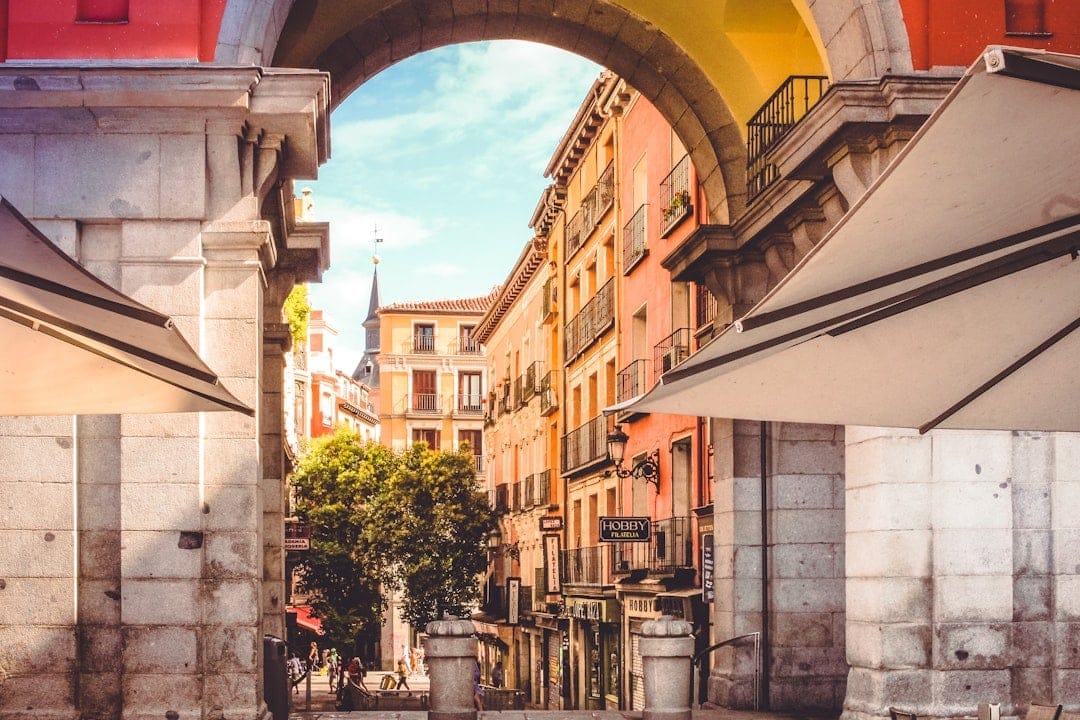
Let's settle it right away: yes, you can absolutely visit Madrid without a guide. Millions of travellers do it every year, and they gain something no organised tour can offer — total freedom. Your itinerary. Your pace. Your budget. The right to linger an hour in front of a Velázquez, or slip off for tapas the moment you fancy it.
The only mistake to avoid is setting off completely blind. Because Madrid, with no context at all, can quickly boil down to handsome façades and grand squares whose story you never grasp. And that would be a shame: it's precisely that story — the Habsburgs, the Golden Age, the court painters — that turns a stroll into a journey.
The right approach fits in one sentence: stay free, but don't stay clueless. Here's how.
What nobody tells you about Madrid "with nothing"
Standing before Las Meninas at the Prado, an unprepared traveller sees… a nice family portrait. They miss one of the most dizzying masterpieces in the history of art: Velázquez paints himself into it, plays with mirrors and with the king's gaze. Without a key to read it, the genius stays invisible.
It's the same trap all over Madrid. The Puerta del Sol is just a crowded crossroads until you learn it's Spain's "kilometre zero", the point from which every road in the country is measured. The Plaza Mayor is just a pretty square until you know kings were crowned there and trials were held during the Inquisition. The signs on site are rare, often only in Spanish, and never tell the anecdotes that bring a place to life.
Visiting without a guide doesn't mean "visiting with nothing". It means giving yourself the right tools to understand — while keeping your freedom.
Madrid's must-sees (and why you need to understand them)
Here are the places you shouldn't miss. But remember one thing: in front of each, what changes everything isn't seeing it — it's knowing what you're looking at.
The Prado Museum
One of the greatest art galleries on earth. Velázquez, Goya, El Greco… without a key to read them, you walk through three centuries of genius thinking you're just seeing pretty paintings.
The Royal Palace
The largest palace in Western Europe by floor area: over 3,000 rooms. The kings no longer live here, but every hall tells the grandeur of the Spanish Bourbons.
The Plaza Mayor
An enclosed Golden Age square. Kings were crowned here, bullfights staged and trials held during the Inquisition — beneath these now-peaceful arcades.
The Puerta del Sol
The beating heart of Madrid. This is "kilometre zero", where every road in Spain begins, and where the country counts the twelve chimes of the new year.
The Retiro Park
Once the kings' private garden, now Madrid's green lung. A glass palace hidden among the trees and a lake where you can row beneath a royal monument.
The Gran Vía
Madrid's "Broadway", carved through the city in the early 20th century. Art Deco façades, cinemas and theatres: the avenue that dragged Madrid into the modern age.
The Reina Sofía & Guernica
Here hangs Picasso's Guernica, a scream against the Civil War. Standing before the canvas, you finally understand why it travelled the whole world.
The Temple of Debod
A genuine 2,200-year-old Egyptian temple, gifted by Egypt and rebuilt stone by stone in Madrid. The finest sunset spot in the city.
And these are only the best-known: Madrid has hundreds of places worth pausing for, from overlooked neighbourhoods to hidden treasures.
How to visit Madrid without a guide, in practice
1. Group your must-sees by neighbourhood
You now know the big must-sees. Spot them on a map and group them by area so you don't zigzag: the Royal Palace with the Plaza Mayor and the Puerta del Sol in Habsburg Madrid, the museum triangle (Prado, Reina Sofía) with the Retiro to the east, and the Gran Vía to tie it all together. And leave room for the unexpected — in Madrid, it's often the unplanned side streets that leave the deepest mark.
2. Give yourself a way to understand what you're seeing
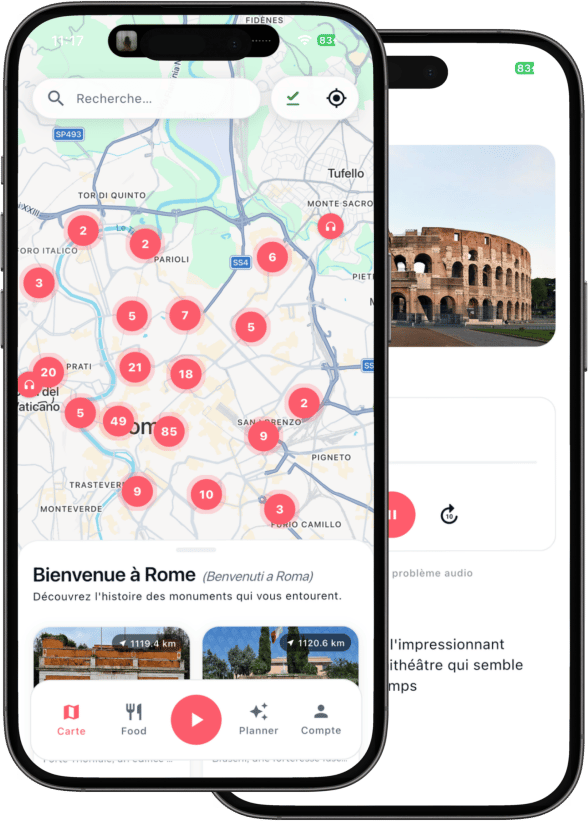
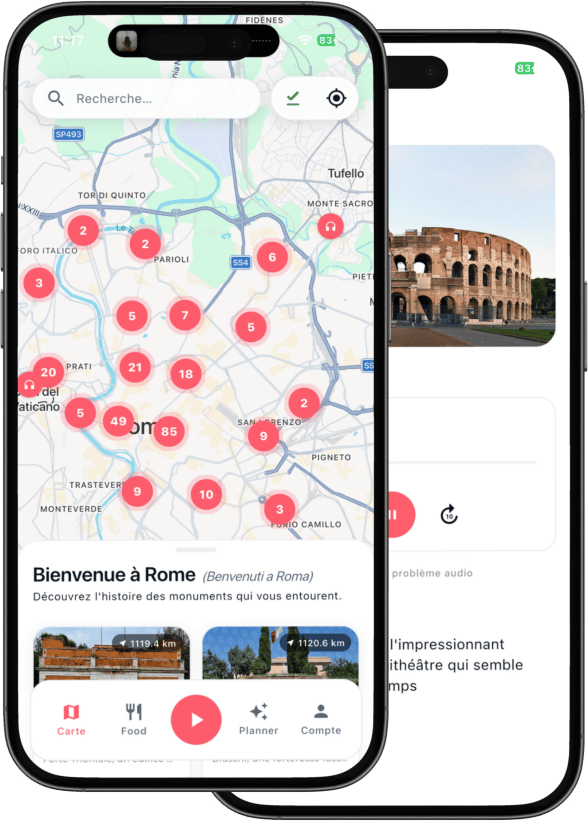
This is the step most people skip — and the one that makes all the difference. You have several options: a paper guidebook (effective, but you read it head-down with your hands full), a DIY prep (notes, videos), or the solution independent travellers have adopted in recent years: the geolocated audio guide, which detects where you are and starts the story of a place the exact moment you reach it — hands and eyes free, across Madrid.
3. Pick the right moment and dodge the traps
Adopt the Spanish rhythm: Madrileños eat lunch around 2 pm and rarely dine before 9 pm, and some shops close in the afternoon. Visit the big sites early to escape the crowds — and above all the crushing July–August heat (often above 35 °C / 95 °F). Book the Prado and the Royal Palace ahead, keep an eye on your belongings around the Puerta del Sol, and favour spring or autumn. With that, you'll see Madrid more freely — and often better — than on any guided tour.
Paper guide, mobile app or audio guide: which to choose?
On paper the three options look alike. On the streets of Madrid, the experience is very different.
The paper guidebook
Thorough, but you read it standing in the sun, head down, hands full. You look at the pages instead of the city — and you forget it all by evening.
The "classic" audio app
It forces a fixed route to follow in order. The frequent result: you end up disoriented, retracing your steps, feeling like you missed half of it.
The geolocated audio guide
The story starts on its own wherever you are: impossible to get lost or miss the order. And it's no robot — a real story, with the anecdotes and secrets no sign ever tells. You look up at Madrid, not at a screen, even offline. That's the CityGuide approach.
A typical day in Madrid without a guide
An example walking itinerary, to adapt to your mood — each stop tells its own story if you have an audio guide that triggers as you walk.
Habsburg Madrid: the Royal Palace, the Almudena Cathedral, then the Plaza Mayor and the Puerta del Sol. Arrive early with palace tickets booked to skip the queues.
A tapas lunch like a Madrileño, around 2 pm, in the La Latina district. Look for the raciones bars away from the most touristy terraces.
The museum triangle: the Prado for Velázquez and Goya, or the Reina Sofía for Guernica, then a walk through the Retiro park. Every room has its story.
Sunset at the Temple of Debod, then a late dinner and a night out in the bars of Malasaña or Huertas. In Madrid, the evening is only just beginning.
— Questions fréquentes
Visiting Madrid without a guide: your questions
Yes, absolutely. Millions of travellers visit Madrid independently every year. You gain total freedom — your itinerary, your pace, your budget. The one thing to plan for: having a bit of context to understand what you're looking at, otherwise the Prado's masterpieces and the great squares stay silent.
Not necessarily. A good audio guide like CityGuide downloads before you leave and then works 100% offline — without touching your data plan or paying roaming charges in Spain. GPS is enough.
That's the difference with a geolocated audio guide: instead of forcing a fixed route to follow in order, it detects where you are and starts the right story in the right place. You walk as you like, from the Royal Palace to the Retiro, and you can't miss the order or end up disoriented.
Not if you equip yourself a little. A well-made audio guide tells you the stories and anecdotes a guide would — who's really hiding in Las Meninas, why the Puerta del Sol is kilometre zero — except you keep it forever and replay it whenever you want. You gain the freedom on top.
The Prado Museum, the Royal Palace, the Plaza Mayor and the Puerta del Sol, the Retiro park, the Gran Vía, the Reina Sofía with Guernica, and the Temple of Debod at sunset. But Madrid is also lived in its neighbourhoods — La Latina, Malasaña — and its overlooked side streets.
Spring (April–May) and autumn (September–October): mild weather, thinner crowds and bearable heat. Avoid July and August, when the city regularly tops 35 °C (95 °F) and partly empties out. And whatever the season, arrive early at the big sites to beat the queues.
— Pour aller plus loin
The audio guide that tells you Madrid as you walk
CityGuide turns your phone into a personal audio guide: you walk, and the precise moment you reach a monument, a voice begins — a real story, with the anecdotes and secrets no sign ever tells. And it's more than an audio guide: ready-made walks to follow, the best spots for tapas like a local, an itinerary planner. Plenty of places across Madrid, even offline — everything you need to see the city from A to Z, without ever staying clueless.
Discover the Madrid audio guide