

— TRAVEL TIPS · ROME
Rome audio guide: explore Rome at your own pace with your phone
The Colosseum, the Roman Forum, the Pantheon… Here's how to choose and use an audio guide to visit Rome freely, without following a group or booking a guided tour at every monument.
By Sophie Dorval, Italy specialist · August 18, 2026 · 8 min read

Rome is probably one of the cities where an audio guide makes the biggest difference.
The Colosseum, the Roman Forum, the Pantheon, the Trevi Fountain… It's easy to walk past dozens of exceptional monuments without really understanding what you're looking at.
And booking a guided tour for every single monument quickly becomes expensive and restrictive.
Another option is to use a Rome audio guide directly on your phone. This lets you discover the history behind the monuments, hear interesting stories and explore the city at your own pace, without following a group or sticking to a set schedule.
Here's how to choose and use an audio guide to visit Rome, the places where it's particularly worthwhile, and the different options available.
Why use an audio guide to visit Rome?
Rome has nearly 3,000 years of history.
The problem is that most of this history is invisible if you simply wander through the city.
Take the Roman Forum.
Without any explanation, you're essentially standing in front of a pile of ruins. But once you understand that this site was once the political, religious and commercial heart of ancient Rome, the visit takes on a whole new dimension.
That's exactly the point of a Rome audio guide: understanding what's in front of you the moment you see it.
Unlike a traditional guided tour, you can also:
- visit the monuments in whatever order you like;
- pause the audio at any time;
- stay 10 minutes or a whole hour in front of a site;
- change your route during the day;
- listen to the explanations with your own headphones;
- discover several places without booking a new tour each time.
This is especially handy for a short stay of a few days in Rome.
Which monuments should you visit with an audio guide in Rome?
The Colosseum
You can't talk about Rome without starting with the Colosseum.
Built in the 1st century AD, the amphitheatre could hold tens of thousands of spectators who came to watch gladiator fights and various public spectacles.
An audio guide helps you understand how the monument was organised, how the spectacles worked, and what life was like for the gladiators.
The Roman Forum
This is probably one of the places where explanations are most useful.
The Forum was the centre of public life in ancient Rome. Today, it can be hard to picture what the different buildings once were when you're simply walking among the remains.
Hearing their history as you go round puts each ruin back into context.
The Pantheon
The Pantheon is one of the best-preserved ancient monuments in Rome.
Its huge dome and central opening, the oculus, are particularly impressive. But its history, its architecture and the figures buried there make the visit even more fascinating.
The Trevi Fountain
You could come to the Trevi Fountain just to take a photo.
Or you could find out why this huge baroque fountain was built here, what it represents, and where the famous tradition of throwing a coin into the water comes from.
This is exactly the kind of place where a short audio explanation adds a lot.
Piazza Navona
Now filled with cafés and street performers, Piazza Navona hides a much older history.
Its distinctive shape comes from the ancient stadium that once stood on this very spot.
The Vatican and St Peter's Basilica
The Vatican packs in an astonishing amount of history, art and architecture.
An audio guide can be especially useful for understanding the works and monuments you come across, particularly around St Peter's Square and the basilica.
Which audio guide should you choose for Rome?
There are several ways to get an audio guide in Rome.
Some monuments offer their own audio guide at the entrance. This works well if you only want to visit one specific site.
However, if you want to discover Rome as a whole, juggling multiple audio guides and guided tours quickly becomes impractical.
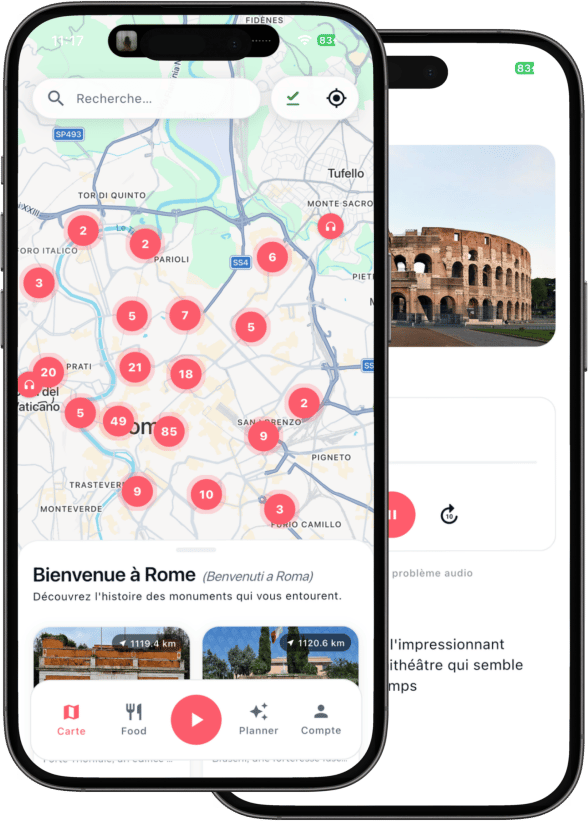
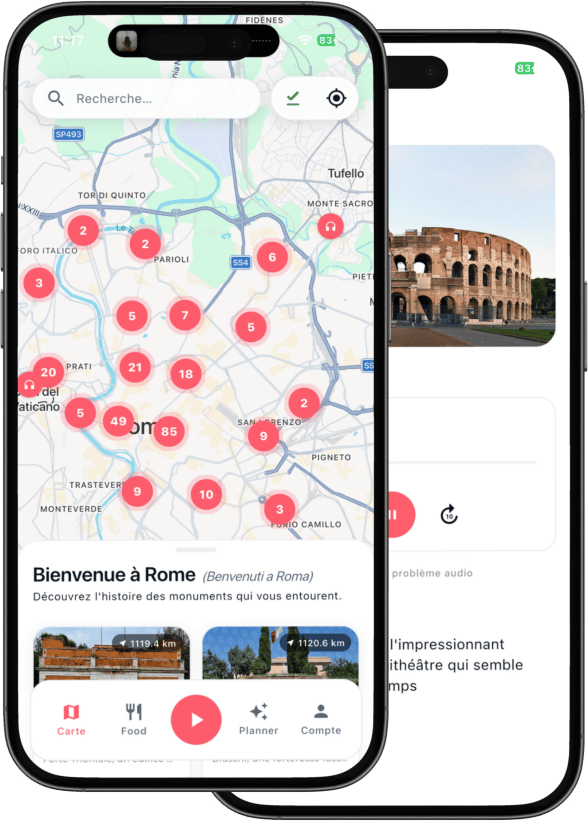
That's why apps like CityGuide take a different approach: turning your phone into a personal tour guide for the whole of your stay.
CityGuide: a Rome audio guide right on your phone
With CityGuide, you get audio guides covering Rome's main monuments and points of interest, all in a single app.
The idea is simple: put in your headphones, explore the city as normal, and play the stories and explanations for the places around you.
So there's no need to book a separate tour for every monument.
But the app isn't limited to audio guides.
It also gives you routes and walks around Rome, practical information for planning your visits, and various tools to help you explore the city more easily.
Photograph a monument to discover its history
Standing in front of a building with no idea what it is?
CityGuide also lets you take a photo of a monument or a place to identify it and find out its history.
This is especially useful in Rome.
The city is full of churches, palaces, statues, fountains and ancient ruins that you sometimes stumble upon completely by chance.
Instead of googling the name of the monument, you can simply use your phone to find out what you're looking at.
Audio guide or guided tour in Rome: which should you choose?
The two options don't quite serve the same purpose.
A tour with a real guide can be excellent if you want to go into depth on a particular monument and be able to ask questions.
But it usually comes with a fixed schedule, a set route and a group to keep up with.
An audio guide offers more freedom.
You can start your day at 9am or 11am, change your plans completely, stop for lunch whenever you like, and stay in front of a monument for as long as you want.
For many travellers, the best approach is to book a guided tour for one very specific site if needed, then use an audio guide to explore the rest of Rome freely.
How much does an audio guide cost in Rome?
The price depends a great deal on which option you choose.
Audio guides sold separately by individual monuments may seem cheap on their own, but the cost adds up as you visit more sites.
The same goes for guided tours: a handful of tours during a trip can quickly add up to a significant expense per person.
An app covering several sites across Rome can therefore be particularly worthwhile if you're planning to visit a lot.
CityGuide works with a single Rome pass, letting you use the guide throughout your stay instead of buying a new experience for every monument.
Discover the Rome audio guide on CityGuide
Can you visit Rome without a guide?
Yes, and Rome is actually a particularly pleasant city to explore on foot.
Many of its most famous monuments are relatively close to one another.
You could, for example, walk through the historic centre taking in Piazza Navona, the Pantheon, the Trevi Fountain and then the Spanish Steps.
The main downside of a completely independent visit is simply the lack of context.
You see an enormous amount, but you don't necessarily know what you're looking at.
This is exactly where a phone audio guide becomes useful: keeping the freedom of an independent visit while still having a guide's explanations whenever you need them.
How to use an audio guide during your stay in Rome
The simplest approach is to bring a pair of headphones and download your guide before starting your day.
Then, don't try to listen to absolutely everything.
Rome is huge.
Instead, use your audio guide as you go: when a monument catches your eye or you arrive at an important site, listen to its story, then carry on with your visit.
The goal isn't to spend your whole trip staring at your phone.
It's exactly the opposite: look more at the city, and only use your phone when you want to understand what you're seeing.
Our advice for discovering Rome
Don't turn your trip into a marathon of guided tours.
Pick perhaps one or two experiences you really want to dive into, then give yourself time to walk around and discover Rome freely.
It's often between two famous monuments that you stumble upon the most interesting spots.
With an audio guide like CityGuide on your phone, you keep that freedom while still getting the explanations you need, exactly when you need them.
No group to keep up with. No fixed schedule. No need to book a guided tour for every monument.
Just put in your headphones and explore Rome at your own pace.
— Frequently asked questions
Frequently asked questions about audio guides in Rome
It depends on your visit. For a single monument, the site's official audio guide may be enough. To discover several monuments and explore Rome over several days, an app that brings together different audio guides, like CityGuide, is generally more practical.
Yes. Several monuments offer audio guides in English, and there are also apps that let you listen to content about Rome directly in English.
Yes. Mobile audio guides let you use your own smartphone and headphones instead of renting a different device at every monument.
It depends on the service you use. Audio guides offered inside certain monuments may depend on the site's access conditions. With a smartphone audio guide, the guide can be set up directly before your visit.
Absolutely. Rome is very easy to visit independently, especially on foot. An audio guide is a good compromise for getting historical explanations without having to follow a group or book a guided tour for every monument.
— Go further
Explore Rome at your own pace
CityGuide combines a location-aware audio guide (over 500 places in Rome), ready-made walks, local recommendations and a trip planner — even offline.
Discover the Rome audio guide