

— TRAVEL TIPS · NAPLES
Visiting Naples on your own: the practical guide
Naples is the Italian city best suited to going it alone, and the one that makes it hardest. Nothing is signposted, almost nothing is translated, churches close without warning. In exchange, everything is open, cheap, and nobody is hurrying you.
Sophie Dorval, Italy specialist · September 8, 2026 · 8 min read

Visiting Naples alone is not only possible, it is the best way to see it: the city is walkable, distances are short, and most of the historic centre costs nothing to enter.
Only three things need booking: Pompeii in high season, Vesuvius, and some of the underground tours. Everything else can be decided the same morning.
The real difficulty is not logistics, it is reading the place. Naples shows an enormous amount and explains almost none of it: no panels, no translations, even in front of masterpieces. That is where crossing the city and understanding it part ways.
What nobody tells you before you go alone
The historic centre is dense and loud, but it is not dangerous for an attentive visitor. The precautions are those of any large city: bag in front, phone away, no visible jewellery. The traffic, however, deserves real caution — scooters do not always stop.
Many churches close between 12.30 and 4.30 pm, and some open only in the morning. Without that reflex, a whole afternoon can end in closed doors.
Naples works on separate tickets rather than a pass. Most sites cost a few euros, and the total stays below a tourist card unless you do six sites a day.
What to see, and how to approach each one alone
For each: what needs booking, what is free, and what you will not understand unless someone tells you.
The National Archaeological Museum
No booking needed, never an unreasonable queue. See it BEFORE Pompeii: the frescoes and mosaics from the sites were moved here, and the ruins become legible once you have seen what they contained.
Spaccanapoli and the historic centre
Entirely free, always open. This is the line of the ancient Greek street: the modern city still follows the plan of a colony founded twenty-five centuries ago — something nothing on site points out.
The Sansevero Chapel
The Veiled Christ is carved from a single block of marble. Timed slots online, often sold out two or three days ahead in season: it is the one booking in the centre you genuinely cannot skip.
The Duomo and the Treasury Chapel of San Gennaro
The cathedral is free, the treasury chapel ticketed. The cult of San Gennaro and the liquefaction of his blood structure Neapolitan identity; without that key, the intensity of the place stays baffling.
Underground Naples
Forty metres below the city: Greek cisterns, Roman aqueducts, 1943 air-raid shelters. A guided tour is compulsory — one of the few genuine exceptions to going it alone, since the network cannot be walked unaccompanied.
The Vomero and the San Martino Charterhouse
Three funiculars climb up for the price of a bus ticket. The charterhouse has the finest view over the bay, and its cloister stays near-empty even in August.
Pompeii
Forty minutes on the Circumvesuviana from Napoli Centrale. Book in high season. On site no commentary is provided: it is where the gap between seeing walls and understanding a city is at its most brutal.
The seafront and Castel dell'Ovo
Free, open, and the best place in the city at sunset. The castle stands on the islet where the first Greek colony, Parthenope, was founded — the ancestor of Naples.
Beyond those: dozens of baroque churches, courtyards and monumental staircases that no tour mentions. Naples rewards anyone willing to push a door open.
How to organise yourself, in practice
Book three things, improvise the rest
The Sansevero Chapel, Pompeii in high season, and one underground tour. Those three have limited slots. Everything else — museums, churches, funiculars — can be sorted the same morning.
Start early, break at midday
Churches close in the early afternoon and the heat is punishing from June to September. The Neapolitan rhythm — out early, long pause, out again late afternoon — is not quaint local colour, it is an adaptation to the climate.
One excursion per trip, not three
Pompeii, Vesuvius, the Amalfi Coast: each takes a full day. Stacking two into one day means missing both.
Guidebook, guided tour or audio guide: what to choose on your own?
In Naples the problem is not finding your way — the centre is small. It is understanding what you are looking at, in a city that explains it nowhere.
A paper guidebook
Thorough, but you have to know in advance what you are looking for, and consulting it standing in a lane full of scooters is no fun.
A guided tour
Excellent for one specific site such as the underground, but fixed times, in a group, and it covers only a fraction of the historic centre.
A location-aware audio guide
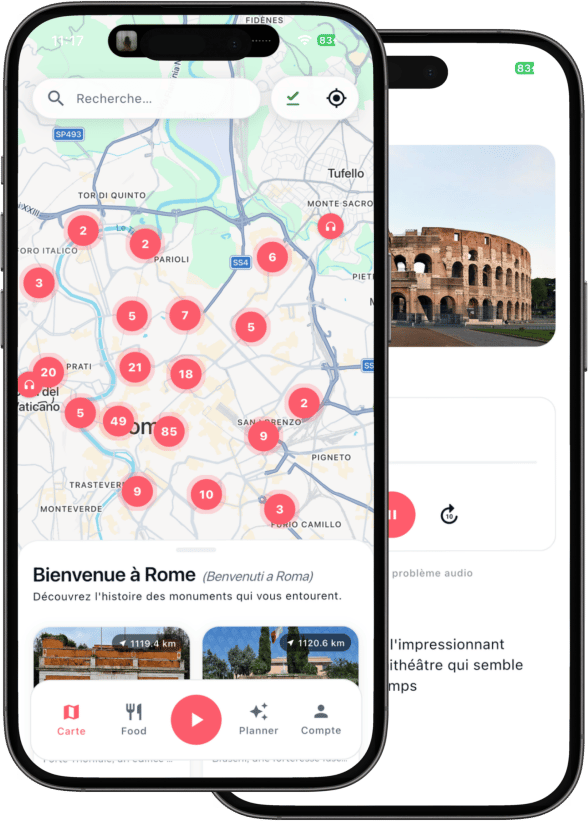
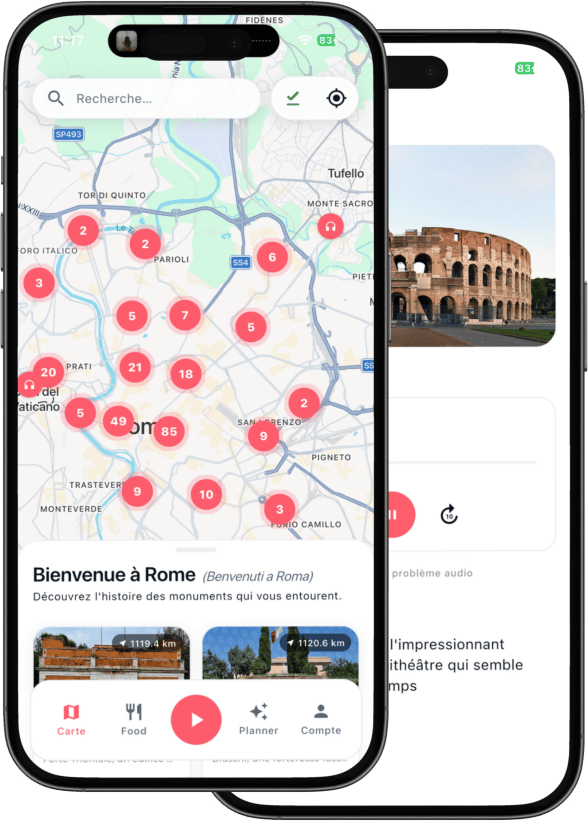
The commentary starts on its own at each church, square and courtyard — including the ones no tour stops at. You keep your own pace, and it all works offline.
A typical day in Naples, without a guide
An example of a walking itinerary, to adapt as you like.
At opening, ahead of the groups. Two hours are enough if you target the Alexander mosaic, the Secret Cabinet and the Pompeii frescoes.
A slow walk down into the historic centre: the Sansevero Chapel on your booked slot, whichever churches are open, and the nativity-figure workshops of Via San Gregorio Armeno.
Lunch in the centre, then the funicular up to the Vomero. The San Martino Charterhouse and the view over the bay deserve the late afternoon.
Back down to Chiaia and Castel dell'Ovo for sunset, then pizza in the centre. The day will have cost almost nothing.
— Questions fréquentes
Visiting Naples on your own: your questions
No, provided you take the precautions of any large city: bag closed and in front of you, phone away on transport and in crowded lanes. The real daily hazard in Naples is the traffic and the scooters, not crime.
It is not essential, but Naples is markedly less English-speaking than Rome or Florence. A few words help a great deal, and museum labels are rarely translated — that is where the barrier really shows.
Two full days cover the city. Three let you add Pompeii or Herculaneum. Herculaneum is smaller, better preserved and far less busy: often the better choice if you only do one site.
The whole historic centre, most churches outside their paying chapels, the seafront, Castel dell'Ovo, Piazza del Plebiscito and the Galleria Umberto I. State museums are free on certain Sundays.
On foot in the centre, funicular up to the Vomero, metro line 1 for longer journeys — its stations are contemporary artworks in their own right. The Circumvesuviana train serves Pompeii and Sorrento.
In high season, yes: the ticket queue can reach an hour. Off season, buying on arrival is fine. Bring proper shoes — five hours of walking on ancient paving with very little shade.
— Pour aller plus loin
The audio guide that tells you Naples as you walk
CityGuide turns your phone into a personal guide: you walk, and the commentary starts on its own at each church, square and courtyard — in a city that explains almost nothing of what it shows. It all works offline, and one purchase covers everyone travelling with you.
See the Naples audio guide