

— TRAVEL TIPS · VIENNA
Visiting Vienna on your own: the practical guide
Vienna is arguably the easiest European capital to visit alone: compact, impeccably served by transport, and remarkably legible. The trap lies elsewhere — this was the capital of an empire of fifty million people, and almost every façade points back to that history.
Sophie Dorval, Austria specialist · September 8, 2026 · 8 min read

Vienna's historic centre sits inside the Ring and can be crossed on foot in twenty-five minutes. Most of the imperial monuments are concentrated there, apart from Schönbrunn and the Belvedere.
Two bookings genuinely matter: Schönbrunn, which runs on timed slots and fills up in summer, and the Kunsthistorisches Museum at weekends. The Hofburg and the major churches can be done on the day.
The trick few visitors know: the State Opera sells standing places for a few euros, released eighty minutes before curtain-up. It is the cheapest way to see an opera anywhere in Europe.
What nobody tells you before you go alone
Trams 1 and 2 circle the Ring for the price of an ordinary ticket. It is the city sightseeing tour without the sightseeing tour: Opera, Parliament, City Hall, Burgtheater and university roll past in twenty minutes.
A Viennese café is not a place you pass through. You stay, you read, nobody hurries you — the institution is on UNESCO's intangible heritage list. Ordering 'a coffee' means nothing: ask for a Melange, a Verlängerter or a Kleiner Brauner.
Many museums close on Mondays, but not all: the Belvedere and the Albertina open seven days a week. Check before you build a day around a Monday.
What to see, and how to approach each one alone
For each: what needs booking, what is free, and what the place does not tell you about itself.
St Stephen's Cathedral
The nave is free, the towers and catacombs ticketed. The glazed tile roof carries the double-headed Habsburg eagle — the cathedral doubled as political signage.
The Hofburg
Not one palace but six centuries of successive extensions piled together. The ticket covers the imperial apartments, the Sisi Museum and the court silver; the Treasury, with the crown of the Holy Roman Empire, is paid separately.
Schönbrunn
Timed slots are compulsory and often sold out in summer: book before you travel. The park, the Gloriette and the outdoor maze are free — many visitors come for the grounds alone, and they are right.
The Belvedere
Klimt's The Kiss hangs in the upper palace. The garden between the two palaces is free, and the view from the top over central Vienna was part of the original composition.
The Kunsthistorisches Museum
The largest Bruegel the Elder collection in the world — twelve paintings out of the forty or so that survive. The building itself, and its staircase decorated by a young Klimt, justify the ticket.
The Ring
Free, by tram or on foot. These boulevards replaced the ramparts pulled down in 1857: each building adopts the historical style matching its function — Gothic for the city hall, Greek for parliament.
The State Opera
Daytime guided tours, but above all: standing places for a few euros, sold eighty minutes before the performance, at the counter only. Expect an hour's queue; it is still unbeatable.
The Naschmarkt and Karlsplatz
Both free. The market runs for a mile and a half above a culverted river; at its end, the Karlskirche and its two columns modelled on Trajan's close the perspective.
Beyond those: the Hundertwasserhaus, the Central Cemetery with the graves of Beethoven, Brahms and Schubert, the Prater and its 1897 Ferris wheel, and a hundred historic cafés, each with its own character.
How to organise yourself, in practice
Book Schönbrunn, improvise the rest
It is the only hard scheduling constraint of the trip. Everything else — Hofburg, Ring museums, churches — can be arranged the same morning, even in high season.
One palace a day, not two
Hofburg and Schönbrunn on the same day means six kilometres of interior walking and guaranteed saturation. Always alternate with a park, a café or a district.
Buy a day travel ticket
The U-Bahn, tram and bus network is unified. A 24- or 48-hour ticket pays off from three journeys, and it covers the Ring tram, which is a destination in itself.
Guidebook, guided tour or audio guide: what to choose on your own?
Vienna lets you cross it effortlessly. What is missing is the thread: why this building is neo-Gothic and that one neo-Greek, who Sisi was beyond the myth, what exactly the Secession was rejecting.
A paper guidebook
Excellent for planning a day, awkward standing in front of a Ring façade when you simply want to know what you are looking at.
A guided tour
Solid on the Hofburg or Schönbrunn, but fixed times, in a group, and it stops at the palace doors.
A location-aware audio guide
The commentary starts on its own at each palace, church and square — including during the Ring tram loop. You keep your own pace, and it all works offline.
A typical day in Vienna, without a guide
An example route through the centre, entirely on foot apart from the tram.
The cathedral at opening, then the Graben and Kohlmarkt through to the Hofburg. Allow two hours for the imperial apartments and the Sisi Museum.
Tram 1 or 2, a full circuit in twenty minutes, then step off at the Kunsthistorisches Museum or the Albertina, whichever appeals.
An hour in a historic Kaffeehaus, guilt-free. It is a local practice, not a break: nobody will come and free up your table.
Klimt's The Kiss at the end of the day, or the standing-ticket queue at the Opera if the programme tempts you.
— Questions fréquentes
Visiting Vienna on your own: your questions
Three full days comfortably cover the palaces, two or three museums and the centre. Two force a choice between Schönbrunn and the Belvedere. Four allow a trip to the Wachau valley or Bratislava, an hour away by train.
The nave of St Stephen's, the Schönbrunn park and Gloriette, the Belvedere gardens, the Volksgarten and Burggarten, the Naschmarkt, the Central Cemetery, and the Ring loop for the price of a tram ticket.
It combines transport with discounts, but few entries are genuinely included. For a normal trip, a 48- or 72-hour transport pass plus separate tickets usually costs less.
The State Opera sells standing places for a few euros, released eighty minutes before curtain-up, at the dedicated counter only. Arrive an hour before sales open to be sure of one.
No, English is spoken throughout tourist venues and transport. A few polite phrases are appreciated: Vienna is a city where protocol still counts for something.
May-June and September for mild weather and open terraces. December for the Christmas markets, among the oldest in Europe — but the city is then packed and hotels markedly dearer.
— Pour aller plus loin
The audio guide that tells you Vienna as you walk
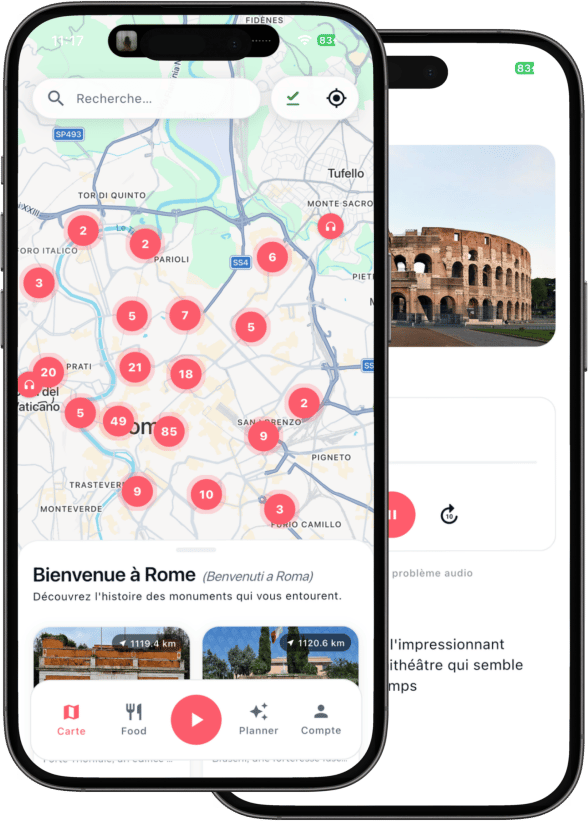
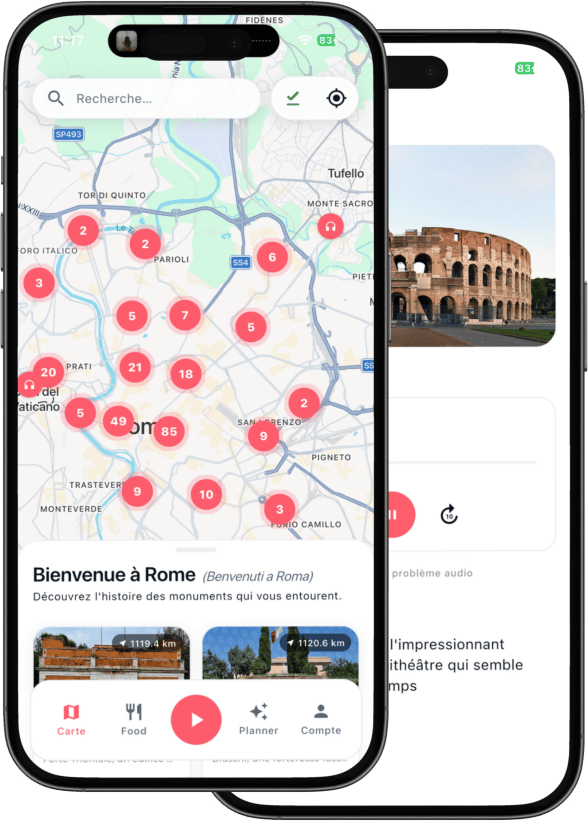
CityGuide turns your phone into a personal guide: you walk, and the commentary starts on its own at each palace, each church, each Ring façade. It all works offline, and one purchase covers everyone travelling with you.
See the Vienna audio guide