

Explore Lisbon on foot
Free walking tour Lisbon: the full self-guided route (totally free)
This is the real route of Lisbon's free walking tours, with all the stops open for free. Follow this step-by-step guide and discover the city your way, at your own pace, with no costs or hassle.
By the CityGuide Team · September 7, 2026 · 10 min read
 Free
Alyona Nagel · Pexels
Free
Alyona Nagel · Pexels
Free walking tour Lisbon – Classic route
- Duration
- 2h10
- Distance
- 4.6 km
- Difficulty
- Moderate
- Start
- Jardim de São Pedro de Alcântara (miradouro)
- Finish
- Castelo de São Jorge (outside view)
- Best time
- Morning or late afternoon to avoid the heat and catch the best light
no guide, no booking, no tipping
Looking to explore Lisbon without breaking the bank? Here’s the exact route followed by most free walking tours. You’ll stroll through Baixa, Alfama, Chiado, and take in the city’s best miradouros—just the exteriors and the free viewpoints.
With CityGuide, each stop triggers automatically as you walk by: no need for a guide or tip, you’ve got the entire route in your hands!
The route
 1
Alyona Nagel · Pexels
1
Alyona Nagel · Pexels
1. Jardim de São Pedro de Alcântara (miradouro)
This terraced garden gives you one of the best panoramas over the old city, the castle, and the Tagus. Laid out in the 19th century, it’s dotted with busts of famous writers and fountains. Locals love it as a meeting spot—perfect for a break. You’ll spot the Castelo, Alfama’s red rooftops, and church domes from here. Don’t miss the tiled map (azulejos) that helps you pick out landmarks on the skyline.
- Access :
- Free access, day and night.
- Tip :
- The golden hour in the evening is perfect for photos.
Walking to the next stop : Head down the street towards Avenida da Liberdade to reach the Glória Lift, about 5 minutes.
 2
2
2. Glória Lift (Ascensor da Glória)
The Glória Lift, opened in 1885, climbs the hill between Praça dos Restauradores and Bairro Alto. It’s a Lisbon icon, with yellow cars and a steep route. It originally ran on steam before switching to electricity. The walls nearby are covered in street art, showing the neighborhood’s creative vibe. Few visitors know this funicular became a national monument in 2002.
- Access :
- Free to view from outside. Funicular ride is paid.
- Tip :
- The funicular costs money, but walking up gives you great views and skips the wait.
Walking to the next stop : Walk downhill towards Rossio Square (Praça Dom Pedro IV)—it’s straight ahead and quick, about 5 minutes.
 3
Jose Cruz · Pexels
3
Jose Cruz · Pexels
3. Rossio Square (Praça Dom Pedro IV)
You’ve reached one of Lisbon’s liveliest squares. The wavy black and white paving was laid in the 19th century. In the center stands Dom Pedro IV atop a tall column. The National Theatre Dona Maria II across the way was built on the ruins of the old Inquisition Palace. Rossio has seen major political events, protests, and street parties. Few know that beneath the square, a neo-Gothic station has run trains to Sintra since 1890, and the cafés here were once haunts for writers and revolutionaries.
- Access :
- Free access, exterior only.
- Tip :
- The paving stones can get super slippery, especially after rain.
Walking to the next stop : From Rossio, head to Rua do Ouro and walk until you spot the Santa Justa Lift (from below), about 5 minutes.
This walk, narrated in your headphones
The CityGuide Lisbon audio guide starts by itself at every stop. You walk, it tells the story.
Full audio guide
$21.90 $39.90
★ 4.8/5 · 15 reviews
30-day money-back guarantee
 4
Eduard Pretsi · Unsplash
4
Eduard Pretsi · Unsplash
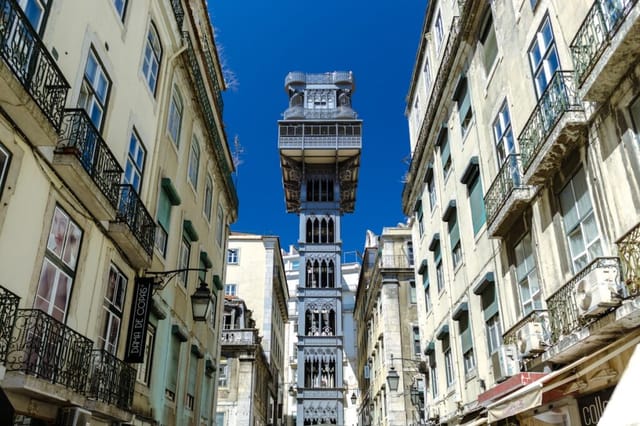
4. Santa Justa Lift (view from below)
The Santa Justa Lift, all wrought iron, has linked Baixa with Carmo since 1902. Designed by Raoul Mesnier du Ponsard, it’s 45 meters tall and stands out for its neo-Gothic details. Inside, there are wooden cabins (paid), but even from the street, the tower and its walkway are spectacular. Here’s a tip: you can actually reach the viewpoint for free via Largo do Carmo, skipping the elevator fee.
- Access :
- Free to view from outside. Access to the lift and viewpoint is paid, unless you go via Largo do Carmo.
- Tip :
- Skip the queue and fees: the view from Largo do Carmo is free.
Walking to the next stop : Keep going straight into the Chiado district and head to the Church of Loreto, about 7 minutes.
 5
5
5. Church of Loreto
The Church of Loreto, with its simple baroque façade, marks the entrance to Bairro Alto. Built in the 16th century for the Italian community, it survived the 1755 earthquake—a rare feat in Lisbon. Inside, it’s bright and simple, with gilded altars and frescoes. Locals know it well for its role in local religious life. A little-known detail: its bell, cast in Rome, still rings out the hours.
- Access :
- Free access outside. Interior is free, check opening hours.
- Tip :
- Entry is free when open, but just the façade is worth a look.
Walking to the next stop : From the Church of Loreto, keep going along the same street to the National Museum of Contemporary Art – Chiado Museum (outside), about 3 minutes.
 6
Efrem Efre · Pexels
6
Efrem Efre · Pexels
6. National Museum of Contemporary Art – Chiado Museum (outside)
The Chiado Museum sits in a simple 19th-century building, in a neighborhood famous for literary cafés and creativity. Chiado was mostly destroyed by a fire in 1988 and rebuilt. The museum, opened in 1911, shows Portuguese painting and sculpture from romanticism to today. Even from outside, it’s a symbol of the area’s cultural revival. Few people know that Fernando Pessoa, Portugal’s literary legend, often walked these streets.
- Access :
- Free to see from outside. Museum entry is paid.
- Tip :
- The museum is paid, but the area is packed with historic façades and bookshops.
Walking to the next stop : Head south to Rua Augusta and walk to the Triumphal Arch, about 6 minutes.
 7
Masood Aslami · Pexels
7
Masood Aslami · Pexels
7. Rua Augusta Arch (Arco da Rua Augusta)
Ahead of you, the Triumphal Arch marks the entrance to Rua Augusta, the main street of Baixa. Built after the earthquake, it celebrates Lisbon’s resilience. It’s decorated with allegorical figures and statues of key figures like Vasco da Gama and the Marquis of Pombal. Here’s a detail many miss: the river-facing side has clocks and commemorative inscriptions, and the (paid) rooftop view is unique. But even from the street, the Arch is a powerful symbol of Lisbon’s revival.
- Access :
- Free to see from outside. Rooftop access is paid.
- Tip :
- To dodge the crowds, look up—most people miss the sculpted details.
Walking to the next stop : Walk through the Arch and you’ll be on Praça do Comércio—immediate access.
This walk, narrated in your headphones
The CityGuide Lisbon audio guide starts by itself at every stop. You walk, it tells the story.
Full audio guide
$21.90 $39.90
★ 4.8/5 · 15 reviews
30-day money-back guarantee
 8
8
8. Praça do Comércio
Before you stretches the vast Praça do Comércio, opening onto the Tagus and lined with yellow arcaded buildings, dominated by the equestrian statue of Dom José I. The royal palace once stood here, destroyed in the great 1755 earthquake that reshaped the whole area. Its reconstruction, led by the Marquis of Pombal, created today’s Baixa—a rare example of neoclassical urban planning in Portugal. What many don’t know is that beneath your feet, old customs houses and warehouses from 18th-century merchant Lisbon still remain.
- Access :
- Free access, exterior only.
- Tip :
- Keep an eye on your stuff—this square is always packed.
Walking to the next stop : From Praça do Comércio, follow the riverside east to the Casa dos Bicos, about 7 minutes.
 9
9
9. Casa dos Bicos
Casa dos Bicos, with its spiky stone façade, was built in 1523 for Brás de Albuquerque, son of an Indies governor. Its unique style mixes Italian and Manueline influences, rare in Lisbon. It survived the 1755 earthquake, though partly damaged. Today, it houses the José Saramago Foundation (paid inside), Nobel Prize for Literature. Look out for this: some of the ‘bicos’ (spikes) still show the marks of time, proof of the building’s resilience.
- Access :
- Free to see the façade outside. Entry is paid, depending on exhibition.
- Tip :
- The ground floor sometimes hosts free exhibitions—check when you visit.
Walking to the next stop : Now head up into Alfama to reach the outside of Castelo de São Jorge, about 15 minutes.
 10
Mylo Kaye · Pexels
10
Mylo Kaye · Pexels
10. Castelo de São Jorge (outside view)
Perched on Lisbon’s highest hill, Castelo de São Jorge has towered over the city since Moorish times. Retaken by Afonso Henriques in 1147, it became the royal residence until the 16th century. The crenellated walls and towers you see from below hint at its defensive past. Entry to the castle is paid, but the esplanade and views of the ramparts are free and spectacular. Not many realize these stones are among Lisbon’s oldest remains.
- Access :
- Free outside. Paid entry for the castle interior.
- Tip :
- For the view, try the nearby Miradouro das Portas do Sol—it’s free too.
What next : You’re now at Castelo de São Jorge—enjoy the view over Lisbon or wander Alfama’s scenic lanes.
Guided free tour or solo: which is best in Lisbon?
Torn between a guided free walking tour and this solo route? Here’s how they compare.
Price
Guided free tour
Free to join, but tipping is strongly encouraged (about €10-15).
The same route on your own
Free, no tips or hidden fees.
Schedule & pace
Guided free tour
Fixed times, group sets the pace.
The same route on your own
Go whenever you want, at your own speed, with breaks whenever.
Language
Guided free tour
Usually in English or Spanish, a few French-speaking guides.
The same route on your own
French guaranteed with CityGuide.
Group size
Guided free tour
Sometimes 20–40 people, making it hard to interact.
The same route on your own
Just you or your friends, relaxed vibe.
Content depth
Guided free tour
Live stories, answers to questions.
The same route on your own
Accurate, thorough info, but no personal interaction.
Practical info for your free walking tour in Lisbon
Shoes & hills
Lisbon is super hilly, with slippery calçada paving. Wear good shoes, especially if it’s rained.
Safety & pickpockets
Watch out on trams (especially the 28) and in crowded spots like Baixa or Praça do Comércio. Keep your belongings close.
Street sellers
Ignore anyone offering illegal substances in the city center—it’s a common tourist scam.
CityGuide, your French-speaking ally
With CityGuide, the audio guide triggers automatically at each stop. No rush, everything’s at your own pace and in French.
— Frequently asked questions
Frequently asked questions about the free walking tour Lisbon
No, this route is totally open. Start where you want, when you want—no sign-up needed.
Yes, all the suggested stops are free to access from the outside. Interior visits (museums, castle, viewpoints) are optional and paid.
It’s possible, but some streets are really steep and cobbled. A baby carrier is best, and plan for breaks.
Yes, CityGuide offers this route as an audio guide, triggered automatically at each stop, in French.
Plan for about 2.5 to 3 hours if you walk leisurely and enjoy the views.
— Go further
Discover Lisbon at your own pace, without missing a thing
This route gives you all the freedom and richness of a real free walking tour, with no pressure or cost. With CityGuide, everything triggers automatically in French for a smooth visit.
Try CityGuide’s audio tour for Lisbon—it’s free!