

— TRAVEL TIPS · BUDAPEST
Visiting Budapest on your own: the practical guide
Budapest is an easy and inexpensive city to visit alone, on one condition: understanding that it is two cities. Buda, on the hills, and Pest, on the plain, only merged in 1873. Almost everything that confuses visitors comes from that.
Sophie Dorval, Central Europe specialist · September 8, 2026 · 8 min read

Buda holds the castle, Matthias Church and the viewpoints; Pest holds the Parliament, the basilica, the Jewish quarter and daily life. The Danube and its bridges stitch the two together.
Only one booking is genuinely binding: the Parliament, visitable on timed slots only, with ID, and sold out days ahead in summer.
Everything else can be improvised, thermal baths included. It is arguably the Central European city where you can do most with no planning at all.
What nobody tells you before you go alone
The currency is the forint, not the euro. Shops pricing in euros apply a poor rate, and independent ATMs in tourist areas push conversions to avoid: always decline conversion into your own currency.
The baths have their conventions: a cap is required in some swimming pools, you choose cabin or locker at the entrance, and towels are rarely provided. Nothing complicated, but nobody explains it on site.
Metro line 1, the yellow one, dates from 1896: the oldest on the European continent and UNESCO-listed. It costs the price of an ordinary ticket and is worth riding as a sight in itself.
What to see, and how to approach each one alone
For each: what needs booking, what is free, and what the place does not tell you about itself.
The Parliament
Booking compulsory, timed slot, ID required. Inside are the Hungarian crown jewels, including St Stephen's crown with its bent cross — bent by accident, and never straightened since.
The Fisherman's Bastion
The upper terraces are ticketed during the day, the lower level is free at all times — and the view is nearly identical. The bastion never defended anything: it is a decorative structure from 1902.
Matthias Church
Ticketed. Its glazed tile roof and interior decoration come from a nineteenth-century restoration that reinvented Hungarian Gothic more than it restored it. It served as a mosque during the Ottoman occupation.
The Széchenyi Baths
The largest in Europe, set in the city park. No booking needed outside event nights. The outdoor pools sit at thirty-eight degrees all year, snow included.
The Rudas Baths
A sixteenth-century Ottoman dome, still in service. Some days are single-sex: check the calendar before going. The rooftop panoramic pool looks straight down the Danube.
The Dohány Street Synagogue
The largest in Europe. Ticketed, combined with the museum and the memorial cemetery in the courtyard — a cemetery inside a synagogue is an anomaly, a direct consequence of the 1944 ghetto.
Shoes on the Danube Bank
Free, always accessible, on the Pest embankment. Sixty pairs of iron shoes, where thousands of Hungarian Jews were shot into the river in 1944-45. There is no explanatory panel on site.
Gellért Hill
Free, always open. Twenty minutes up from Elisabeth Bridge for the finest view over both cities and the seven bridges.
Beyond those: the House of Terror, the Great Market Hall, Margaret Island, the ruin bars of the Jewish quarter set up in abandoned buildings, and St Stephen's Basilica, whose dome can be climbed for a few hundred forints.
How to organise yourself, in practice
Book the Parliament, nothing else
It is the only constraint of the trip. Take a morning slot as soon as your dates are fixed, and build the rest around it.
One side of the river per day
Buda one morning, Pest the next. Crossing the Danube three times in one day costs an hour each time, funicular or not.
Save the baths for the end of the day
Two hours in the baths after a day of walking is the best possible use of them. Széchenyi closes late, and the outdoor pools are better at dusk.
Guidebook, guided tour or audio guide: what to choose on your own?
Budapest tells three overlapping stories — the Austro-Hungarian Empire, occupation and the Holocaust, forty years of communism — and explains almost none of them on site. The most powerful memorials carry no panel at all.
A paper guidebook
Fine for planning, but you will not consult it standing at a memorial where you simply want to understand what you are looking at.
A guided tour
Good on the Jewish quarter or the castle, but fixed times, in a group, and it leaves out half the city.
A location-aware audio guide
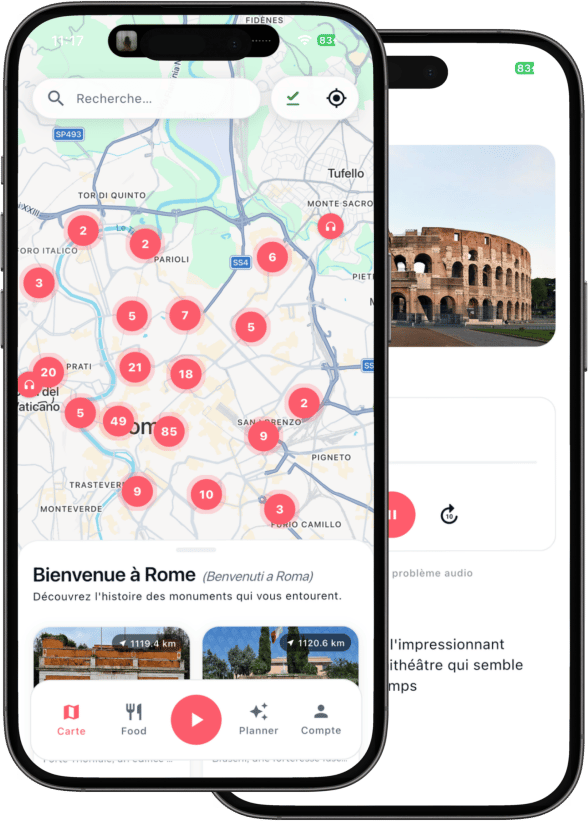
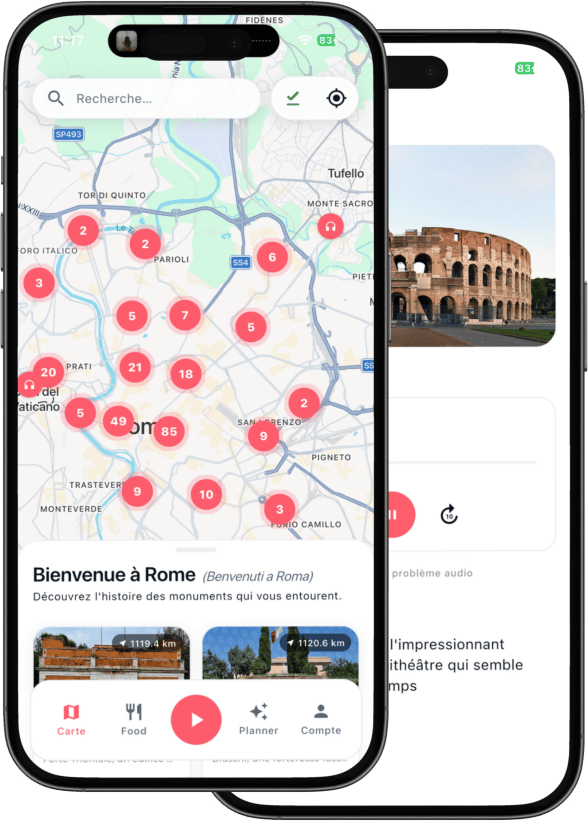
The commentary starts on its own at each monument, memorial and bridge — including the ones with no signage at all. It all works offline.
A typical day in Budapest, without a guide
An example route, on foot and by public transport.
Booked morning slot, ahead of the crowds. Then Shoes on the Danube Bank, five minutes south on foot.
The Dohány Street Synagogue, the surrounding lanes, then lunch at the market or in a neighbourhood canteen.
Funicular or bus up to the castle, the Fisherman's Bastion from its free terrace, Matthias Church, and down on foot to the Chain Bridge.
Széchenyi or Rudas, as you prefer. Two hours, then dinner. It is the local ritual, not a tourist activity.
— Questions fréquentes
Visiting Budapest on your own: your questions
Three full days comfortably cover both banks, one or two museums and a session at the baths. Two are enough if you skip the museums. Four allow a trip to Szentendre or the Danube Bend.
Yes, it is the only genuinely constrained visit: timed slots, quotas per language, compulsory ID, and sold out days ahead from May to September.
You choose locker or cabin at the entrance, receive an electronic wristband, and move freely between the pools. Bring a towel and flip-flops, they are rarely provided. A cap is required in the swimming pools, not in the thermal ones.
The lower terrace of the Fisherman's Bastion, Gellért Hill, Margaret Island, Shoes on the Danube Bank, the embankments and every bridge. Budapest is one of the cheapest European capitals to visit.
No. Withdraw forints from a bank ATM on arrival, and always decline the conversion offered in your own currency, which costs several per cent. Avoid exchange offices in tourist areas.
May-June and September: mild weather, open terraces, reasonable crowds. Winter is cold but it is the best season for the outdoor baths, and the Vörösmarty Square Christmas market is worth the detour.
— Pour aller plus loin
The audio guide that tells you Budapest as you walk
CityGuide turns your phone into a personal guide: you walk, and the commentary starts on its own at each monument, memorial and bridge — including the ones with no signage. It all works offline, and one purchase covers everyone travelling with you.
See the Budapest audio guide