

— TRAVEL TIPS · SEVILLE
Visiting Seville on your own: the practical guide
Seville works very well alone, provided you accept two local rules: book the Alcázar well ahead, and do not fight the heat. Everything else — the squares, the patios, the orange trees, the river — is free and permanently open.
Sophie Dorval, Spain specialist · September 8, 2026 · 8 min read

Seville fits into a compact historic centre, one of the largest in Europe yet entirely pedestrian. Three poles: the cathedral and the Alcázar, the Santa Cruz quarter, and Triana across the Guadalquivir.
Only one booking is genuinely critical: the Real Alcázar, whose slots go days ahead all year round. The cathedral also takes bookings, but with more flexibility.
The rest can be improvised. Plaza de España, the María Luisa park, the lanes of Santa Cruz, the riverbanks and most squares are free and always open.
What nobody tells you before you go alone
From June to September it regularly passes forty degrees in the afternoon. That is not a detail: you go out before ten, come back between two and six, and go out again in the evening. The whole city runs that way.
The Real Alcázar offers free late-afternoon entry one day a week, reserved for EU residents and requiring online booking. The places go within minutes of being released.
Flamenco in Seville operates on three levels: tourist tablaos, serious venues such as the Casa del Flamenco, and neighbourhood peñas that are hard to get into. Price says very little about quality.
What to see, and how to approach each one alone
For each: what needs booking, what is free, and what the place does not tell you about itself.
The cathedral and the Giralda
The largest Gothic cathedral in the world, built on the Almohad mosque. The Giralda is its former minaret: you climb thirty-four ramps rather than steps, so the muezzin could ride up on horseback.
The Real Alcázar
The oldest royal palace still in use in Europe. Booking essential, timed slots. The palace of Peter I is Mudéjar: a Christian king having Muslim craftsmen build him a palace in the style of his adversaries.
Plaza de España
Free, always open. Built for the 1929 Ibero-American Exposition, it is not old at all: a twentieth-century set quoting Andalusian architecture — something almost nobody realises on site.
The Santa Cruz quarter
Free. This is the former Jewish quarter, and its labyrinthine plan is not picturesque by accident: narrow lanes and shaded patios are an architectural answer to the heat.
María Luisa Park
Free, vast and shaded. It is the best place to spend the hottest hours of the day without spending anything.
Las Setas
The largest wooden structure in the world, planted on a square in the centre. The walkway on top is ticketed; the square below is free, and the basement holds Roman remains found during construction.
Triana
Free, across the bridge. A quarter of ceramicists, sailors and Roma families, it is one of the cradles of flamenco. The market built on the ruins of the Inquisition castle is worth the crossing.
Casa de Pilatos
Far quieter than the Alcázar for comparable architecture — Mudéjar, Gothic and Renaissance combined. No booking needed, and it is where Seville is easiest to actually look at.
Alongside those: the Torre del Oro, the Hospital de la Caridad, the Archive of the Indies holding the documents of the conquest of the Americas, and dozens of baroque churches open free of charge in the late afternoon.
How to organise yourself, in practice
Book the Alcázar first
Before the hotel if need be. It is the only real constraint of the trip, and the morning slots — the pleasant ones — go first.
Build the day around the heat, not your list
Monuments and walking in the morning, siesta or park in the afternoon, the city in the evening. In summer, trying to sightsee at three o'clock is not brave, it is a mistake.
Keep one evening for flamenco
Not a dinner show, a proper venue. Book the day before: the good places seat forty and sell out.
Guidebook, guided tour or audio guide: what to choose on your own?
Seville layers eight centuries of Islam, the Reconquest, the gold of the Americas and a 1929 stage set. Without a key, it all looks alike: handsome azulejos and flowering patios.
A paper guidebook
Useful in the evening, awkward in narrow lanes where you walk hugging the shade.
A guided tour
Good for the Alcázar and the cathedral, but fixed times, in a group, and it almost never leaves the cathedral–Alcázar–Santa Cruz triangle.
A location-aware audio guide
The commentary starts on its own at each church, square and patio — including in Triana or La Macarena, where no tour goes. It all works offline.
A typical day in Seville, without a guide
An example route built around the heat, entirely on foot.
First booked slot, ahead of the groups and the heat. Allow two hours, gardens included.
Five minutes away on foot. The Giralda climb is easy — ramps, not steps — and the view justifies the effort.
Lunch, then María Luisa Park or a shaded patio. This is when the city stops; do not fight it.
Across the bridge, the Triana market, back along the banks at sunset, then flamenco or tapas.
— Questions fréquentes
Visiting Seville on your own: your questions
Two full days cover the major monuments and the centre. Three allow Triana, La Macarena and a flamenco evening without rushing. Four permit a day trip to Córdoba, forty-five minutes away by high-speed train.
Yes, without exception. Slots go days ahead all year, and same-day tickets are practically never available. Book as soon as your dates are fixed.
Plaza de España, María Luisa Park, all of Santa Cruz, the banks of the Guadalquivir, the Triana market and many churches. Some monuments offer free late-afternoon entry, usually with booking.
By adopting the local rhythm: out early, stop between two and six, out again in the evening. The narrow streets of Santa Cruz are designed for shade, and many squares have misting systems.
In a dedicated venue such as the Casa del Flamenco, or a neighbourhood peña in Triana. Avoid dinner shows: the meal takes precedence over the stage. Book the day before, the rooms are small.
March-May and October-November. Avoid July and August if you can: forty degrees changes the experience entirely. Holy Week and the Feria are spectacular but saturate the city and triple hotel prices.
— Pour aller plus loin
The audio guide that tells you Seville as you walk
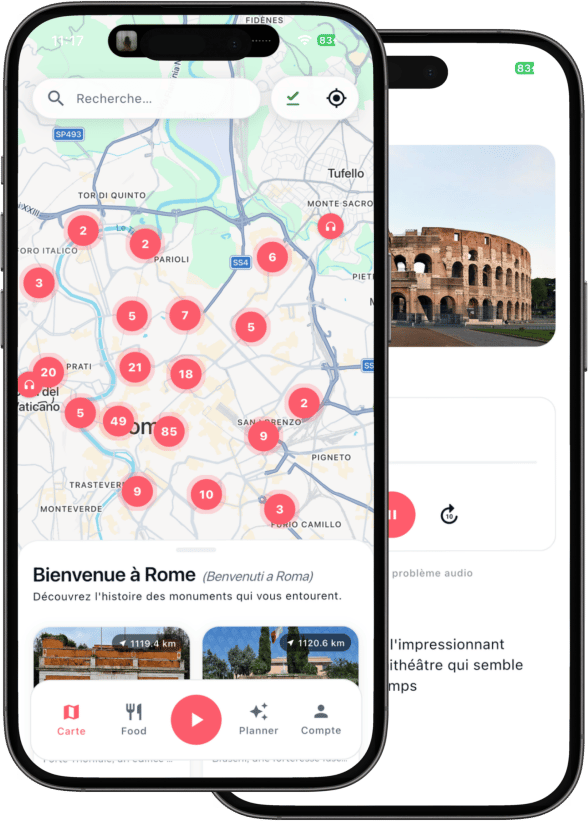
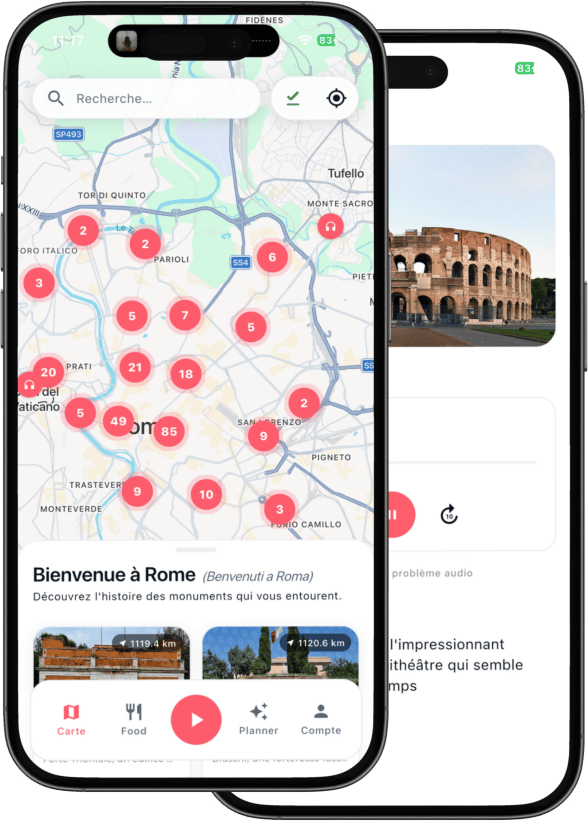
CityGuide turns your phone into a personal guide: you walk, and the commentary starts on its own at each church, square and patio — including in the districts no tour reaches. It all works offline, and one purchase covers everyone travelling with you.
See the Seville audio guide