

— TRAVEL TIPS · PRAGUE
A self-guided tour of Prague: the route, bank by bank
Prague plays out across two riverbanks and one hill. Most visitors walk it the wrong way round, climb to the castle at the busiest hour and cross the Charles Bridge when it's impassable. The order changes everything.
Sophie Dorval, Central Europe specialist · September 4, 2026 · 9 min read

Prague comes in three blocks: the Old Town and Josefov on the right bank, Malá Strana and the castle on the left, and the New Town to the south. All of it walkable.
The difficulty isn't distance but gradient and crowds. The castle sits roughly a hundred metres above the city, and the Charles Bridge alone concentrates most of the visitors.
On a self-guided tour you can reverse the usual direction: up to the castle early, back down around midday, and across the bridge at the hours when nobody's on it.
What to know before you go
The Charles Bridge is impassable from 10am to 6pm in season. At 7am it's nearly empty, and it's an unrelated experience — often with mist rising off the Vltava.
The castle isn't a building but an entire quarter, with a cathedral, lanes and gardens. Allow two to three hours, not forty minutes.
Most of Prague is outdoors and free: squares, bridges, facades, viewpoints. Tickets concern only a handful of interiors.
Prague in four blocks
Each fills half a day. Two a day is comfortable, and the gradient forces breaks anyway.
1. The Old Town and its square
The tourist heart, with the astronomical clock and its interlocking facades. Go early: the square fills from 9am and the clock draws a dense crowd on every hour.
2. Josefov, the old Jewish quarter
Only a few streets, but among the most historically loaded in Europe. The synagogues and the old cemetery share a combined ticket.
3. The Charles Bridge
Less a crossing than a place in itself, lined with baroque statues. Cross before 8am or after 8pm — in between you shuffle along and hear nothing.
4. Malá Strana
The left bank at the foot of the castle: sloping lanes, baroque palaces and gardens. Markedly quieter than the Old Town, five minutes from the bridge.
5. The castle and cathedral
The largest castle complex in the world. St Vitus Cathedral is its summit. Climb early: the coach groups arrive en masse mid-morning.
6. Petřín
The wooded hill beside the castle, with its lookout tower and funicular. Almost nobody goes up, and the view matches the castle's.
7. The New Town and Wenceslas Square
Wider, more modern, heavy with recent history. This is where Prague stops being a postcard and becomes a working capital again.
8. Vyšehrad
The second fortress, to the south, ignored by nearly every tour. Ramparts, a cemetery and one of the finest views over the Vltava — free and deserted.
Between these blocks, Prague is scattered with covered passages, inner courtyards and small squares that no sign points to and that nobody pushes open. They're often the best moments of a trip.
Organising your self-guided tour of Prague
Reverse the usual direction
Almost everyone starts in the Old Town, crosses the bridge mid-morning and climbs to the castle around noon — precisely the worst hours. Do the route backwards.
Take tram 22 up
It drops you near the castle without the hundred metres of climb. You keep your legs for the descent, which is the pleasant half.
One bank per half-day
Crossing the Vltava repeatedly costs time and energy for nothing. One bank in the morning, the other in the afternoon.
Download before you head out
Signal is poor in the lanes of Malá Strana and inside the castle grounds. A downloaded audio guide works in airplane mode.
Having Prague explained without a guide
Prague is a city whose history is hard to read off its facades: gothic, baroque and communism sit on top of one another with no labels.
The paper guidebook
Solid, but unwieldy on a packed bridge or partway up to the castle.
Free walking tours
Plentiful in Prague, but tip-based, in groups of forty, and on a fixed route. Quality swings enormously from guide to guide.
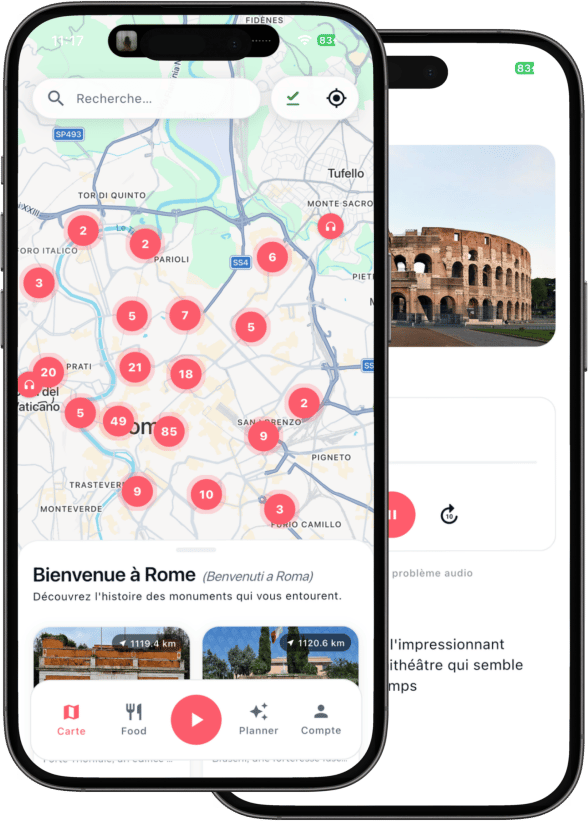
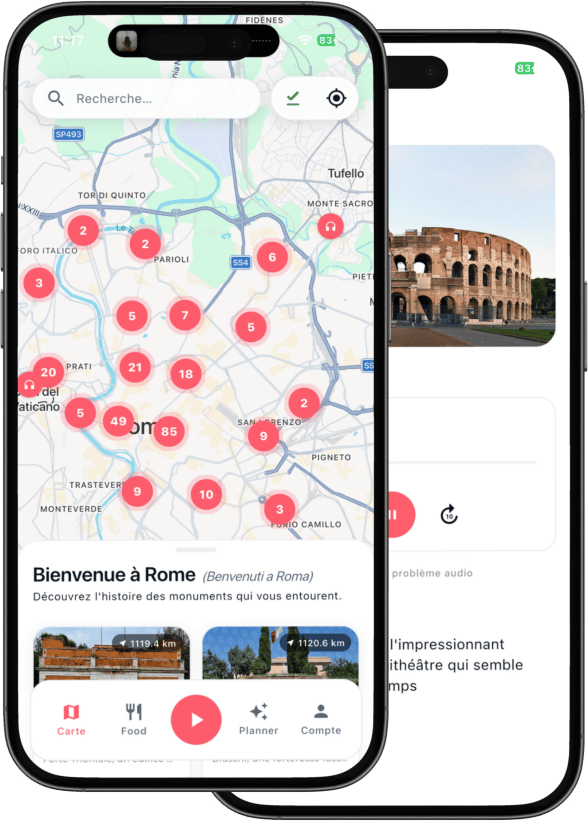
The location-aware audio guide
Commentary starts by itself at each place, including the ones no tour covers — Vyšehrad, Petřín, the courtyards of Malá Strana.
A typical day in Prague
The direction that dodges both the crowd and the midday climb.
The Charles Bridge empty, then the Old Town Square before the shops open. The only window when either is genuinely walkable.
Up to the castle, ideally by tram. Cathedral, lanes and gardens, then the walk back down into Malá Strana.
Lunch in Malá Strana or the New Town, then a break. Your legs will want it after the morning's climb.
Josefov or Vyšehrad, depending on your appetite for history or quiet. Vyšehrad is close to deserted in late afternoon.
Back toward the Charles Bridge at sunset, then dinner. The lit statues and the Vltava are worth a second crossing.
— Questions fréquentes
Self-guided tour of Prague: your questions
Two full days cover the four main blocks. Three let you add Vyšehrad and Petřín without rushing, and enjoy the evenings, which are one of the city's real strengths.
Yes, with one caveat: the climb to the castle is around a hundred metres of ascent. Tram 22 removes it for the price of a ticket and leaves you the walk down, which is far nicer.
Before 8am or after 8pm. In between, the density makes crossing tiresome and listening impossible. Early morning you can often have it nearly to yourself, frequently in mist.
The grounds and lanes are freely accessible; only certain interiors, including the cathedral beyond the narthex, need a ticket. A good share of the interest is outdoors.
The Czech Republic uses the koruna, not the euro. Cards are accepted almost everywhere, and it's better to use one than the exchange booths downtown, whose rates are poor.
The center does, though the cobbles and gradient tire small legs quickly. The Petřín funicular and the trams are excellent allies, and a self-guided tour lets you cut things short whenever needed.
— Pour aller plus loin
The audio guide that tells you Prague as you walk
CityGuide starts the commentary on its own at each place — including Vyšehrad and Petřín, where no tour takes you. Everything works offline, and one purchase covers everyone traveling with you.
Explore the Prague audio guide