

— TRAVEL TIPS · FLORENCE
A self-guided tour of Florence: the complete route
Florence is tiny: you can cross the historic center on foot in twenty minutes. That's its strength and its trap — everything is so close that you end up circling in the crowd instead of moving forward.
Sophie Dorval, Italy specialist · September 4, 2026 · 9 min read

Florence isn't a city where you walk a lot — it's a city where you wait. The Uffizi, the Accademia, the Duomo's dome: three queues that can swallow half a day if you've booked nothing.
On a self-guided tour, then, the real skill isn't finding your way. It's locking in your timed slots and filling the gaps between them intelligently.
The good news: most of Florence is outdoors and free. Squares, facades, bridges, the banks of the Arno — none of it needs a ticket or a queue.
What isn't said enough about Florence
The historic center takes twenty minutes to cross on foot. There's no reason to take transport: everything that matters sits inside half a square mile.
Without a booking you will not see the David or the Uffizi in high season. Slots go weeks ahead, not days.
The left bank — the Oltrarno — is two minutes from the Ponte Vecchio and holds a tenth of the crowd. That's where Florence becomes a city again rather than a stage set.
Florence in five zones
Each takes two to three hours. Two zones a day is plenty.
1. The Duomo complex
Cathedral, bell tower, baptistery and dome are one ticket and one place. The dome must be booked ahead and climbed early: 463 steps, no lift, and it gets hot in there.
2. Piazza della Signoria and the Uffizi
The square is an open-air museum and entirely free — the Loggia dei Lanzi holds sculptures most cities would put behind glass.
3. The Ponte Vecchio and the riverbanks
Florence's only bridge spared in 1944. Go early or at dusk: in between, you shuffle across at walking pace.
4. The Oltrarno
The left bank, its craft workshops and its squares without tourist terraces. Pitti Palace and the Boboli Gardens on one side, the lanes of Santo Spirito on the other.
5. Santa Croce and the east
The church where Michelangelo, Galileo and Machiavelli are buried, in a quarter noticeably more alive than the historic core.
6. San Lorenzo and the market
Medici territory, including the chapel they built for themselves — and the central market, still the best place to eat well without spending much.
7. Piazzale Michelangelo
The postcard view over Florence, free, twenty minutes uphill on foot. Do it at sunset, never at midday.
8. The Accademia
A single masterpiece justifies the visit, but it justifies it completely. Book a slot, and take the first one of the day.
Between these zones, Florence is dotted with small churches and palace courtyards that are freely open and that almost nobody pushes on — and that often reward you as much as the famous names.
Organising your self-guided tour of Florence
Book first, plan second
The Uffizi, the Accademia and the dome all run on timed slots. Lock those in first, then build your days around them. It's the reverse of the usual logic, but in Florence it's the only one that works.
Aim for opening or late afternoon
Florentine museums are saturated from 11am to 4pm. The first slot of the morning and the last of the afternoon change the experience entirely.
Cross the Arno every day
The instinct to stay on the right bank makes you miss half the city. The Oltrarno is five minutes away and it's where Florentines actually live.
Download before you head out
The narrow center blocks signal, and museums block it further. A downloaded audio guide works everywhere — including in the queue.
Having Florence explained without a guide
Florence is a city of details: a facade records a family rivalry, a statue carries a political message. Without context, all of it stays decorative.
The paper guidebook
Excellent on the Renaissance, but you have to read standing in a crowd. On Piazza della Signoria, that isn't workable.
Museum audio guides
Good inside, nonexistent outside. And the bulk of Florence is precisely outside, and free.
The location-aware audio guide
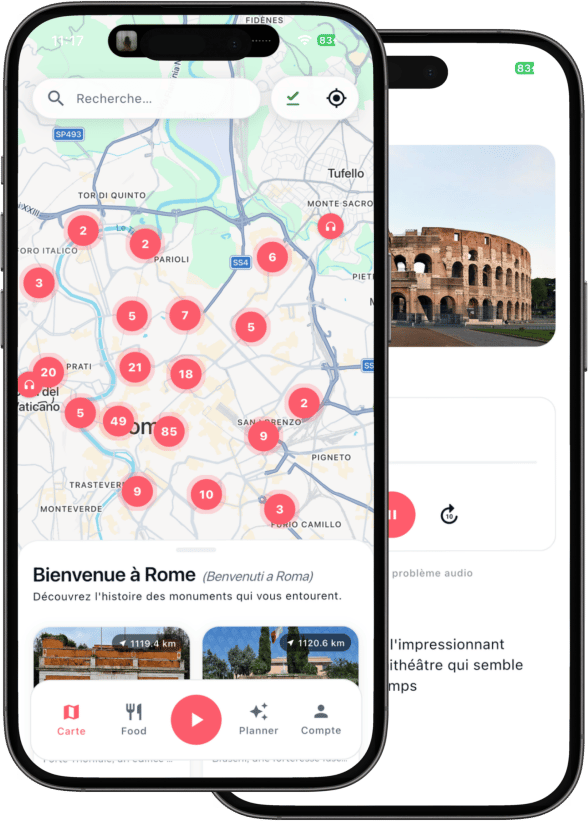
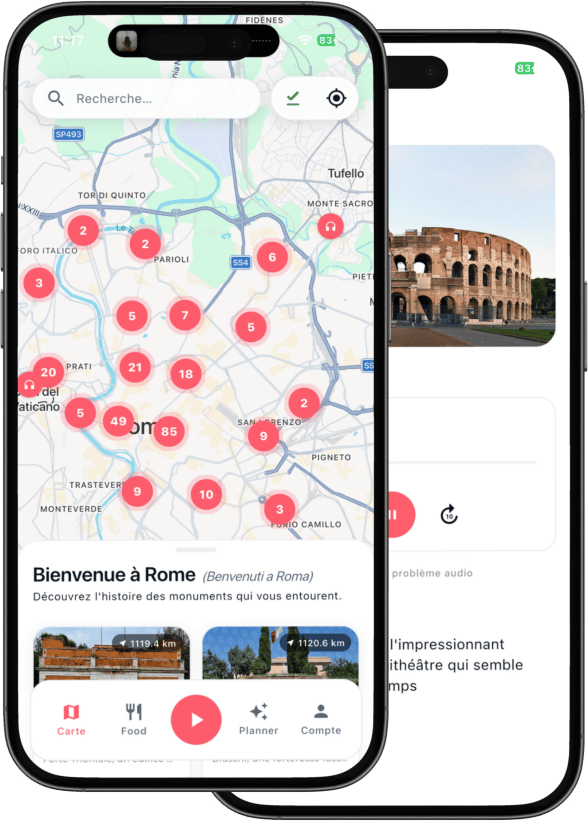
It works in the streets and on the squares, starts by itself at each facade, and covers what no museum narrates: the city itself.
A typical day in Florence
A shape that dodges both the queues and the heat.
The center, empty. The Duomo from outside, Piazza della Signoria, the Ponte Vecchio with nobody on it. The best light of the day, and the only moment you hear your own footsteps.
One major museum on your booked slot: Uffizi or Accademia. Allow three hours for the Uffizi; an hour is enough at the Accademia.
Lunch at the central market or in the Oltrarno, then a break. Florence at midday is punishing, and the streets offer no shade.
The Oltrarno: Santo Spirito, the workshops, Pitti Palace or the Boboli Gardens if the energy holds.
Up to Piazzale Michelangelo for sunset, then back down for dinner on the left bank.
— Questions fréquentes
Self-guided tour of Florence: your questions
Two full days cover the essentials, museums included. Three let you add the Oltrarno without rushing and leave time to wander. Beyond that, Florence becomes a base for Tuscany.
Absolutely in high season. Without a slot, the Uffizi wait regularly passes two hours. Book several weeks ahead for summer.
Yes, completely. The historic center crosses in twenty minutes and nothing essential falls outside it, except Piazzale Michelangelo — which is also walkable, uphill.
Entry to the cathedral itself is free, but the dome, bell tower, baptistery and museum need a combined ticket. The dome requires a specific timed slot.
Late afternoon, an hour before sunset. The climb takes twenty minutes from the Ponte Vecchio and the view is worth the effort. Avoid midday: there's no shade on the way up.
The center does — short and pedestrian. The big museums less so; three hours in the Uffizi is hard going. A self-guided tour lets you cut things short without imposing on anyone.
— Pour aller plus loin
The audio guide that tells you Florence as you walk
CityGuide starts the commentary on its own at every square, facade and bridge — including everything that's free and that nobody explains to you. Works offline, and one purchase covers your whole group.
Explore the Florence audio guide