

— TRAVEL TIPS · ATHENS
Visiting Athens on your own: the practical guide
Athens is one of the easiest capitals to visit alone: every ancient site sits within a twenty-minute walk, and a single ticket covers almost all of them. The real challenge is timing — and the fact that ruins, with no commentary, stay ruins.
Sophie Dorval, Greece specialist · September 8, 2026 · 8 min read

The ancient centre of Athens is tiny: Acropolis, Ancient Agora, Roman Agora, Kerameikos, Temple of Olympian Zeus and Hadrian's Library all follow on foot.
The combined ticket covers those six sites and stays valid for five days. It costs barely more than Acropolis entry alone: the single best-value purchase of the trip, and plenty of visitors never hear about it.
The Acropolis now runs timed slots with a visitor cap. Book, and take the first morning slot: by midday in summer the rock is an oven without a scrap of shade.
What nobody tells you before you go alone
The Acropolis Museum is not included in the combined ticket. Visit it AFTER the site, not before: the sculptures on show came from the buildings you will have seen, and the order changes everything.
The marble on the Acropolis has been polished by millions of footsteps and turns slippery. Grippy soles are not a luxury, especially on the way down.
From June to September the Acropolis sometimes closes in the middle of the day during heatwaves. It is a last-minute decision: check on the day if you are aiming for the afternoon.
What to see, and how to approach each one alone
For each: what the combined ticket covers, what is free, and what the stone does not say about itself.
The Acropolis and the Parthenon
Included in the combined ticket, timed slots compulsory. The Parthenon has almost no straight lines: slightly bulging columns, a curved base — optical corrections calculated so the eye reads it as perfectly regular.
The Acropolis Museum
Separate ticket. The top floor reproduces the exact dimensions of the Parthenon, and the empty spaces mark the friezes held in London — the museum was designed as an argument in that dispute.
The Ancient Agora
Included, and far more eloquent than the Acropolis about daily life: this is where Socrates argued, where citizens voted and judged. The Temple of Hephaestus here is the best-preserved in Greece.
The Plaka district
Free. Built over the ancient city, it still follows its layout. Its flat-roofed houses betray the Ottoman period — Athens was a town of ten thousand people before 1834.
Anafiotika
Free, clinging to the north face of the Acropolis. This Cycladic-looking hamlet was built in the nineteenth century by masons brought from the island of Anafi to build the royal palace: they reproduced their island's architecture where they lived.
Philopappos Hill
Free, always open. It gives the best view of the Acropolis, especially at sunset — and a far clearer one than Lycabettus.
The National Archaeological Museum
Separate ticket, often skipped by hurried visitors. Yet it holds the richest collection of Greek art anywhere: the mask of Agamemnon and the Antikythera mechanism are both here.
The Temple of Olympian Zeus
Included in the combined ticket. Seven centuries of building, finished by Hadrian. Fifteen columns standing out of a hundred and four: the rest were taken as building material, which says a great deal about the fate of ruins.
Alongside those: the Monastiraki market, the First Cemetery with its neoclassical sculpture, the changing of the guard outside parliament, and the Koukaki and Exarchia districts where today's Athens actually lives.
How to organise yourself, in practice
Buy the combined ticket, not six tickets
It covers six major sites for five days at barely more than the Acropolis alone. Buy online to skip the queue, and start with the Acropolis.
Climb the Acropolis at opening
First slot, eight o'clock. You get two hours of relative cool and low light before the cruise groups arrive.
Do the museum after the site, never before
Seeing the friezes in the museum and then the empty spaces on the monument works badly. The reverse — recognising in the museum what you have just seen in place — works perfectly.
Guidebook, guided tour or audio guide: what to choose on your own?
Athens poses a particular problem: what you come to see survives only as fragments. A footing, three columns, a wall. Without mental reconstruction, the visit comes down to stones in the sun.
A paper guidebook
Useful for planning, hard to handle on a site in full sun where you walk on slippery marble.
A guided tour
Effective on the Acropolis, but fixed times, in a group, and it almost always stops at the ancient perimeter.
A location-aware audio guide
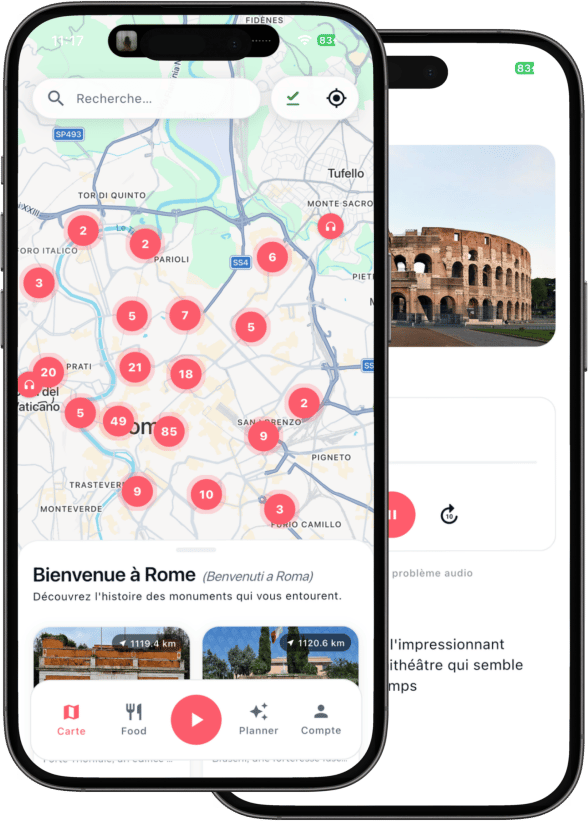
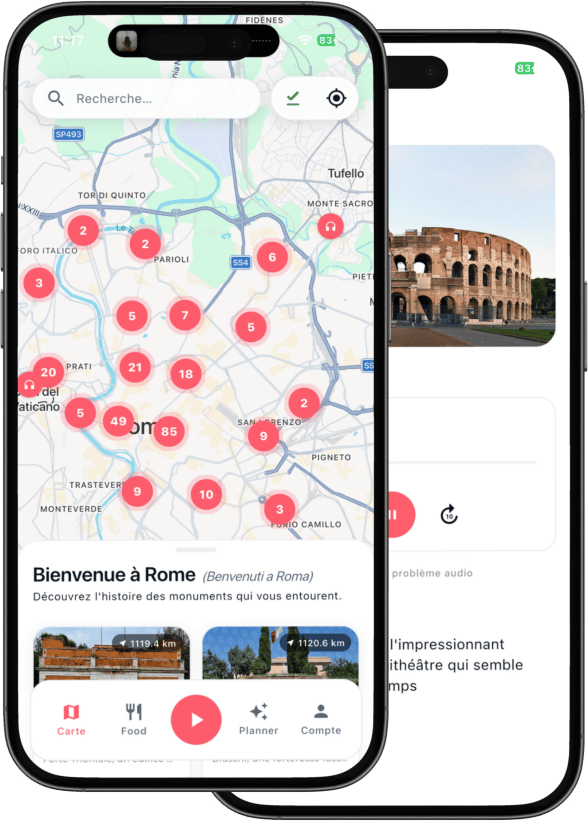
The commentary starts on its own at each temple, agora and district — which is exactly what you need where only foundations remain. It all works offline.
A typical day in Athens, without a guide
An example route built around the heat, entirely on foot.
First slot, ahead of the heat and the groups. Allow two hours including the Propylaea, the Erechtheion and the Theatre of Dionysus on the way down.
Included in your ticket, ten minutes away on foot. The Temple of Hephaestus and the reconstructed Stoa of Attalos give a concrete sense of what the square looked like.
The shaded lanes of Plaka, the climb up to Anafiotika, then a long break while the sun is at its highest.
The museum in the late afternoon, then Philopappos Hill for sunset over the Parthenon. Free, and beyond comparison.
— Questions fréquentes
Visiting Athens on your own: your questions
Two full days cover all the ancient sites and the Acropolis Museum. Three allow the National Archaeological Museum and the modern districts. Four permit a trip to Cape Sounion or Aegina.
Yes: the site runs timed slots with a visitor cap, and the morning slots go first. Buying online also spares you the ticket-office queue.
The Acropolis, the Ancient Agora, the Roman Agora, Kerameikos, Hadrian's Library and the Temple of Olympian Zeus, for five days. It does not cover the Acropolis Museum or the National Archaeological Museum.
Plaka, Anafiotika, Monastiraki, Philopappos and Lycabettus hills, the changing of the guard outside parliament, and the National Garden. Public sites are free on certain holidays and on the first Sunday of the month from November to March.
Yes, in the tourist areas and by day. As everywhere, watch for pickpockets on the metro and at Monastiraki. Some areas around Omonia are best avoided at night — no more caution than in any capital.
April-May and September-October: bearable heat, sites walkable all day, superb light. July and August regularly exceed thirty-five degrees, and the Acropolis has not one square metre of shade.
— Pour aller plus loin
The audio guide that tells you Athens as you walk
CityGuide turns your phone into a personal guide: you walk, and the commentary starts on its own at each temple, agora and district — including where only foundations remain. It all works offline, and one purchase covers everyone travelling with you.
See the Athens audio guide