

Historical Tour of Athens
Free Acropolis of Athens Audio Guide: Full Written Commentary
Discover the fascinating history of the sacred rock and the Parthenon with our full written commentary, freely accessible before you start your climb.
The CityGuide Team · September 8, 2026 · Reading time: 7 min

You are preparing your visit to the most famous monument in Greece and probably looking for a convenient way to understand its history without spending a fortune. On-site, the archaeological site requires an entrance fee, and official audio guides or those rented at the ticket counter often represent an extra expense. Finding a completely free audio solution on your smartphone is often an uphill battle.
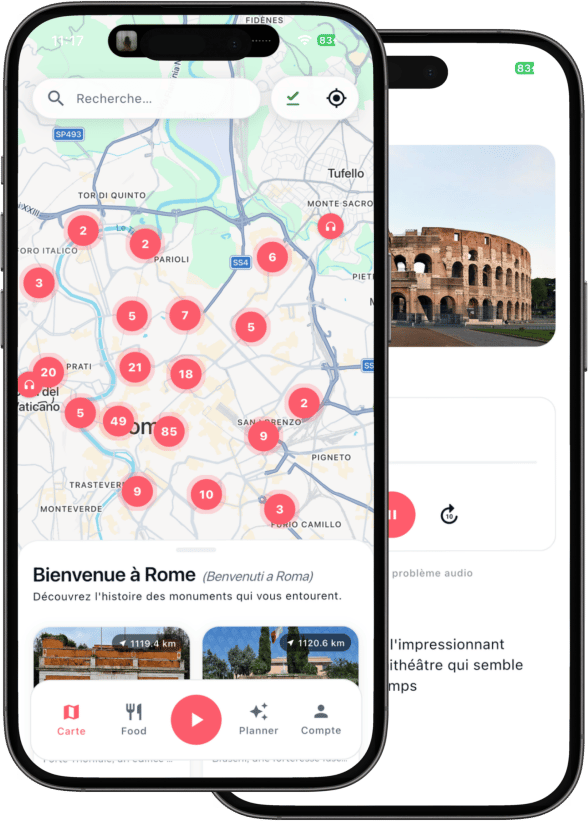
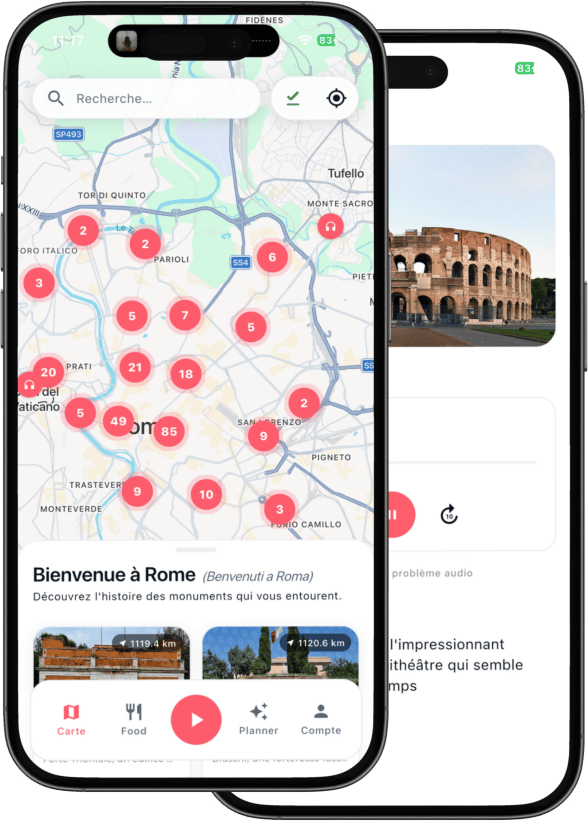
Let us be direct and honest: on this page, we offer you the full historical text for free to read during your visit, along with a short twenty-second audio sample to discover what we do. Our full mobile app for exploring Athens with automatic geolocation is paid. With this complete text right before you, you already have everything you need to decipher every stone of the sanctuary.
Listen to an Audio Sample of the Monument
Take twenty seconds to listen to our narration below. The full text remains freely accessible above, while our geolocated audio guide for all of Athens is available in the paid app.
Play a sample
Greece > Athens > Acropolis of Athens
20-second sample. The full city audio guide is paid.
What is Free and What is Not
We clearly outline our offerings to avoid any misunderstanding before you arrive at the ticket counters.
Free
Full guide text on this page
You can read all of our historical explanations without paying a penny.
Free
Audio sample demo
A twenty-second audio excerpt is available to listen to freely on this page.
Paid
Acropolis of Athens entrance ticket
Admission to the archaeological site requires a fee; check the official website for current rates.
Paid
Full CityGuide audio guide app
Our full audio guide app for the city of Athens with automatic playback is paid.
The Complete Acropolis of Athens Commentary to Read On-Site
Here are the six key steps to understand the ancient citadel, written to accompany you step by step in front of the monuments.
1. The majestic arrival through the Propylaea
As you prepare to pass through the Propylaea, this monumental gateway designed to impress ancient visitors, you notice to your right the delicate Temple of Athena Nike, perched on the edge of the cliff. Once on the sacred plateau of the Acropolis of Athens, you recall that the ancient Greeks came here to celebrate the goddess of victory and seek her benevolent protection over the city. Looking down at the ground, you immediately notice the rugged limestone rock, polished smooth by millions of footsteps across centuries. Ahead of you, slightly to the right, the Parthenon imposes its white marble silhouette. Picture this place buzzing with excitement during the Panathenaic games, when civic processions climbed solemnly to present a new peplos to the statue of the goddess. Everything here was conceived to leave an impression and proclaim the intellectual, religious, and political power of Athens at the height of its Golden Age.
2. The Parthenon and Pericles' great building program
The Parthenon was built between 447 and 432 BCE under the leadership of the statesman Pericles. To bring this monumental project to life, he enlisted the architects Ictinus and Callicrates, as well as the renowned sculptor Phidias. Together, they used white marble quarried from Mount Pentelicus, located about fifteen kilometers northeast of the city. The stone blocks were hauled up the rock using sophisticated ramps and complex pulley systems. The monument was primarily dedicated to Athena Parthenos, the virgin patron goddess of the city, and once housed a colossal chryselephantine statue made of gold and ivory. This masterpiece of the Doric order was not merely a temple dedicated to traditional worship, but also served as the civic treasury where the funds of the Delian League were kept. This colossal endeavor sparked fierce political debates in Athens because of its extraordinary cost.
3. The Erechtheion and the mystery of the Caryatids
On the north side of the plateau stands the Erechtheion, an exquisite Ionic structure featuring deliberately asymmetrical architecture. It conforms to the natural slope of the terrain while sheltering several ancient cults of Athenian mythology. It was right here that the legendary contest between Athena and Poseidon for supremacy over Attica supposedly took place. The most famous feature is unquestionably the Porch of the Caryatids, where six statues of richly draped young maidens support the entablature of the south porch. Look closely: the figures you see on the monument are actually faithful casts created to withstand modern pollution. Five of the original statues are safely kept in the Acropolis Museum at the foot of the rock, while the sixth is in London at the British Museum. The Caryatids blend sculptural grace with engineering prowess, their thick braided hair subtly reinforcing the statues' necks to bear the crushing weight of the stone roof.
The full Athens audio guide
The commentary on this page is part of the CityGuide audio guide, which starts by itself in front of every place in the city.
Full audio guide
$21.90 $39.90
★ 4.8/5 · 15 reviews
30-day money-back guarantee
4. The temple's incredible optical illusions
From a distance, the Parthenon gives an absolute impression of straight lines and geometric perfection. Yet, it contains virtually no straight lines or perfect right angles. Ancient builders incorporated countless optical refinements to deceive the human eye and achieve this magnificent harmony. If the columns were perfectly cylindrical and parallel, an optical illusion would create the unpleasant perception that they curve inward and narrow in the middle. The architects therefore applied entasis, a slight swelling visible in the lower third of each column shaft. In addition, all columns lean slightly inward: if their axes were projected miles into the sky, they would eventually converge high above the ground. The stylobate, the marble base upon which the columns rest, is itself imperceptibly convex toward the center. These prodigious geometric refinements required calculations of incredible precision and custom carving for each block of marble.
5. The tragedies of the Venetian siege and looting
The Acropolis of Athens has survived more than two millennia of transformations, some violent and tragic. In the Middle Ages, the Parthenon was converted into a Byzantine Christian church, then into a Latin cathedral after the Crusades, before becoming a mosque complete with a minaret under Ottoman rule. The most devastating event occurred in September 1687, during the siege of the city by Venetian forces commanded by Morosini. The Ottoman army was using the interior of the Parthenon as an ammunition dump and gunpowder magazine. A mortar shell fired from nearby Philopappos Hill pierced the roof, triggering a colossal explosion that shattered fourteen columns and destroyed the walls of the cella. In the early nineteenth century, Lord Elgin removed a substantial portion of the sculptured friezes and metopes to take them to Great Britain. These successive upheavals remind us that this rocky plateau was long a besieged military fortress as much as a spiritual sanctuary dedicated to the Olympian gods.
6. What remains today and visiting in the present
For over forty years, the Acropolis of Athens has been undergoing meticulous restoration projects. Specialists patiently dismantle damaged blocks, correct hasty restorations from past centuries, and reassemble original fragments using modern white marble quarried from the same ancient sites. As you walk through the grounds, keep in mind that you are treading on heavily worn limestone, made particularly slick by countless footsteps. There is virtually no shade across the entire plateau, making the environment scorching under the summer sun. Take time to take in the full panoramic view of the Athenian basin, from the Aegean Sea to Mount Lycabettus. To admire the plateau without spending a single cent, you can also head after your visit to the Areopagus rock right below, or climb the Pnyx hill, where the silhouette of the Parthenon rises proudly above the modern metropolis.
Three Ways to Get an Audio Guide for the Acropolis of Athens
Here is an objective comparison of the different ways to visit the monument with commentary.
Official on-site devices or apps
Available at the ticket offices or as an add-on to the official ticket, they offer very detailed entries but often require entering numbers manually and can lack narrative flow.
Free online videos and tutorials
You can find free videos or podcasts online. However, they drain battery life, require a stable internet connection on the plateau, and force you to keep your eyes glued to a screen.
The CityGuide mobile app
Our paid app triggers automatically as you walk thanks to GPS. Keep your phone in your pocket and enjoy commentary in the right place, at your own pace throughout the city.
Practical Tips for a Successful Visit
Beware of the scorching heat
There is strictly no shade on the rocky plateau of the Acropolis of Athens. During the summer, the sun reflecting off the white marble makes the heat stifling. Be sure to bring water, a hat, and sunscreen, and aim for an early morning time slot.
Watch out for slippery marble
The limestone bedrock and marble flagstones have been polished smooth by centuries of footsteps. Even in perfectly dry weather, the stone can be exceptionally slick, especially near the Propylaea. Avoid flip-flops or smooth-soled shoes at all costs and wear sturdy walking shoes with good grip.
Incomparable free viewpoints
If you want to admire the Acropolis of Athens from the outside without paying for admission, several public hills are accessible for free. The Areopagus rock right near the exit offers an overlooking view of the Propylaea, while Philopappos Hill and the Pnyx provide breathtaking panoramas of the Parthenon.
Access and official opening hours
The Acropolis of Athens is a paid archaeological site managed by the Hellenic Ministry of Culture. Opening hours and admission terms vary by season, and strict timed-entry slots may be required. Be sure to check prices and current terms on the official website before heading out.
— Frequently asked questions
Frequently Asked Questions About Visiting the Acropolis of Athens
No, there is no official full audio guide provided for free on-site. Mobile apps offering full audio tracks are paid. However, you can read our complete six-part written guide on this page for free and listen to an audio demo sample.
No, the Acropolis of Athens site requires an entrance fee for most visitors. Occasional free admission applies depending on age or during specific national heritage days. Check the official website for current ticket terms and eligibility.
You can enjoy spectacular free panoramic views from neighboring hills open to the public: the Areopagus rock located directly beneath the Propylaea, Philopappos Hill to the southwest, or the Pnyx hill.
The statues seen outside on the temple are protective replica casts. Five of the six original Caryatids are displayed inside the climate-controlled rooms of the Acropolis Museum at the base of the rock. The sixth statue is preserved in London at the British Museum.
It generally takes between 1.5 and 2 hours to walk up the path, pass through the Propylaea, tour around the Parthenon and the Erechtheion, and take in the various viewpoints over the city of Athens.
Ancient architects intentionally curved the steps, tilted the columns inward, and gave their shafts a gentle convex bulge through entasis. This sophisticated optical correction compensated for the natural distortions of human vision, creating an impression of flawless geometric perfection.
— Go further
Explore All of Athens at Your Own Pace
Don't stop at the summit of the sacred rock. Download our mobile app to enjoy our comprehensive walking tours that trigger automatically via GPS as you stroll through the Greek capital.
Discover the CityGuide App