

Free walking tour
Free walking tour Amsterdam: the official self-guided (and free) route
Discover Amsterdam on foot with this route inspired by real free walking tours: from Dam Square to the Jordaan, passing through the Red Light District and along the canals. Everything is designed so you can explore the city without a guide, for free, at your own pace.
The CityGuide Team · September 7, 2026 · 10 min
 Free
Free
Free walking tour Amsterdam
- Duration
- 1h45
- Distance
- 3.1 km
- Difficulty
- Easy
- Start
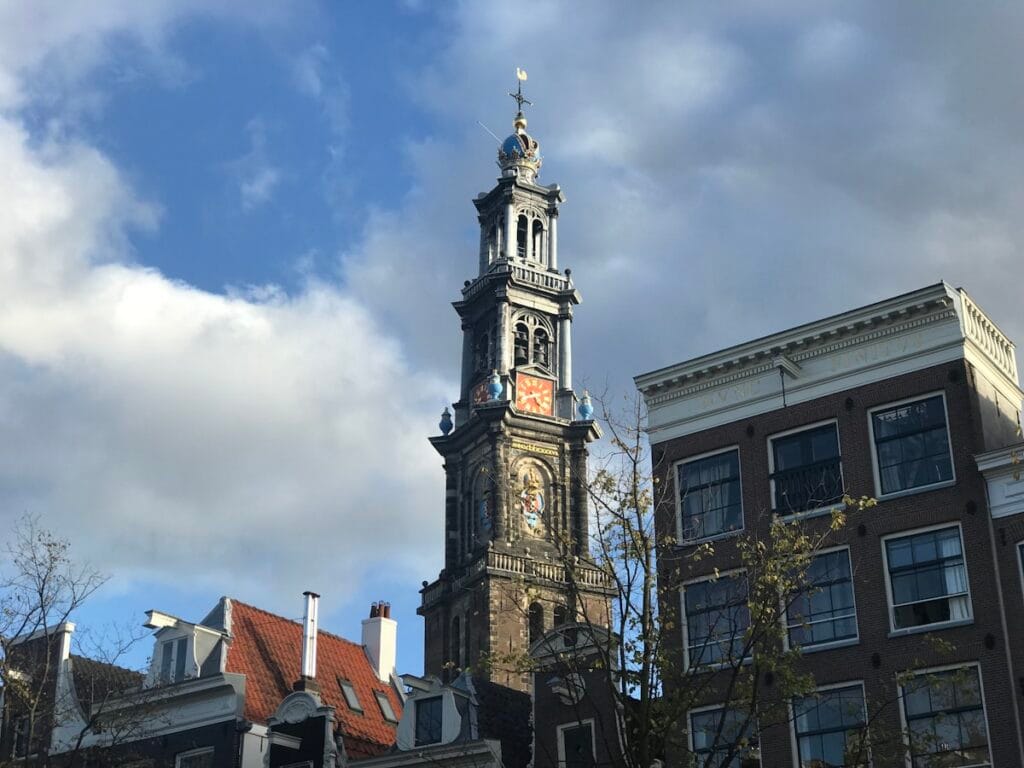
- Westerkerk
- Finish
- Flower Market
- Best time
- All year round, ideally in the morning to avoid crowds.
no guide, no booking, no tipping
This route follows the classic path of Amsterdam's free walking tours: a loop from Dam Square, taking in palaces, canals, historic districts, and iconic markets.
With CityGuide, you can listen to explanations at each stop, right on the street—no booking or tips required. Here, you’ll find all the written content for a 100% independent and free walk.
The route
 1
1
1. Westerkerk
Westerkerk is Amsterdam’s most famous Protestant church, completed in 1631 by architect Hendrick de Keyser. Check out its 85-meter tower, the tallest in the city, topped by the imperial crown gifted by Maximilian of Austria. The church is tied to many historic events—Rembrandt was buried here in 1669. The view from the bell tower is spectacular (paid entry). Look for the plaque on the south wall, marking the nearby house where Anne Frank and her family hid. The carillon’s chimes ring out across the neighborhood every quarter hour.
- Access :
- Free exterior; paid access to the tower.
- Tip :
- Climb the tower for the view—but expect long lines, especially in summer.
Walking to the next stop : Exit Westerkerk and head east toward the canal; Bartolotti House is just a few minutes away on Herengracht.
 2
Arendzen, Petrus Johannes (1846-1932) · Public domain · Wikimedia Commons
2
Arendzen, Petrus Johannes (1846-1932) · Public domain · Wikimedia Commons
2. Bartolotti House
Bartolotti House at 170 Herengracht is one of the finest mansions on the ‘Gouden Bocht’, the golden bend of the canal. Built between 1617 and 1621 for wealthy merchant Willem Bartolotti van den Heuvel, it stands out for its wide Dutch Renaissance façade and exuberant decorations. Unlike typical Amsterdam houses, it’s not narrow but very wide—a rare privilege linked to the owner’s wealth. Look for mythological figures and masks on the façade, a rarity in the city. Today, the house sometimes hosts exhibitions—check ahead.
- Access :
- Façade free. Interior accessible during paid events.
- Tip :
- The façade and canal are freely accessible, but interior visits are occasional and paid.
Walking to the next stop : Continue straight on Herengracht, then turn right toward the center; the Royal Palace is about a 5-minute walk.
 3
Marcos Pena Jr · Unsplash
3
Marcos Pena Jr · Unsplash
3. Royal Palace
In front of you is Amsterdam’s Royal Palace, a masterpiece of Dutch classicism completed in 1655. Built by architect Jacob van Campen, it was meant to embody the young Republic’s power. Transformed into a royal palace by Louis Bonaparte in 1808, it now hosts official ceremonies. Admire the façade’s allegorical sculptures by Artus Quellinus. Note the central pediment, where Amsterdam is depicted as ruling the maritime world. Few notice the golden weather vane at the very top, shaped like a ship—a nod to the city’s trading heritage.
- Access :
- Free exterior. Optional paid interior visit.
- Tip :
- The interior is paid and sometimes closed for official events—check ahead if you want to visit.
Walking to the next stop : Cross the square in front of the Royal Palace; Dam Square is right opposite, less than 2 minutes away.
This walk, narrated in your headphones
The CityGuide Amsterdam audio guide starts by itself at every stop. You walk, it tells the story.
Full audio guide
$21.90 $39.90
★ 4.8/5 · 15 reviews
30-day money-back guarantee
 4
Mario Gogh · Unsplash
4
Mario Gogh · Unsplash
4. Dam Square
You’re standing on Dam Square, the historic and symbolic heart of Amsterdam. In front of you is the Royal Palace, a grand 17th-century classical building, once the city hall and later a royal residence. On the square, you’ll also see the New Church and the National Monument, a tribute to World War II victims. This is where the city began, on a dam (‘dam’ in Dutch) built around 1270 across the Amstel river. The square was long the city’s political and commercial center—a place for markets, gatherings, and major public events. Fun fact: Dam Square was once crossed by tram tracks, and you can still spot some old rails embedded in the paving.
- Access :
- Public square, open access.
- Tip :
- Don’t stop on the bike lanes around the square. Watch out for touristy shops on Damrak.
Walking to the next stop : From Dam Square, head east along Damstraat; the Oude Kerk is about a 5-minute walk away, in the historic district.
 5
Fons Heijnsbroek · Unsplash
5
Fons Heijnsbroek · Unsplash
5. Oude Kerk (Old Church)
This is the Oude Kerk, or Old Church, built in 1306. Notice its brick Gothic architecture and squat tower that dominates the district. Originally, this church was the religious and social center of the old port. It saw sailors, merchants, and local families come and go, and survived the Protestant Reformation. Inside, there’s a monumental organ and carved choir stalls, but entry is paid. Outside, you’ll spot gravestones—Rembrandt had his children baptized here. Look closely: on the square, search for a small bronze sculpture of a hand emerging from the pavement, a discreet nod to the area’s life.
- Access :
- Free exterior. Paid interior.
- Tip :
- Keep quiet and remember you’re near the busy Red Light District.
Walking to the next stop : From Oude Kerk, continue east and turn left into the Red Light District (De Wallen)—it’s very close.
 6
Zoltan Tasi · Unsplash
6
Zoltan Tasi · Unsplash
6. De Wallen (Red Light District)
You’re entering De Wallen, Amsterdam’s famous Red Light District. It’s the oldest part of the city—a maze of narrow streets, canals, and window displays. Here, prostitution has been legal and regulated since 2000, but the district’s roots go back much further, tied to the port’s history. Since 2020, group tours have been banned here, but you can stroll solo and observe the architecture: medieval façades, red lanterns, and centuries-old cafés. Fun fact: on Oudezijds Achterburgwal, some windows now house artists or social initiatives—a sign the district is evolving.
- Access :
- Streets and façades freely accessible. No access to the windows themselves.
- Tip :
- Respect privacy: never photograph the windows. Keep an eye on your belongings.
Walking to the next stop : Leave the Red Light District heading southwest toward Amsterdam’s Canal Belt—it’s about an 8-minute walk.
 7
Adrien Olichon · Unsplash
7
Adrien Olichon · Unsplash
7. Amsterdam Canal Belt
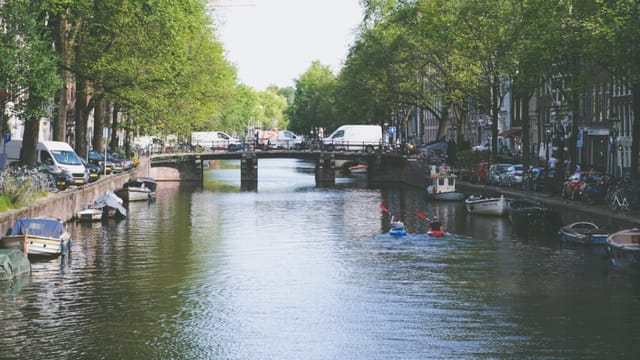
You’re on the famous ‘Grachtengordel’, the canal belt listed as a UNESCO World Heritage site. Planned in the 17th century during the Dutch Golden Age, it’s made up of three main canals: Herengracht, Keizersgracht, and Prinsengracht. Admire the tall, narrow merchant houses, often topped with carved gables. The canals were used for transport, defense, and drainage. Look for the hooks at the tops of façades, used to hoist up furniture and goods. Fun detail: some bridges still have tiny plaques showing the maximum height for boats.
- Access :
- Canals and quays freely accessible.
- Tip :
- Watch out for bikes on bridges and quays; it’s busy.
Walking to the next stop : Follow the canals south to the Begijnhof, about a 7-minute walk.
This walk, narrated in your headphones
The CityGuide Amsterdam audio guide starts by itself at every stop. You walk, it tells the story.
Full audio guide
$21.90 $39.90
★ 4.8/5 · 15 reviews
30-day money-back guarantee
 8
8
8. Begijnhof
You’ve arrived at the Begijnhof, a peaceful green oasis hidden in the heart of Amsterdam. Founded around 1346, this lay convent housed Beguines—pious women living in community without taking monastic vows. The central garden is surrounded by elegant houses, including Amsterdam’s oldest wooden house (from around 1528). After the Reformation, the Begijnhof became one of the few places where Catholic worship was tolerated—hence the two chapels. This peaceful haven contrasts with the city buzz. Look for the small-paned windows and painted crests marking the site’s benefactresses.
- Access :
- Garden and courtyard freely accessible. Chapels paid, optional.
- Tip :
- Speak softly and respect the residents’ peace—some live here year-round.
Walking to the next stop : From Begijnhof, continue straight to Spui Square—it’s right next door, 2 minutes away.
 9
9
9. Spui
You’ve reached Spui, a lively little square known for its bookshops, cafés, and secondhand book markets. It used to be a moat at the city walls, filled in during the 19th century. Today, it’s a favorite meeting spot for students, intellectuals, and artists. Look for the bronze statue of ‘Het Lieverdje’, symbolizing the rebellious youth of the 1960s. Several historic houses around the square show the area’s bourgeois past. Fun fact: every Friday, the book market attracts bargain hunters and book lovers under the plane trees.
- Access :
- Public square, open access.
- Tip :
- Take time to browse the independent bookstores around the square.
Walking to the next stop : From Spui, walk south toward the Singel canal; the Flower Market is along the canal, 3 minutes on foot.
 10
E · Unsplash
10
E · Unsplash
10. Flower Market
The Bloemenmarkt is the world’s only floating flower market, founded in 1862. The stalls rest on old barges moored along the Singel canal. Here you’ll find tulip bulbs, souvenirs, and colorful bouquets year-round. This spot reflects the Dutch passion for horticulture, dating back to the ‘tulip mania’ of the 17th century, when a single rare bulb could cost more than a house. Today, most bulbs sold are for export, but the colorful display is still impressive. Fun detail: look under some stalls to spot the original floats.
- Access :
- Outdoor market, open access. Bulb purchases are paid.
- Tip :
- Check if you can export bulbs if you’re traveling outside Europe.
What next : You’re at the Flower Market—wander among the colorful stalls or continue your visit along the Singel canal.
Guided free tour or solo walk: which to choose?
Here are the differences between a guided free walking tour and this self-guided route. See what suits you best for exploring Amsterdam.
Actual price
Guided free tour
Officially free, but a tip is expected (€5–15).
The same route on your own
Free, no fees or tips.
Schedule and pace
Guided free tour
Fixed times, group pace.
The same route on your own
Completely free—pause whenever you want.
Language
Guided free tour
Mainly English or Spanish.
The same route on your own
Read or listen in your language with CityGuide.
Group size
Guided free tour
Up to 30 people, sometimes more.
The same route on your own
Solo, as a couple or with friends—take it easy.
Content depth
Guided free tour
Lively explanations, unique stories.
The same route on your own
Verified, historical, and precise info at every stop.
Practical tips for your walk
Bikes and safety
In Amsterdam, bikes have priority. Never walk or stop on a bike path. Crosswalks can be hard to spot—stay alert.
Red Light District
Photos of the windows are forbidden. Since 2020, groups are banned, but solo visitors are fine.
Hours and weather
Most places are open all day, but canals are quieter in winter. Go in the morning to avoid crowds.
Shopping and souvenirs
Around Damrak and the Flower Market, many shops are tourist traps. Prefer local small businesses for authentic souvenirs.
— Frequently asked questions
FAQ: all you need to know before you go
Yes, each stop is in public space or in front of freely accessible sites. No guide or tip needed. For an audio experience, CityGuide offers these explanations in the app.
No, entry to these sites is paid and often sells out. Only the exteriors and façades are included in this free route.
No, the route is accessible at any time, but some places (market, towers) may have specific hours—check depending on the season.
About 2.5 to 3 hours, depending on your pace and how long you spend at each stop.
Yes, but the Red Light District may not be suitable for all ages. The rest of the route is family-friendly.
— Go further
Want an audio-guided experience?
Explore Amsterdam at your own pace with the CityGuide app: listen to each stop along the route, no booking needed, wherever you are in the city.
Check out CityGuide for Amsterdam