

London on foot, for free
Free walking tour London: the complete self-guided (and free) route
Discover London like on a free walking tour, but without a guide or tips. Here’s the real step-by-step route to explore for free.
CityGuide France team · September 7, 2026 · 12 min
 Free
The Now Time · Unsplash
Free
The Now Time · Unsplash
Classic Free walking tour London
- Duration
- 2h30
- Distance
- 6.4 km
- Difficulty
- Easy
- Start
- Buckingham Palace
- Finish
- Royal Opera House (Covent Garden)
- Best time
- Morning for the Changing of the Guard and to avoid the crowds
no guide, no booking, no tipping
Dreaming of discovering London on foot without breaking the bank? This route follows the classic free walking tour itinerary, but in 100% free mode. You’ll stroll past royal landmarks, seats of power, iconic squares, and end in lively Covent Garden.
With CityGuide, your phone automatically tells you the story of each place as you walk. All you have to do is wander and keep your eyes open.
The route
 1
The Now Time · Unsplash
1
The Now Time · Unsplash
1. Buckingham Palace
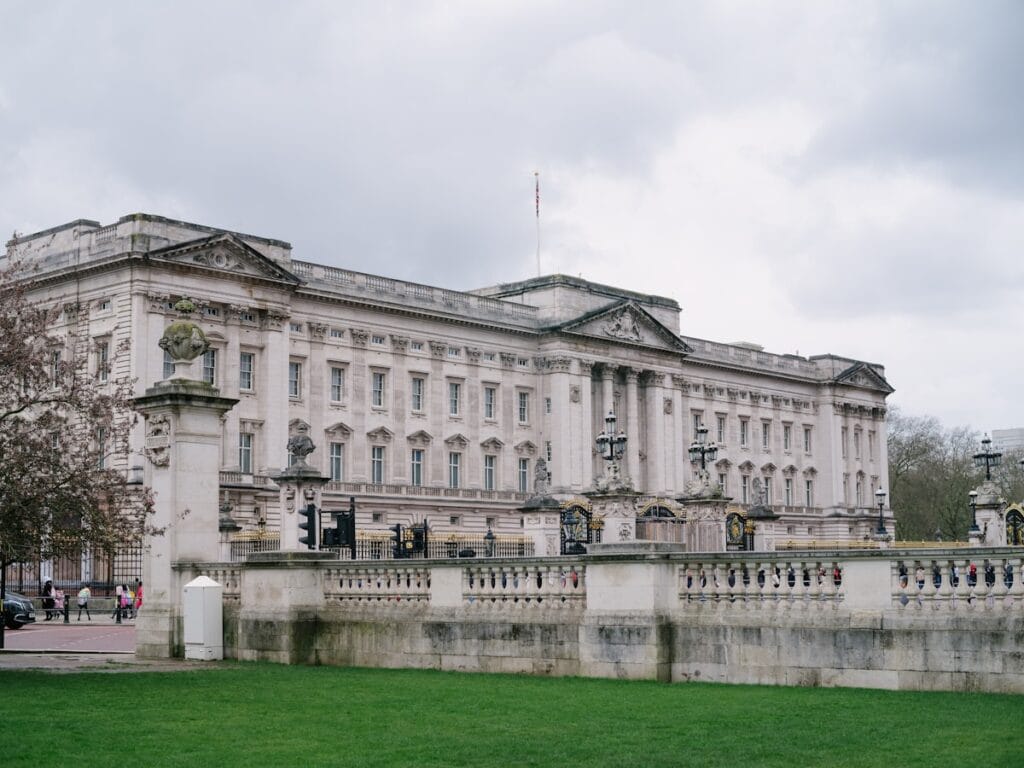
Right in front of you is the iconic façade of Buckingham Palace, the official residence of British monarchs since 1837. The current building was expanded in the 19th century and modernized under George V. The famous Changing of the Guard ceremony takes place in front of the gates (check the schedule), attracting hundreds of onlookers every day. Look at the balconies: this is where the royal family greets crowds during major events. Don’t miss this detail: the flag flying above indicates if the king (or queen) is present. If it’s the Royal Standard, the sovereign is in residence.
- Access :
- Free exterior view, Changing of the Guard is free according to schedule.
- Tip :
- The Changing of the Guard can be canceled in case of rain or official ceremonies.
Walking to the next stop : Exit Buckingham Palace and walk straight ahead to the Victoria Memorial, right in front, less than 2 minutes away.
 2
Herry Sutanto · Unsplash
2
Herry Sutanto · Unsplash
2. Victoria Memorial
This imposing structure in white marble pays tribute to Queen Victoria, who reigned from 1837 to 1901. Inaugurated in 1911 by King George V, it was created by artist Thomas Brock. The gilded statue on top represents Victory, surrounded by allegorical figures symbolizing Truth, Justice, and Charity. The memorial is a gathering point for major royal events. Look at the base: small pools and lion sculptures recall the power of the British Empire. Few visitors notice the seated statue of the Queen, facing The Mall, the grand ceremonial avenue.
- Access :
- Open access, exterior only.
- Tip :
- Great spot for a photo of the palace without the crowds.
Walking to the next stop : From the Victoria Memorial, take The Mall northeast and reach St James’s Palace in 5 minutes.
 3
Abdus Samad Mahkri · Pexels
3
Abdus Samad Mahkri · Pexels
3. St James’s Palace
St James’s Palace, built in 1536 under Henry VIII, is one of the oldest royal palaces in London. Its red brick and turrets are classic Tudor style. Once the main residence of the monarchs, it’s still used for official ceremonies, like the proclamation of a new monarch. The palace isn’t open to the public, but you can see the entrance courtyard and royal chapel from the street. A historical note: this is where Queen Victoria held her first Privy Council in 1837, marking the start of her reign.
- Access :
- Free exterior view, interior access reserved for official ceremonies.
- Tip :
- The palace is discreet—its entrance opens directly onto the street, with no large gardens in sight.
Walking to the next stop : Continue along The Mall, then turn right toward Parliament Square, about 10 minutes on foot.
This walk, narrated in your headphones
The CityGuide London audio guide starts by itself at every stop. You walk, it tells the story.
Full audio guide
$21.90 $39.90
★ 4.8/5 · 15 reviews
30-day money-back guarantee
 4
Suzy Hazelwood · Pexels
4
Suzy Hazelwood · Pexels
4. Parliament Square
You’re at one of London’s most famous squares, surrounded by statues of historical figures like Winston Churchill and Gandhi. To your right are the towers of Westminster Abbey, while the Houses of Parliament stand opposite. This is the site of major demonstrations, ceremonies, and political gatherings. The square has been redesigned several times—the latest revamp was in 2001 to improve pedestrian access and showcase the statues. A detail often missed: the central lawn wasn’t always open to the public. Now you can sit and watch the buzz of the city under the gaze of past leaders.
- Access :
- Open access, exterior views of the monuments.
- Tip :
- Watch out for pickpockets during big events or gatherings.
Walking to the next stop : Cross Parliament Square to reach Elizabeth Tower (Big Ben), just 2 minutes on foot.
 5
Acabashi · CC BY-SA 4.0 · Wikimedia Commons
5
Acabashi · CC BY-SA 4.0 · Wikimedia Commons
5. Elizabeth Tower (Big Ben)
In front of you stands the famous Elizabeth Tower, often called Big Ben (which is actually the name of the bell). It’s been at the heart of British political life since its completion in 1859. Its neo-Gothic façade and monumental clock are London icons. The clock holds a record: it’s only stopped a handful of times in over 150 years, notably during World War II. Look at the clock face: each Roman numeral is 60 cm tall. A discreet detail: under the north clock face, you can read in Latin “Domine Salvam Fac Reginam Nostram Victoriam Primam”—a prayer for Queen Victoria.
- Access :
- Open access, exterior view only.
- Tip :
- Visiting the tower is only possible for UK residents with advance booking.
Walking to the next stop : From Big Ben, head north along Whitehall to reach 10 Downing Street in 5 minutes.
 6
6
6. 10 Downing Street
This is Britain’s most famous political address: Downing Street. Behind the black gates at number 10 is the official residence of the Prime Minister since the 18th century. The building looks modest but hides a maze of historic offices and salons. Churchill led the country from here during World War II. In 1991, the gate was added for extra security. Few people notice that the number 10 on the door is painted at a slight angle—a nod to British tradition and quirkiness. You can’t get close, but you’ll feel the weight of history through these walls.
- Access :
- Open access up to the gate, exterior view.
- Tip :
- You can’t access the street, but the gate gives you a clear view of the famous door.
Walking to the next stop : Continue north on Whitehall, Horse Guards Parade is on your right after 3 minutes.
 7
Daria Agafonova · Pexels
7
Daria Agafonova · Pexels
7. Horse Guards Parade
You’ve arrived at Horse Guards Parade, a vast parade ground used for military ceremonies since the 18th century. Every summer, it hosts the Trooping the Colour ceremony for the monarch’s official birthday. The Horse Guards, in red uniforms and silver helmets, stand guard daily—the changing of the guard is a highlight (check the schedule). The building at the end of the square was once the headquarters of the Royal military command. One detail: the small central arch is reserved for the royal family and closed to the public. Look up: you might spot an officer overseeing the parade from the first-floor windows.
- Access :
- Open access to the parade ground, free outdoor spectacle.
- Tip :
- The guard change draws crowds—arrive early for a good spot.
Walking to the next stop : Walk north on Whitehall, then straight ahead to Trafalgar Square, about 7 minutes.
This walk, narrated in your headphones
The CityGuide London audio guide starts by itself at every stop. You walk, it tells the story.
Full audio guide
$21.90 $39.90
★ 4.8/5 · 15 reviews
30-day money-back guarantee
 8
Mostly London · Pexels
8
Mostly London · Pexels
8. Trafalgar Square
You’ve reached Trafalgar Square, the vibrant heart of London since the 19th century. Nelson’s Column, 52 meters tall, commemorates the British victory at Trafalgar in 1805. The four bronze lions at its base were added in 1867, sculpted by Edwin Landseer. The square hosts protests, concerts, and national celebrations. Take note: one of the four plinths is left empty or features temporary contemporary art, called the “Fourth Plinth.” A fun detail: the giant old pigeon house was removed to keep the square clean.
- Access :
- Public square, open access.
- Tip :
- The fountains are a popular hangout for Londoners in summer.
Walking to the next stop : From Trafalgar Square, cross the square north to enter the National Gallery, 2 minutes away.
 9
Mathew Browne · Unsplash
9
Mathew Browne · Unsplash
9. National Gallery
This majestic museum, with its neoclassical architecture, houses one of Europe’s greatest painting collections. Founded in 1824, the National Gallery displays over 2,300 works for free, from Leonardo da Vinci to Van Gogh. The main building dates to 1838, with later extensions. Don’t miss masterpieces like Van Gogh’s “Sunflowers” or Holbein’s “The Ambassadors.” A detail few notice: the entrance hall mosaic by Boris Anrep is packed with satirical references to 20th-century London society.
- Access :
- Free entry (except for temporary exhibitions), suggested donation not required.
- Tip :
- Free entry, but temporary exhibitions may charge a fee.
Walking to the next stop : Exit the National Gallery, head east on St Martin’s Place, then right onto Long Acre to reach the Royal Opera House in Covent Garden in 10 minutes.
 10
Gabriel Varaljay · Unsplash
10
Gabriel Varaljay · Unsplash
10. Royal Opera House (Covent Garden)
Here you are at the eclectic façade of the Royal Opera House, in the heart of lively Covent Garden. This theatre, inaugurated in 1858 after two fires, is home to the Royal Ballet and Royal Opera. It blends neoclassical columns with modern extensions added in 1999. Even if you don’t go in, check out the spectacular glass roof of the Floral Hall at the back. Covent Garden itself was a flower and fruit market until the 1970s, now transformed into a bustling pedestrian zone. Insider detail: the entrance portico still bears the original market inscriptions.
- Access :
- Exterior and entrance hall free, shows ticketed.
- Tip :
- Access to the entrance hall and shop is free, shows are ticketed.
What next : Now you’re in front of the Royal Opera House at Covent Garden: take time to explore this lively area or catch a show.
Guided free tour or self-guided route?
Not sure whether to join a free walking tour with a guide or do it solo? Here are the real differences.
Actual price and tips
Guided free tour
Free to book but tips expected (£5–20 per person)
The same route on your own
100% free, no tips or booking needed
Timing and pace
Guided free tour
Fixed times, group sets the pace
The same route on your own
Start whenever you want, pause as you like
Language
Guided free tour
English (some tours in French, check availability)
The same route on your own
French with CityGuide, or your preferred language
Group size
Guided free tour
10 to 40 people depending on the season
The same route on your own
Alone, with a partner, or friends—peace guaranteed
Depth of content
Guided free tour
Anecdotes and live answers, sometimes tailored to the group
The same route on your own
Solid, verified info to listen or read at your own pace
Practical tips for your free walking tour in London
Changing of the Guard: plan ahead
The schedule changes seasonally. Check the official Household Division website on the day to make sure you catch the ceremony at Buckingham Palace.
Watch out for tourist scams
On Westminster Bridge, avoid shell games—they’re illegal and impossible to win.
Free museums in London
Many national museums are free, like the National Gallery, British Museum, or Tate Modern. Temporary exhibitions may charge a fee, so check before visiting.
Queues and timings
For the Changing of the Guard and major sights, arrive early (before 10am) to beat the crowds and get a good view.
— Frequently asked questions
Frequently asked questions about the free walking tour London
Yes, the entire route is on the street or in free venues. No tips or booking required. With CityGuide, you can follow the same route and listen to info at every stop.
Plan about 2 hours, not counting breaks or optional museum visits.
No for the Changing of the Guard (but check the schedule). For museums like the National Gallery, entry is free but some exhibitions charge or require booking.
Yes, this is the classic route of the main free walking tours in central London, but without the group constraints.
Westminster Abbey, the Tower of London, and St Paul’s nave are ticketed. National museums are free for permanent collections.
— Go further
Want an audio guide that plays automatically?
With CityGuide, your phone tells you the story of monuments as you walk. No ads, no tips, no hassle.
Download CityGuide and try the London audio guide for free