

— GUIDED TOURS · BARCELONA
10 unmissable guided tours in Barcelona (free)
Ten walking routes through Barcelona you follow on your own, whenever you like, with no booking and no guide to pay. Streets, squares, façades, viewpoints and seafront: everything you walk past here is free to reach. Where a ticket is needed, each route says so plainly.
Helen Marsden, Barcelona and Catalonia specialist · September 6, 2026 · 9 min read
Barcelona rewards walking: the old centre is compact, flat near the sea, and most of what makes it special stands outdoors. So these ten routes are built around themes that never overlap — the Gothic core, the Roman town, a neighbourhood that stayed a village, the hilltop viewpoints, open churches, parks, markets, modernista façades, dusk on Montjuïc, and a factory district gone creative. Each fits into half a day, and each works without a ticket.
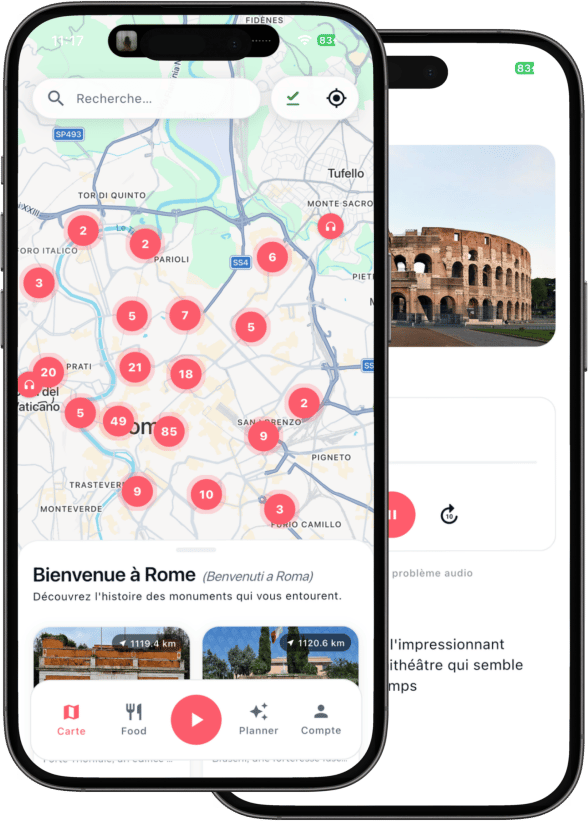
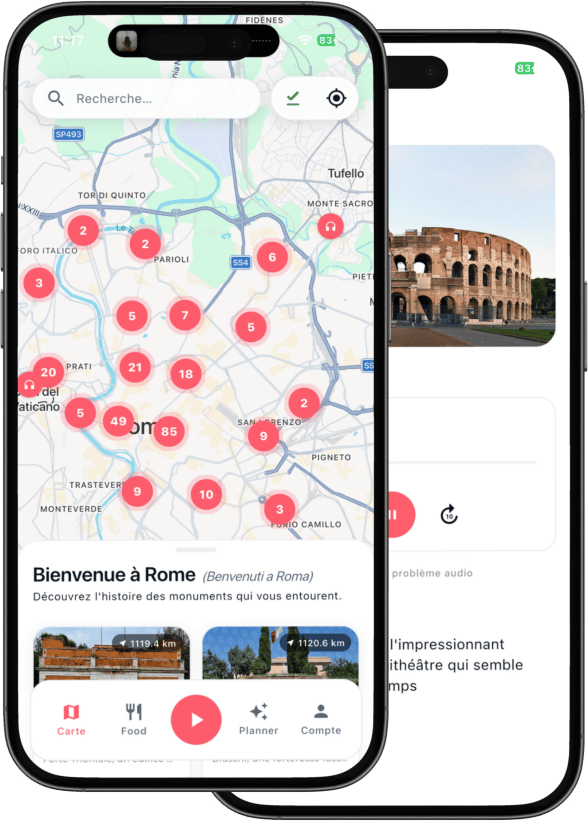
Treat every route as a frame rather than a rule: you get a starting point, the order of the stops, a duration and a distance, then you stretch or shorten it as your legs allow. Two walks in a day is plenty if you actually stop and look. If you would rather listen than read while walking, the CityGuide app plays a commentary by itself as you approach a place; it is paid and entirely optional.
Prefer one single route, step by step?
Free walking tour Barcelona: the complete itinerary to do solo (and for free) →
Read the full itinerary
10 tours · ranked from the most unmissable
No booking · no tipping
 #1
John Disandolo · Unsplash
#1
John Disandolo · Unsplash
1. The Gothic heart, from La Rambla to Sant Jaume
The essentials of the old centre in one loop
- 1h35
- 2.4 km · Easy
- 6 stops
- Optional audio: EN · FR · ES · DE
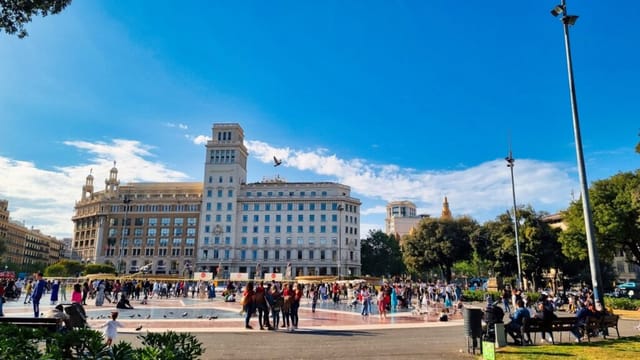
You walk down La Rambla, a drained stream bed that turned into a promenade, then slip into the tangle of the Barri Gòtic. Plaça Reial lines up palm trees and lamp posts drawn by a young Gaudí. Further on, the Pont del Bisbe throws its stone lacework across a lane: it looks medieval, but dates from 1928. The loop closes at the cathedral, then on the square where the city hall and the Generalitat face each other.
- Route :
- Plaça de Catalunya → La Rambla → Plaça Reial → Pont del Bisbe → Barcelona Cathedral → Plaça de Sant Jaume
- Start :
- Plaça de Catalunya, La Rambla side
- Access :
- Streets, squares and exteriors: free. The cathedral is free only at certain hours and charges for the rest of the day.
- Tip :
- Start early: before ten the Gothic lanes are almost empty and the light rakes low across the façades.
Free
self-guided, at your own pace
 #2
#2
2. Barcino, the Roman town under your feet
Walls, a temple and tombs, all free to see
- 1h15
- 1.2 km · Easy
- 5 stops
- Optional audio: EN · FR · ES · DE
Barcino, the colony founded in the time of Augustus, still shapes the old town, and the evidence sits at street level: the round towers on Plaça Nova, long stretches of wall above Plaça de Ramon Berenguer, the four columns of the Temple of Augustus wedged into a courtyard, and finally a row of Roman tombs sunk in the middle of a modern square. One hour links two thousand years.
- Route :
- Plaça Nova and the Roman towers → Roman wall, Plaça de Ramon Berenguer el Gran → Temple of Augustus → Plaça del Rei → Roman burial road, Plaça de la Vila de Madrid
- Start :
- Plaça Nova, in front of the Roman towers
- Access :
- Exteriors, walls and the burial road: free. The city history museum, an optional stop, charges admission.
- Tip :
- The Temple of Augustus hides at the back of a courtyard on Carrer Paradís; entry is free, but evening hours are short.
Free
self-guided, at your own pace
 #3
#3
3. Gràcia, the village inside the city
Neighbourhood squares, terraces and early Gaudí
- 1h30
- 2.3 km · Easy
- 6 stops
- Optional audio: EN · FR · ES · DE
Gràcia was an independent town until 1897, and it still behaves like one: narrow streets, squares built for sitting, shops that serve the block rather than the visitor. You link Plaça de la Vila and its bell tower, Plaça del Sol, Plaça de la Virreina and its church, then climb to Casa Vicens, the very first house Gaudí built, sheathed in green and white tiles.
- Route :
- Jardinets de Gràcia and Casa Fuster → Carrer Gran de Gràcia → Plaça de la Vila de Gràcia → Plaça del Sol → Plaça de la Virreina → Casa Vicens façade
- Start :
- Jardinets de Gràcia, top of Passeig de Gràcia
- Access :
- Streets and squares: free. Casa Vicens can be visited with a ticket; the façade is visible from the street.
- Tip :
- Late on a Sunday afternoon the squares fill with families; that is when the neighbourhood makes the most sense.
Free
self-guided, at your own pace
These 10 tours, narrated in audio
The CityGuide Barcelona audio guide starts by itself in front of each place. You walk, it tells the story.
Full audio guide
$21.90 $39.90
★ 4.8/5 · 15 reviews
30-day money-back guarantee
 #4
D Jonez · Unsplash
#4
D Jonez · Unsplash
4. Carmel viewpoints, Barcelona from above
Bunkers, hills and panoramas with no ticket
- 2h10
- 3.4 km · Challenging
- 6 stops
- Optional audio: EN · FR · ES · DE
This is the Barcelona few visitors climb to see: a ridge of hills above the grid of the Eixample. On top of Turó de la Rovira sit the concrete platforms of a Civil War anti-aircraft battery, now an open terrace with a full circle of city below. You come back down through Parc del Carmel to the free part of Park Güell, the one with pine woods and rough stone viaducts.
- Route :
- Parc del Guinardó → Mirador del Nen de la Rutlla → Turó de la Rovira bunkers → Mirador de Joan Sales → Parc del Carmel → Park Güell, free area
- Start :
- Parc del Guinardó, upper entrance
- Access :
- Hills, bunkers and viewpoints: free. The monumental zone of Park Güell needs a ticket; the rest of the park does not.
- Tip :
- It climbs seriously: closed shoes, water in the bag, and in summer avoid the middle of the day altogether.
Free
self-guided, at your own pace
 #5
Jose Cruz · Pexels
#5
Jose Cruz · Pexels
5. Five churches, from sea Gothic to Romanesque
Open naves between La Rambla, El Born and El Raval
- 1h45
- 2.9 km · Moderate
- 5 stops
- Optional audio: EN · FR · ES · DE
Five sanctuaries, five periods. Santa Anna hides behind a plain door, steps away from the crowds. Santa Maria del Pi opens its huge rose window onto a square full of terraces. Santa Maria del Mar, built in the fourteenth century in only a few decades, owes its unity of style and its light to that speed. La Mercè watches over sailors, and Romanesque Sant Pau del Camp keeps the smallest cloister in the city.
- Route :
- Church of Santa Anna → Basilica of Santa Maria del Pi → Basilica of Santa Maria del Mar → Basilica of La Mercè → Former monastery of Sant Pau del Camp
- Start :
- Plaça de Catalunya, Rivadeneyra corner
- Access :
- Naves are usually free outside tourist visiting slots; towers, crypts and guided visits are ticketed. Check opening hours.
- Tip :
- Respect services: several of these churches close between midday and mid-afternoon. Aim for the morning or early evening.
Free
self-guided, at your own pace
 #6
at · Unsplash
#6
at · Unsplash
6. Ciutadella, the great park of Barcelona
Triumphal arch, cascade and 19th-century glasshouses
- 1h20
- 2 km · Easy
- 6 stops
- Optional audio: EN · FR · ES · DE
The red brick Arc de Triomf was the gateway to the 1888 Universal Exhibition, and the avenue behind it drops you straight into the park. Inside, the monumental cascade designed by Josep Fontserè unfolds its staircases and bronze horses. Around it stand two nineteenth-century glasshouses, a boating pond, very loud green parakeets and plenty of grass to collapse on.
- Route :
- Arc de Triomf → Passeig de Lluís Companys → Parc de la Ciutadella → Monumental cascade → Hivernacle and Umbracle glasshouses → Plaça d’Armes and its pond
- Start :
- Arc de Triomf, Passeig de Sant Joan side
- Access :
- Park, arch and cascade: free. The zoo, in the corner of the park, is a separate paid visit.
- Tip :
- The park closes at dusk; late morning is better, when the cascade is lit straight on rather than against the light.
Free
self-guided, at your own pace
 #7
AXP Photography · Pexels
#7
AXP Photography · Pexels
7. Barcelona markets, from Sant Antoni to El Born
Three halls, one straight line and a lot of smells
- 1h50
- 3 km · Moderate
- 5 stops
- Optional audio: EN · FR · ES · DE
Three market halls tell three versions of the city. Sant Antoni, a nineteenth-century iron structure reopened after a very long refurbishment, now shows underfoot the remains found during the dig. La Boqueria, on La Rambla, is the best known and by far the densest. Santa Caterina wears a rippling roof of coloured ceramic, laid over the site of a former convent.
- Route :
- Mercat de Sant Antoni → Carrer del Parlament → Mercat de la Boqueria → Palau de la Virreina → Mercat de Santa Caterina
- Start :
- Mercat de Sant Antoni, main entrance
- Access :
- Walking through the markets: free. Whatever you taste or buy is on you. Closed on Sundays.
- Tip :
- Walking through costs nothing; if you want to eat, move past the first aisles of La Boqueria, where prices are highest.
Free
self-guided, at your own pace
These 10 tours, narrated in audio
The CityGuide Barcelona audio guide starts by itself in front of each place. You walk, it tells the story.
Full audio guide
$21.90 $39.90
★ 4.8/5 · 15 reviews
30-day money-back guarantee
 #8
AXP Photography · Pexels
#8
AXP Photography · Pexels
8. Modernista façades, from Passeig to the Sagrada
The whole of modernisme, seen from the pavement
- 2h
- 3.2 km · Moderate
- 6 stops
- Optional audio: EN · FR · ES · DE
A single avenue holds most of Catalan modernisme. On the Illa de la Discòrdia, three houses by three different architects answer each other from the same pavement. Higher up, the rippling stone front of La Pedrera and its chimney stacks read perfectly from below. Look down as well: the hexagonal paving slabs and the lamp posts are part of the design. You finish facing the towers of the Sagrada Família.
- Route :
- Passeig de Gràcia → Illa de la Discòrdia and Casa Lleó Morera → Casa Amatller and Casa Batlló façades → Casa Milà, La Pedrera, façade → Casa de les Punxes → Plaça de la Sagrada Família
- Start :
- Plaça de Catalunya, corner of Passeig de Gràcia
- Access :
- Façades, avenue and squares: free. Casa Batlló, Casa Amatller, La Pedrera and the Sagrada Família all charge inside.
- Tip :
- Cross the avenue to photograph the façades: from the far pavement a whole house fits in the frame.
Free
self-guided, at your own pace
 #9
Mehmet Turgut Kirkgoz · Pexels
#9
Mehmet Turgut Kirkgoz · Pexels
9. Montjuïc at sunset
Terraces, gardens and a floodlit fountain
- 1h40
- 2.6 km · Moderate
- 6 stops
- Optional audio: EN · FR · ES · DE
The climb to the Palau Nacional is pure stagecraft, inherited from the 1929 Exhibition: two brick towers, a rising avenue, then the wide terrace that opens all at once onto the city and the sea. Afterwards you drift through the Laribal gardens, all steps and small pools, before heading back down for the Font Màgica, designed by Carles Buïgas for that same fair.
- Route :
- Plaça d’Espanya → Venetian towers → Avinguda de la Reina Maria Cristina → Palau Nacional terrace → Jardins de Laribal → Font Màgica
- Start :
- Plaça d’Espanya, at the foot of the Venetian towers
- Access :
- Terrace, gardens and the fountain show: free. The national art museum of Catalonia, optional, is ticketed.
- Tip :
- Arrive an hour before sunset, and check which evenings the fountain runs: the schedule changes with the season.
Free
self-guided, at your own pace
 #10
Manuel Torres Garcia · Pexels
#10
Manuel Torres Garcia · Pexels
10. Poblenou, the factory district gone creative
Brick chimneys, a local rambla and a beach
- 2h10
- 4.2 km · Moderate
- 5 stops
- Optional audio: EN · FR · ES · DE
People called this the Catalan Manchester while its mills were still running. What survives is a scatter of brick chimneys stranded between new blocks, old sheds converted into studios and offices, and a great deal of painted wall. The Rambla del Poblenou, far calmer than its famous namesake, runs quietly down to the water, where you end up barefoot on Bogatell beach.
- Route :
- Plaça de les Glòries → Parc del Centre del Poblenou → Rambla del Poblenou → Macosa chimney → Platja del Bogatell
- Start :
- Plaça de les Glòries, park side
- Access :
- Streets, parks, murals and beaches: free. Galleries and studios in the district set their own prices.
- Tip :
- Do it in the late afternoon and finish on the sand; the metro at Llacuna takes you back in minutes.
Free
self-guided, at your own pace
How to do these walks for free (without missing anything)
1. Choose by your day, not by the list
Look at the duration, the distance and the climb first. The old centre is flat and fine in ordinary shoes; Carmel and Montjuïc genuinely go uphill. With a single day, take the Gothic heart in the morning and Montjuïc at the end of the afternoon: they complement each other and never overlap. On two days, add Gràcia and the markets, both far better without a schedule.
2. Walk the right way round, at the right time
The order of the stops is not decoration: it avoids backtracking and puts the climbs before the heat. Early on, the lanes of the Barri Gòtic are empty; by midday they are jammed. Churches often close between noon and mid-afternoon. Markets shut on Sundays, and many stalls already pack up on Saturday afternoon.
3. Audio commentary, if you want the context
Reading a map while walking splits your attention, and many of these places do not explain themselves. The CityGuide app starts a place’s audio commentary on its own as you get close, and downloaded guides work with no signal; it is a paid option. Every walk above works perfectly well without it, with a map or simply by looking up.
— Frequently asked questions
Free guided tours in Barcelona: your questions
Yes. They are routes you follow yourself, in public streets: no guide to pay, no tip expected, no booking. Anything that costs money is named in the access line of each walk: the inside of Casa Batlló, the Sagrada Família, the monumental zone of Park Güell or the zoo, for instance. Everything else is open access.
Two, sensibly. Allow between one hour and two and a half per route, plus stops, plus the travel between districts. One in the morning and one in the late afternoon leaves room for lunch and avoids the hottest hours. Three is possible in winter if you stay inside Ciutat Vella, but you stop really seeing anything.
Never. You leave when you want, stop where you want, and abandon halfway if it starts raining. That is the difference from tip-based free tours, which start at a fixed time, move as a group and end with a collection. Here nobody is waiting for you at the meeting point.
CityGuide is an audio guide app triggered by your position: as you approach a place, the commentary starts on its own, and downloaded guides work offline. It is a paid option, independent of this page. All ten routes described here work entirely without it, map in hand.
Spring and autumn are the most comfortable: mild temperatures, long daylight. In summer, save the Carmel hills and Montjuïc for the early morning or the late afternoon, and take the shade of the Barri Gòtic at midday. Winter still works, with shorter days, so start early.
— Go further
Barcelona in your ears, with no guide
These ten routes walk perfectly well on their own. If you want the context as well — who built what, what happened on this square, why that façade looks like that — the CityGuide audio guide tells you in the right place, hands free, and works offline once downloaded.
Explore the Barcelona audio guide