

Self-guided walk
Free walking tour Barcelona: the complete itinerary to do solo (and for free)
Want to discover Barcelona without paying for a guide? Follow this step-by-step route and enjoy the vibe of a free walking tour, at your own pace and for zero cost.
The CityGuide Barcelona Team · September 7, 2026 · 15 min read
 Free
Jose Cruz · Pexels
Free
Jose Cruz · Pexels
Classic free walking tour Barcelona
- Duration
- 1h55
- Distance
- 3.6 km
- Difficulty
- Easy
- Start
- Basilica of Santa Maria del Mar
- Finish
- Columbus Monument
- Best time
- Morning or late afternoon, to avoid crowds and heat.
no guide, no booking, no tipping
Barcelona is just as enjoyable on foot as it is with a guide. Here, you can follow the exact route of the classic free walking tour through the historic center and experience the city’s best neighborhoods, alleys, and monuments—without any hidden fees.
Thanks to CityGuide, you can even listen to the stories in audio, triggered automatically at each stop of your walk.
The route
 1
Jose Cruz · Pexels
1
Jose Cruz · Pexels
1. Basilica of Santa Maria del Mar
Santa Maria del Mar is one of the masterpieces of Catalan Gothic, built between 1329 and 1383. Its massive exterior reflects the power of the merchants and sailors from the Born district. Step inside the nave if you can: entry is free outside tourist hours. Inside, light fills the space, created by unusually slender and widely spaced columns for the era. The church was badly damaged during the Civil War, as shown by some stones blackened by the 1936 fire. Few visitors notice the workers’ marks carved near the doors—reminders of the anonymous builders.
- Access :
- Nave free outside tourist hours; check access on site.
- Tip :
- Free entry outside guided tour or mass times; otherwise, paid.
Walking to the next stop : Exit the basilica and head west toward the Picasso Museum, about a 5-minute walk.
 2
2
2. Picasso Museum (facade and neighborhood)
The Picasso Museum occupies five Gothic palaces in the Born district, on Montcada Street. While entry to the museum is paid, the exterior architecture and the street’s vibe are well worth a look. Pablo Picasso lived in Barcelona from 1895 to 1904, a formative period for his work. Back then, the neighborhood was a hub for artisans and the bourgeoisie. Notice the sculpted lintels, balconies, and stone crests—reminders of the street’s prosperous past. Few know Picasso was a regular in the local cafés. The uneven cobblestones and the shadows of the alleyways tell a thousand stories—imagine them as you walk.
- Access :
- Facades and street always accessible, museum entry is paid.
- Tip :
- Museum entry is paid, but Montcada Street and the facades are free.
Walking to the next stop : From the Picasso Museum, head straight to Plaça del Rei, about a 7-minute walk.
 3
C messier · CC BY-SA 4.0 · Wikimedia Commons
3
C messier · CC BY-SA 4.0 · Wikimedia Commons
3. Plaça del Rei (King’s Square)
Plaça del Rei has been the medieval heart of power in Barcelona since the Middle Ages. Surrounded by Gothic palaces, it houses the Royal Palace where the Catholic Monarchs welcomed Christopher Columbus in 1493 after his first voyage to the Americas. On the left, spot the Mirador tower of King Martí from the 16th century, overlooking the square. Beneath your feet, Roman remains are visible through glass trapdoors. Few visitors notice the small Chapel of St. Agatha at the back, built in the 14th century for Queen Elisabeth of Portugal. In the evening, the light reveals scars on the old city walls.
- Access :
- Public square, always accessible; palace interiors are paid.
- Tip :
- The square is often quiet—a perfect photo stop.
Walking to the next stop : From Plaça del Rei, head to the Cathedral of the Holy Cross and Saint Eulalia, just next door, less than 5 minutes away.
This walk, narrated in your headphones
The CityGuide Barcelona audio guide starts by itself at every stop. You walk, it tells the story.
Full audio guide
$21.90 $39.90
★ 4.8/5 · 15 reviews
30-day money-back guarantee
 4
4
4. Cathedral of the Holy Cross and Saint Eulalia
In front of you stands Barcelona’s majestic Gothic cathedral, built between the 13th and 15th centuries on an earlier Romanesque basilica. Dedicated to Saint Eulalia, a young martyr from the 4th century, it’s one of the city’s symbols. Its neo-Gothic facade was completed in 1913. Admire the gargoyles, the central rose window, and the sculpted doors. Inside (free at certain times), thirteen white geese live in the cloister—a reminder of the saint’s age at her death. Few notice the octagonal bell tower, slightly off-center from the nave, a result of later additions. Just outside, the old Roman wall still peeks through.
- Access :
- Facade and square always free; interior free at certain hours (check on site).
- Tip :
- Free entry early morning or late afternoon, otherwise paid.
Walking to the next stop : Leave the cathedral and head to the Palace of the Generalitat of Catalonia, on Plaça de Sant Jaume, 2 minutes away.
 5
Emilio Sánchez Hernández · Pexels
5
Emilio Sánchez Hernández · Pexels
5. Palace of the Generalitat of Catalonia
Here you are in front of the historic seat of the Catalan government, the Palau de la Generalitat. Dating from the 15th century, it has kept its political role through the ages. Its sober Catalan Gothic facade contrasts with the rich inner courtyard, only open on special open days. Look at the central balcony: this is where election results and major official announcements are made. The marble coat of arms of Catalonia dominates the portal. Many miss the Casa dels Canonges on the right, the president’s residence, connected to the palace by a covered bridge over Bisbe Street.
- Access :
- Exterior always accessible; interior open only during rare official visits.
- Tip :
- Only the exterior facades are freely accessible.
Walking to the next stop : From the Palace of the Generalitat, go straight to Plaça de Catalunya, where you’ll find the Francesc Macià Monument, about a 10-minute walk.
 6
6
6. Francesc Macià Monument (Plaça de Catalunya)
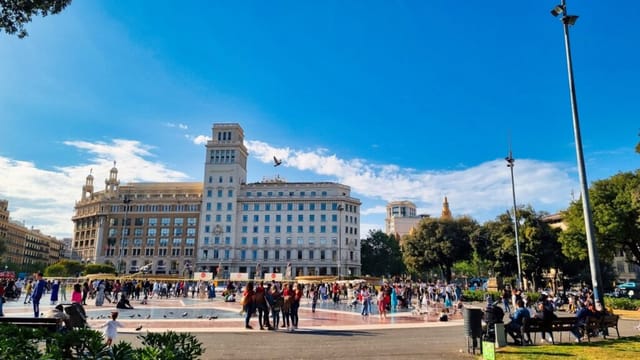
In front of you rises the monument to Francesc Macià, inaugurated in 1991. It pays tribute to this president of the Generalitat of Catalonia, a key figure in Catalonia’s autonomy proclaimed in 1931. Created by Josep Maria Subirachs, its unfinished stairway shape symbolizes the path to freedom and Catalonia’s uncertain future. The marble base represents tradition, while the rough upper part illustrates the ever-evolving construction of Catalan identity. Few visitors notice the discreet inscription of Macià’s name on the stone, or the deliberate contrast between materials—a nod to the complexity of Catalan history, something to ponder before diving into the old city.
- Access :
- Free access on the square, monument is outdoors only.
- Tip :
- Watch your belongings here: the square is a busy thoroughfare.
Walking to the next stop : From Plaça de Catalunya, walk down La Rambla to the Boqueria Market, about 5 minutes away.
 7
AXP Photography · Pexels
7
AXP Photography · Pexels
7. Sant Josep Market - La Boqueria
In front of you is La Boqueria, the covered market opened in 1840 and a true Barcelona institution. Behind its Art Nouveau facade, countless stalls offer fruit, ham, fish, and Catalan treats. The site has hosted a market since the 13th century, first open-air. Today, it’s loved by locals and tourists alike. Check out the metal structure and colorful stained glass at the entrance—a sign of Barcelona’s 19th-century modernity. At the back, a Latin inscription recalls the old Saint Joseph convent, destroyed by fire in 1835. Many walk by without noticing the old crosses in the floor—discreet religious remnants.
- Access :
- Free entry to the hall, purchases extra.
- Tip :
- Fruit juices are tempting, but prices vary—compare before buying.
Walking to the next stop : Leaving the market, continue down La Rambla to Plaça Reial, about 3 minutes away.
This walk, narrated in your headphones
The CityGuide Barcelona audio guide starts by itself at every stop. You walk, it tells the story.
Full audio guide
$21.90 $39.90
★ 4.8/5 · 15 reviews
30-day money-back guarantee
 8
AXP Photography · Pexels
8
AXP Photography · Pexels
8. Plaça Reial (Royal Square)
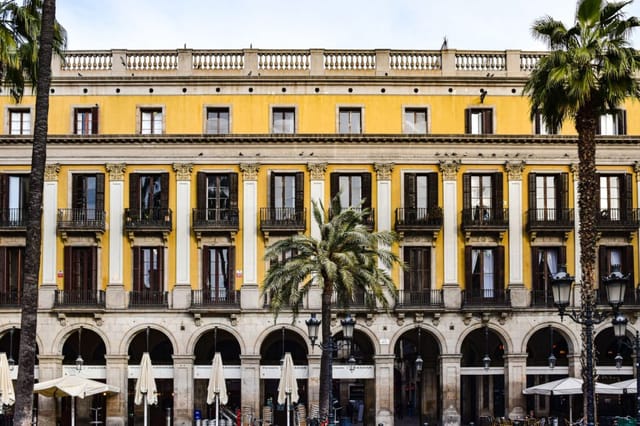
Plaça Reial opens before you, lined with palm trees and elegant arcades. Created in 1848 by architect Francesc Daniel Molina, it replaced an old Capuchin convent. Its purpose: to offer a festive space in the heart of the city. Look at the street lamps with winged helmets—they’re by Antoni Gaudí, made in 1878 as some of his first public works. The yellow facades, wrought-iron balconies, and terraces give the square a unique Mediterranean flair. In the northwest corner, the Fountain of the Three Graces reflects a neoclassical spirit. Many don’t know the square once hosted big public celebrations and masked balls in the 19th century.
- Access :
- Public square, always accessible.
- Tip :
- Cafés here are pricey—opt for a break in the side streets instead.
Walking to the next stop : From Plaça Reial, head back to La Rambla through one of the arcades and continue south—it’s right there.
 9
John Disandolo · Unsplash
9
John Disandolo · Unsplash
9. La Rambla
You’re walking down La Rambla, Barcelona’s most famous street. It links Plaça de Catalunya to the port. Here, the buzz never stops: newspaper stands, street artists, terraces, and a cosmopolitan crowd fill the promenade. Historically, La Rambla was a riverbed that became the city’s central axis in the 18th century. It’s seen parades, protests, and even national funerals. Look down: you’ll spot Joan Miró’s mosaic, often trampled without notice! The plant-filled balconies and modernist street lamps are worth a glance too.
- Access :
- Pedestrian street, always free access.
- Tip :
- Watch out for pickpockets, especially near crowds and terraces.
Walking to the next stop : Keep going straight on La Rambla to the Columbus Monument, about 7 minutes away.
 10
Christian Palau · Pexels
10
Christian Palau · Pexels
10. Columbus Monument
At the end of La Rambla stands the 60-meter-high Columbus Monument, inaugurated in 1888 for the Universal Exhibition. It commemorates Columbus’s triumphant return to Barcelona after his first voyage. The Corinthian column is topped by the statue of the explorer, pointing... toward the sea, but actually east—not toward America! At its base, bronze lions and bas-reliefs tell episodes from Columbus’s life. Many don’t know the pedestal hides an elevator to a panoramic platform (paid entry). On the Rambla del Mar, you can already feel the sea breeze and the Barceloneta vibe.
- Access :
- Free access under the monument and on the square; elevator is paid.
- Tip :
- The viewing platform is paid; you can also enjoy port views from the nearby promenade.
What next : You’re now at the foot of the Columbus Monument, facing the port: enjoy the sea view or continue your walk to the waterfront.
Guided free tour or solo: pros and cons
Not sure whether to pick a free walking tour with a guide or go solo? Here are the real differences for the classic Barcelona city center route.
Actual price and tip
Guided free tour
Pay what you want (but a €10–15 tip is expected).
The same route on your own
100% free, no tip expected.
Schedule and pace
Guided free tour
Fixed departure times, group sets the pace.
The same route on your own
You walk at your own pace, pause and detour as you like.
Language
Guided free tour
Often in English or Spanish, sometimes in French.
The same route on your own
French guaranteed—you read or listen whenever you want.
Group size
Guided free tour
Groups of 20–40 people, sometimes more.
The same route on your own
Alone, as a couple, or with friends—no group limits.
Depth of content
Guided free tour
The guide shares lively stories and answers questions.
The same route on your own
Less interaction, but access to precise, verified info.
Practical tips for your Barcelona walk
Safety and pickpockets
La Rambla and the metro are pickpocket hotspots. Keep your belongings in front of you and avoid pulling out your wallet in the street.
Terrace prices
Cafés on La Rambla and Plaça Reial are much pricier. For a more affordable break, pick a side street.
Monument hours
Churches and the cathedral are free at certain times (usually early morning or late afternoon), but this can change. Check on site or with CityGuide.
Transport
The route starts at Plaça de Catalunya, easily reached by metro (lines 1 and 3). The walk ends at Barceloneta, where you’ll find metro, buses, and taxis.
— Frequently asked questions
Frequently asked questions about Barcelona’s free walking tour
Yes, this route is entirely in public spaces. Some interiors (churches, museums) are paid or only free at certain times.
CityGuide lets you listen to these stories in audio, automatically at each stop, for a real free tour experience.
About 2.5 hours of relaxed walking, including stops. Take longer if you pause or visit monuments.
Generally yes, but keep an eye on your belongings, especially on La Rambla and in tourist areas.
No, this self-guided tour doesn’t require booking or registration. Start whenever you want.
— Go further
Want to see even more?
Discover Barcelona with CityGuide: audio tours triggered automatically, historical anecdotes, and expert tips in your pocket.
Download CityGuide for free to explore Barcelona without getting lost!