

— TRAVEL TIPS · BARCELONA
Things to do in Barcelona: the highlights and the right pace
Barcelona sits on a narrow strip between mountain and sea, and that geography explains everything: the districts stack in horizontal bands, and the order you take them in changes the whole day.
Sophie Dorval, Spain specialist · September 4, 2026 · 9 min read
Barcelona organises itself in bands: the old town and the port at the bottom, the Eixample in the middle with its Gaudí buildings, Gràcia and Park Güell higher up, the sea to one side.
Only two things need firm booking: the Sagrada Família and Park Güell. Everything else can be improvised, and a great deal of it costs nothing.
The city is bigger than it looks. The metro is excellent and cheap: don't insist on walking everything as you would in Florence.
What to know before you go
The Sagrada Família and Park Güell run on timed slots that sell out weeks ahead in season. Without a booking you'll see neither in summer.
Las Ramblas is the one place in Barcelona locals avoid. Walk it once to say you have, then take the perpendicular streets, which are infinitely more interesting.
Barcelona runs late. Restaurants fill at 9pm, not 7pm. Plan your sightseeing accordingly and keep energy for the evening.
Barcelona's essential sights
What to see, and what makes each one interesting beyond the photograph.
The Sagrada Família
A building site begun in 1882 and still under way. The interior is the real argument: light through the stained glass transforms the nave by the hour. Book, and aim for morning for cool tones or late afternoon for warm ones.
Park Güell
A luxury housing development that never found buyers, turned into a park. The monumental zone needs booking; the rest of the park, vast and wooded, stays free and nearly empty.
The Gothic Quarter
A medieval maze at the city's heart, with Roman remains embedded in the walls. Getting lost is the objective here, not the risk.
Casa Batlló and La Pedrera
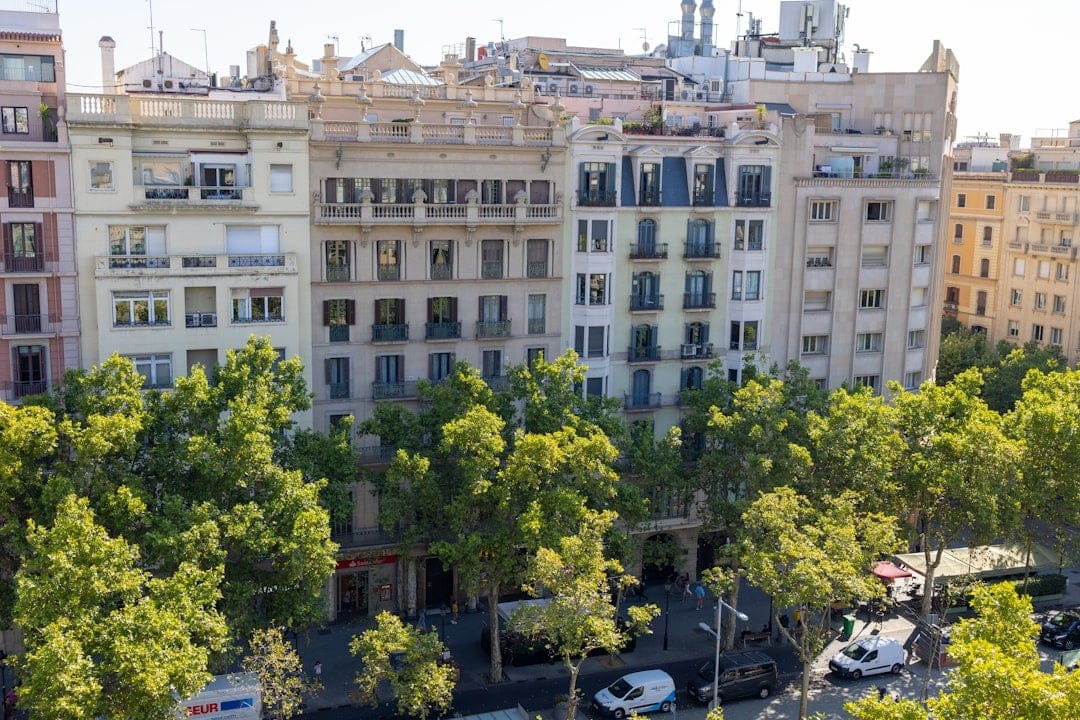
Two Gaudí buildings on Passeig de Gràcia, a few hundred metres apart. The facades can be studied free from the opposite pavement, and they already say a great deal.
La Boqueria market
A nineteenth-century covered market still used by locals despite the crowds. Go early: after 11am it becomes a continuous flow of visitors.
El Born and Santa Maria del Mar
The old merchants' quarter, with the church the dockworkers built themselves in the fourteenth century. It's the pleasantest district for dinner.
Montjuïc
The hill to the south: gardens, a castle, museums and the best view over the port. The funicular removes the climb, and most of the park is free.
Barceloneta and the beach
Barcelona is one of the few major European cities with a genuine urban beach. It only exists since 1992: the entire seafront was created for the Olympic Games.
And beyond those, Barcelona holds dozens of neighbourhood squares, local markets and modernist buildings that nobody signposts — and that often beat the queue next door.
How to structure your days
Book Gaudí first
The Sagrada Família and Park Güell impose slots. Lock them in, then build your days around them: they're the only firm constraints of your stay.
One band per half-day
Old town in the morning, Eixample in the afternoon. Going up and down repeatedly between the sea and Gràcia is the best way to lose two hours.
Use the metro without guilt
It's fast, clean and cheap. Barcelona isn't Florence: some distances simply aren't reasonable on foot, especially in summer.
Save the beach for late afternoon
The sand is packed at midday and the sun is punishing. By late afternoon, Barceloneta becomes markedly more pleasant.
Understanding what you're looking at
Barcelona is a city where architecture tells a political and industrial story — modernisme isn't a decorative style, it's a statement. Without context it stays handsome but silent.
The paper guidebook
Thorough, but unwieldy in the Gothic Quarter's lanes where you move in zigzags.
Monument audio guides
Good inside the Sagrada Família or Casa Batlló, nonexistent in the street. And most of Barcelona is outside, and free.
The location-aware audio guide
Commentary starts by itself at each facade, square and market — including where no tour goes. Everything works offline.
What to do in Barcelona depending on how long you have
Three plans that nest inside each other, built around your booked slots.
Sagrada Família in the morning on your slot, then the Gothic Quarter and El Born in the afternoon, finishing at the port. You'll have seen both faces of the city, medieval and modernist.
Add Park Güell on the second morning and Passeig de Gràcia afterwards. Those two days cover everything people come to Barcelona for.
Add Montjuïc and Gràcia, the village district above the Eixample. That's where the city stops being touristic.
The beach without rushing, or a trip to Montserrat. Both are under an hour away and change the scenery entirely.
Eat late, as they do here. The squares of El Born and Gràcia fill after 9pm, and that's the best hour of the Barcelona day.
— Questions fréquentes
Things to do in Barcelona: your questions
Three days cover the city comfortably. Two are enough for the highlights if your Gaudí slots are well placed. One day forces a choice between the old town and modernisme.
A great deal: the Gothic Quarter, El Born, the facades of Passeig de Gràcia, most of Park Güell outside the monumental zone, the gardens of Montjuïc, the beach and the seafront. Only the Gaudí interiors charge.
Absolutely. Slots sell out weeks ahead in high season, and there's no useful on-site ticket office in summer.
The beach, Park Güell and the Montjuïc cable car all work well. So does the Gothic Quarter, provided you accept getting lost. Avoid two Gaudí interiors in the same day.
May–June and September–October: pleasant heat, and the sea is still swimmable in September. July and August are hot and very busy. Winter is mild and bright, with far fewer people.
Once, for the walk. But the interest lies in the streets running off it, towards the Gothic Quarter and the Raval. Locals themselves no longer stroll there.
— Pour aller plus loin
The audio guide that tells you Barcelona as you walk
CityGuide starts the commentary on its own at each facade, square and market — including everything that's free and that nobody explains to you. Works offline, and one purchase covers your whole group.
Explore the Barcelona audio guide