

— GUIDED TOURS · PARIS
10 unmissable guided tours in Paris (free)
Ten walking routes through Paris that you follow on your own, at your own pace, with nothing to book. Free here means exactly that: no guide to pay, no tip expected, no compulsory ticket. Paid entries do exist, they stay optional, and every route tells you which ones.
Helen Marsh, Paris specialist · September 6, 2026 · 9 min read
Paris rewards walking. It is also the most honest way to read the city: its squares, quays, courtyards and churches are open to everyone, without a ticket. These ten routes were built around ten different themes — the historic core, Roman Paris, the hills, the gardens, the markets, the last hour of daylight — so that no two walks feel alike. Each one fits into half a day and ends close to a métro station.
Pick a route by the time you have and the distance you want to cover, then follow the stops in the order given: they are sequenced so the walk never doubles back. Each card states plainly what is free to enter and what needs a ticket. If you want commentary while you walk, the CityGuide audio guide plays on its own as you approach each place, as a paid option.
Prefer one single route, step by step?
Free walking tour Paris: the full self-guided (and free) route →
Read the full itinerary
10 tours · ranked from the most unmissable
No booking · no tipping
 #1
Michael Fousert · Unsplash
#1
Michael Fousert · Unsplash
1. From Notre-Dame to Concorde: the essentials
Île de la Cité, the Louvre and the Tuileries on foot
- 2h
- 3.4 km · Moderate
- 5 stops
- Optional audio: EN · FR · ES · DE
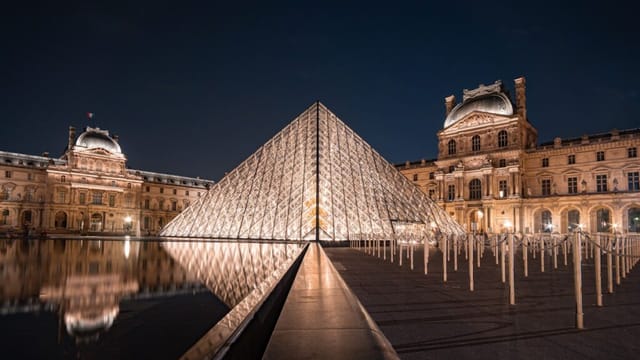
The route follows the Seine, then climbs the royal axis. You cross the forecourt of Notre-Dame, now reopened, reach the tip of the Square du Vert-Galant, then the Cour Napoléon with its glass pyramid, before the Tuileries and the obelisk on Place de la Concorde. The Point Zéro, a small bronze star set in the ground outside the cathedral, marks where road distances in France are measured from.
- Route :
- Notre-Dame forecourt and the Point Zéro marker → Pont Neuf and Square du Vert-Galant → Cour Napoléon and the Louvre Pyramid → Tuileries Garden → Place de la Concorde
- Start :
- Notre-Dame forecourt, Île de la Cité (métro Cité)
- Access :
- Streets, bridges, Louvre courtyard, Tuileries and Concorde: free. Notre-Dame: free entry. Louvre museum: paid ticket.
- Tip :
- Start early: the Louvre courtyard is nearly empty before ten, and the morning light falls straight onto the front of Notre-Dame.
Free
self-guided, at your own pace
 #2
Dylan Freedom · Unsplash
#2
Dylan Freedom · Unsplash
2. Lutetia: the city before Paris
Roman arena, Montagne Sainte-Geneviève and the Cluny baths
- 1h45
- 2.4 km · Moderate
- 6 stops
- Optional audio: EN · FR · ES · DE
The Roman town still sleeps under the 5th arrondissement. You begin at the Arènes de Lutèce, an amphitheatre rediscovered in the 19th century when rue Monge was cut through, now used as a boules pitch. Then you climb the Montagne Sainte-Geneviève, pass Saint-Étienne-du-Mont and its rood screen, and come back down to the walls of the Gallo-Roman baths, visible from boulevard Saint-Michel.
- Route :
- Arènes de Lutèce Roman amphitheatre → Rue de la Montagne Sainte-Geneviève → Saint-Étienne-du-Mont church → Place du Panthéon → Gallo-Roman baths of Cluny → Square René-Viviani and Saint-Julien-le-Pauvre
- Start :
- Entrance to the Arènes de Lutèce, rue Monge (métro Place Monge)
- Access :
- Arena, streets and squares: free. Panthéon and Cluny museum: paid tickets, exteriors visible at no cost.
- Tip :
- The arena closes at dusk, so aim for late afternoon, when the pétanque players take over the sand.
Free
self-guided, at your own pace
 #3
TBD Traveller · Pexels
#3
TBD Traveller · Pexels
3. Montmartre, the hill that stayed a village
Lanes, artists' studios and the Sacré-Cœur terrace
- 2h
- 2.8 km · Challenging
- 6 stops
- Optional audio: EN · FR · ES · DE
Montmartre was an independent village until 1860, the year it was absorbed into Paris, and the hill kept its narrow lanes and staircases. The walk passes the Bateau-Lavoir, where Picasso worked, the last windmills left standing on the butte, then Place du Tertre, before reaching the terrace of the Sacré-Cœur, where the city spreads out to the horizon.
- Route :
- Place des Abbesses and the I Love You Wall → Place Émile-Goudeau and the Bateau-Lavoir → Moulin de la Galette windmill → Place du Tertre → Saint-Pierre de Montmartre church → Sacré-Cœur forecourt
- Start :
- Place des Abbesses (métro Abbesses)
- Access :
- Streets, stairs and forecourt: free. Sacré-Cœur basilica: free entry. Dome and Montmartre museum: paid.
- Tip :
- Climb by rue Lepic rather than the funicular steps: the slope is gentler and the streets are far quieter.
Free
self-guided, at your own pace
These 10 tours, narrated in audio
The CityGuide Paris audio guide starts by itself in front of each place. You walk, it tells the story.
Full audio guide
$21.90 $39.90
★ 4.8/5 · 15 reviews
30-day money-back guarantee
 #4
Yannis Sommera · Unsplash
#4
Yannis Sommera · Unsplash
4. Paris from above, without a ticket
Belleville and Buttes-Chaumont, two public balconies
- 2h15
- 3.6 km · Challenging
- 6 stops
- Optional audio: EN · FR · ES · DE
Eastern Paris sits on hills, and its public parks open up very wide views of the city at no charge. From the Belleville belvedere the eye runs all the way to the Eiffel Tower. At Buttes-Chaumont, the park was laid out under Napoleon III inside a former gypsum quarry: the Temple de la Sibylle stands on a rocky outcrop above the lake.
- Route :
- Parc de Belleville → Belleville belvedere → Rue Piat → Rue de Belleville → Parc des Buttes-Chaumont → Temple de la Sibylle
- Start :
- Lower entrance of Parc de Belleville, rue des Couronnes (métro Couronnes)
- Access :
- Parks and viewpoints: free entry. Buttes-Chaumont closes at night, opening hours posted at the gates.
- Tip :
- Walk it late in the day: the sun sets behind the city and lights up the rooftops from both viewpoints.
Free
self-guided, at your own pace
 #5
The Now Time · Unsplash
#5
The Now Time · Unsplash
5. Churches open to all, free of charge
From Saint-Eustache to Notre-Dame, six centuries of stone
- 2h15
- 3.5 km · Moderate
- 6 stops
- Optional audio: EN · FR · ES · DE
Parish churches in Paris can be visited free of charge, and they tell the city's story better than many museums. Saint-Eustache sets a Gothic frame around Renaissance detail; Saint-Gervais keeps the oldest classical façade in Paris; Notre-Dame, reopened at the end of 2024, has recovered its pale stone. Further down, Saint-Séverin holds an ambulatory with twisted pillars.
- Route :
- Saint-Eustache church → Tour Saint-Jacques → Saint-Gervais-Saint-Protais church → Notre-Dame Cathedral → Saint-Séverin church → Grand Mosque of Paris
- Start :
- Forecourt of Saint-Eustache at Les Halles (métro Les Halles)
- Access :
- Churches: free entry. Notre-Dame: free online time slot advised. Grand Mosque: interior visit charged.
- Tip :
- Avoid service times if you want to move around freely; on weekdays, early afternoon is usually the quietest moment.
Free
self-guided, at your own pace
 #6
Eran Menashri · Unsplash
#6
Eran Menashri · Unsplash
6. Left Bank gardens
From the Luxembourg to the Jardin des Plantes, on flat ground
- 1h40
- 3 km · Moderate
- 5 stops
- Optional audio: EN · FR · ES · DE
The Luxembourg belongs to the Senate, which maintains it and opens it to the public every day: the basin, the metal chairs, the Medici Fountain under the plane trees. You walk down to the Observatory Fountain, where four continents carry a celestial sphere, then cross the quarter to the Jardin des Plantes, whose alleys and botanical school are free to enter.
- Route :
- Luxembourg Garden and the Medici Fountain → Observatory Fountain → Jardin des Plantes → Jardin Tino-Rossi → Square Barye, tip of Île Saint-Louis
- Start :
- Luxembourg Garden gate, place André-Honnorat (RER Luxembourg)
- Access :
- Gardens: free access. Greenhouses, menagerie and Muséum galleries: paid tickets, the alleys stay free.
- Tip :
- The Luxembourg gates close at dusk, earlier in winter, so begin there and finish along the Seine.
Free
self-guided, at your own pace
 #7
David Henry · Pexels
#7
David Henry · Pexels
7. Markets and food streets
Mouffetard, Monge and Aligre, three neighbourhood markets
- 2h10
- 3.6 km · Moderate
- 5 stops
- Optional audio: EN · FR · ES · DE
Three very different markets in a single walk. Rue Mouffetard, an old Roman road turned shopping street, comes alive in the morning around its stalls. The Monge market fills a shaded square three mornings a week. On Place d'Aligre, the covered Beauvau hall sits beside an open-air market and a flea market, one of the few places in Paris where all three still run side by side.
- Route :
- Place de la Contrescarpe → Rue Mouffetard and its market → Monge market → Port de l'Arsenal garden → Place d'Aligre and the Beauvau market hall
- Start :
- Place de la Contrescarpe (métro Place Monge)
- Access :
- Walking the markets: free. Tastings and purchases are on you, and no stall charges an entry fee.
- Tip :
- Come in the morning: markets wind down around one o'clock, and most of them, rue Mouffetard included, close on Mondays.
Free
self-guided, at your own pace
These 10 tours, narrated in audio
The CityGuide Paris audio guide starts by itself in front of each place. You walk, it tells the story.
Full audio guide
$21.90 $39.90
★ 4.8/5 · 15 reviews
30-day money-back guarantee
 #8
Trang · Pexels
#8
Trang · Pexels
8. The Marais: courtyards and mansions
Place des Vosges, hidden gardens and 17th-century façades
- 1h30
- 2.2 km · Easy
- 6 stops
- Optional audio: EN · FR · ES · DE
The Marais escaped Haussmann's avenues, which is why its medieval street plan and its private mansions are still intact. Place des Vosges, the oldest royal square in Paris, opens onto a garden anyone can enter. Behind the carriage doors, several courtyards and gardens are public: the Hôtel de Sully, the Rosiers-Joseph-Migneret garden, the National Archives gardens. The walk ends at the coloured machines of the Stravinsky Fountain.
- Route :
- Place des Vosges → Courtyard and garden of the Hôtel de Sully → Rue des Rosiers → Jardin des Rosiers-Joseph-Migneret → Gardens of the National Archives → Stravinsky Fountain
- Start :
- Place des Vosges, under the arcades (métro Saint-Paul)
- Access :
- Squares, streets, courtyards and gardens: free. Carnavalet museum: permanent collections free. Picasso museum: paid.
- Tip :
- Sunday is the day the Marais is fully awake; on Saturday several shops on rue des Rosiers stay closed.
Free
self-guided, at your own pace
 #9
Chris Karidis · Unsplash
#9
Chris Karidis · Unsplash
9. Trocadéro and the Seine at dusk
The Eiffel Tower head-on, then the bridges to Alexandre III
- 1h50
- 3.3 km · Moderate
- 6 stops
- Optional audio: EN · FR · ES · DE
The esplanade of the Palais de Chaillot, between the two wings of the building, opens a head-on view of the Eiffel Tower, and it costs nothing to stand there. You go down through the Trocadéro gardens and their basins, cross the Pont d'Iéna, walk under the tower and up the Champ-de-Mars. The route ends at Pont Alexandre III, whose lamps come on once night falls.
- Route :
- Human Rights esplanade at the Palais de Chaillot → Trocadéro Gardens → Pont d'Iéna → Eiffel Tower esplanade → Champ-de-Mars → Pont Alexandre III
- Start :
- Place du Trocadéro (métro Trocadéro)
- Access :
- Esplanade, gardens, bridges and Champ-de-Mars: free day and night. Going up the Eiffel Tower: paid ticket.
- Tip :
- Reach Trocadéro half an hour before sunset; the tower sparkles for a few minutes at the top of each hour after dark.
Free
self-guided, at your own pace
 #10
Valeska Huyskens · Pexels
#10
Valeska Huyskens · Pexels
10. Butte-aux-Cailles and the open-air 13th
Large murals, cobbled lanes and village houses
- 2h15
- 4.2 km · Moderate
- 6 stops
- Optional audio: EN · FR · ES · DE
The 13th arrondissement handed its blank gable walls to artists: boulevard Vincent-Auriol lines up murals several storeys high, visible from the elevated métro. Higher up, the Butte-aux-Cailles kept its cobbles, its low houses and an artesian fountain where people still fill their bottles. The Cité Florale, a pocket of small streets named after flowers, takes only a few minutes to cross.
- Route :
- Murals along boulevard Vincent-Auriol → Place d'Italie → Square René-Le Gall → Rue de la Butte-aux-Cailles → Cité Florale → Parc Kellermann
- Start :
- Métro Chevaleret, at the foot of boulevard Vincent-Auriol
- Access :
- Streets, murals, squares and parks: free. No ticket is needed anywhere on this route, fountain included.
- Tip :
- Ride line 6 above ground between Chevaleret and Nationale first, to spot the murals before you go looking for them on foot.
Free
self-guided, at your own pace
How to walk these tours for free (without missing anything)
1. Plan the route, not the budget
None of these ten walks needs a booking or a payment. What does need planning is the order of the stops and your start time: churches shut early, parks close at dusk, markets wind down around one. Note the starting point, find the nearest métro station and carry a bottle of water, since public drinking fountains are common all over the city.
2. Follow the stops in order
The stops are sequenced so the walk stays continuous, with no backtracking. If you run short of time, cut the end rather than the middle: each route deliberately finishes near a métro or a bus stop. Two walks in a day is a sensible rhythm, one in the morning and one in the late afternoon, with a proper break in between.
3. Add audio commentary if you want it
Walking without a guide, you sometimes miss the context. The CityGuide app offers an audio guide that starts by itself as you approach a place, without touching your phone, and works offline once the city is downloaded. It is a paid option and entirely separate from these routes: every walk here works perfectly well without it.
— Frequently asked questions
Free guided tours in Paris: your questions
Yes. Every route uses only streets, squares, bridges, parks and places you can enter without paying. There is no guide to pay, no tip expected and nothing to reserve. The only spending involved is whatever you choose: a coffee, a museum ticket, a métro fare.
Two, comfortably. Each walk runs between an hour and a half and a little over two hours, stops included. Doing three in a row means walking about ten kilometres and stopping to look at nothing. Better to keep one for the next day, at a different hour.
No, entry to both is free. Notre-Dame reopened to the public at the end of 2024 and access remains free of charge; at busy times a free online time slot saves you a long queue. At Sacré-Cœur, only the climb to the dome is charged.
Switch to the covered passages of the 2nd and 9th arrondissements — Galerie Vivienne, Passage des Panoramas, Passage Jouffroy — which link up under glass roofs and cost nothing. The churches on route number 5 also make good shelter, and the métro lets you rejoin your itinerary further along.
It adds audio commentary that starts on its own as you approach a place, so you keep your eyes on the city rather than on a screen. The content downloads in advance and runs without a network. It is a paid option: the ten routes on this page walk perfectly well without it.
— Go further
Walk Paris with commentary in your ear
These ten routes are yours to walk alone, for nothing. If you would rather understand what you are looking at without stopping to read, the CityGuide audio guide for Paris starts according to your position and works offline, even underground. It sits alongside these walks, it does not replace them.
Explore the Paris audio guide