

— TRAVEL TIPS · PARIS
Things to do in Paris: the highlights and the right pace
Paris suffers from its own fame: everything here is famous, so everything feels compulsory. The real skill is choosing little, and placing it well in the day.
Sophie Dorval, France specialist · September 4, 2026 · 9 min read
Paris organises itself into a few coherent blocks: the Louvre–Tuileries–Champs-Élysées axis, the Île de la Cité and the Latin Quarter, the Marais, Montmartre, and the left bank around Saint-Germain.
Most of it is walkable, but the city is far larger than Rome or Florence. The metro isn't a convenience here, it's a necessity as soon as you change district.
A great deal of what makes Paris is free: the quays, the bridges, the squares, the facades, most churches and a good share of the gardens.
What to know before you go
The major museums run on timed slots and fill weeks ahead in season. The Louvre needs half a day minimum — don't wedge it between two other visits.
Distances deceive. From the Louvre to Montmartre is an hour on foot: not a neighbouring district, but the other side of the city.
Paris is a city of terraces and gardens, not only monuments. Building in idle time isn't wasted time — it's often the best of the trip.
Paris's essential sights
What to see, and what makes each one interesting beyond the postcard.
The Eiffel Tower
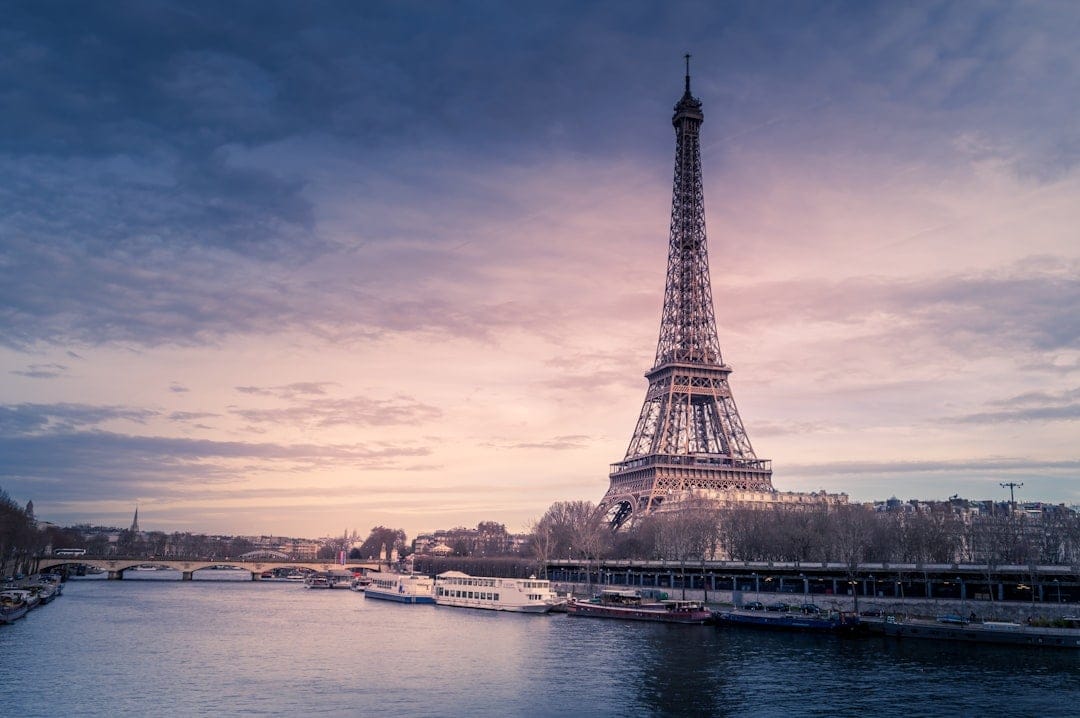
Designed to be dismantled after twenty years, it survived because it worked as an antenna. The most flattering view isn't from it but from the Trocadéro or the Champ-de-Mars — and that's free.
The Louvre
The largest museum in the world: impossible to do in full, and that's fine. Pick two or three wings rather than racing, and book the opening slot.
Île de la Cité and Notre-Dame
The cradle of the city, where Paris began. The cathedral also reads from outside, from the square behind it, where almost nobody goes.
The Marais
The district that escaped the great nineteenth-century rebuilding: narrow lanes, private mansions, the Place des Vosges. The best place to walk with no destination.
Montmartre
A village annexed to Paris in 1860, still legible in its sloping streets. Go up early: after 11am the Place du Tertre becomes impassable.
The Latin Quarter
The Panthéon, the Sorbonne, the bookshops and the Luxembourg Gardens. This is Paris at its most student, and one of the few areas alive on a Sunday.
The banks of the Seine
A World Heritage site, entirely free, and the best way to link the monuments together. Walk from bridge to bridge rather than taking the metro.
The Musée d'Orsay
A railway station turned museum, far more digestible than the Louvre and holding the finest Impressionist collection anywhere. Two hours is enough.
And beyond those, Paris holds dozens of covered passages, small museums and squares where nothing happens — often the parts people like best once home.
How to structure your days
One district per half-day
Paris is too spread out to pick at. Do the Marais properly, then Montmartre properly, rather than crossing the city for three scattered monuments.
Book museums at opening
The Louvre and Orsay are saturated from 11am to 4pm. The first slot of the morning transforms the experience and costs exactly the same.
Walk along the Seine
The quays link almost every major site, free of charge and without the metro. They're also the most pleasant route you'll find.
Keep one evening unplanned
Paris reveals itself after 7pm, when the monuments light up and the terraces fill. Don't fill every evening with visits.
Understanding what you're looking at
In Paris the history is everywhere but rarely explained: a facade, a plaque, a street name all point to episodes no sign recounts.
The paper guidebook
Thorough, but unwieldy in a city where you walk a lot and change district often.
Guided tours
Excellent when the guide is good, but on fixed schedules, in groups, and at a price that multiplies by the number of travellers.
The location-aware audio guide
Commentary starts by itself at each place, including along the quays and in the lanes of the Marais that nobody narrates. Everything works offline.
What to do in Paris depending on how long you have
Three plans that nest inside each other, from the tightest to the most comfortable.
Île de la Cité first thing, the quays as far as the Louvre, then the Tuileries and the Eiffel Tower in the late afternoon. You'll have seen the postcard without ever leaving the riverbank.
Add the Marais in the morning and Montmartre at the end of the day. These are the two districts that give Paris its depth, beyond the monuments.
Add Orsay, the Latin Quarter and the Luxembourg Gardens. You move from the monument circuit to the life of the city, and that's when Paris becomes enjoyable.
Versailles, or a district no tour covers: Belleville, the Canal Saint-Martin, the Buttes-Chaumont park.
Keep an hour after dinner. The lit quays, the bridges and the illuminated facades are worth a visit in themselves, and cost nothing.
— Questions fréquentes
Things to do in Paris: your questions
Three full days cover the major districts without rushing. Two are enough for the headline monuments. One day gets you the Seine and its surroundings, nothing more.
A great deal: the quays, every bridge, the Place des Vosges, Montmartre, most churches including Saint-Eustache and Saint-Sulpice, the Luxembourg and Tuileries gardens. Much of Paris's charm is openly accessible.
Yes, in season it's essential. Slots sell out weeks ahead for the opening hours, which are also the most pleasant.
The Eiffel Tower, the river boats and the Luxembourg Gardens all work well. The big museums much less: an hour at Orsay beats three at the Louvre.
May–June and September: long days, mild temperatures, terraces open. July and August are hotter and many Parisians are away. Winter is quiet, with beautiful late-afternoon light.
District by district yes, but not the whole city: allow an hour's walk between the Louvre and Montmartre. The metro remains essential for changing area.
— Pour aller plus loin
The audio guide that tells you Paris as you walk
CityGuide starts the commentary on its own at each place — a bridge, a facade, a square you cross by accident. Everything works offline, and one purchase covers everyone travelling with you.
Explore the Paris audio guide