

Walking itinerary | 2 h 30 | Central Paris
Free walking tour Paris: the full self-guided (and free) route
Explore Paris on a real free walking tour route, from the Latin Quarter to the Tuileries Gardens, for free and at your own pace.
by the CityGuide team · September 7, 2026 · 8 min
 Free
HANVIN CHEONG · Unsplash
Free
HANVIN CHEONG · Unsplash
Free walking tour central Paris
- Duration
- 2h20
- Distance
- 5.6 km
- Difficulty
- Easy
- Start
- Notre-Dame Cathedral
- Finish
- Place Vendôme
- Best time
- Every day, between 9am and 6pm
no guide, no booking, no tipping
Want to visit Paris for free, like on a free walking tour, but without joining a group or following a guide? Here’s the classic route followed by most free tours in central Paris, detailed step by step. Do it solo, no booking needed, and see all the big monuments and iconic spots.
For an audio tour on your own, the CityGuide app offers this same route in a geolocated version, automatically playing at each stop.
The route
 1
HANVIN CHEONG · Unsplash
1
HANVIN CHEONG · Unsplash
1. Notre-Dame Cathedral
Right in front of you is the majestic façade of Notre-Dame, a Gothic masterpiece begun in 1163. Two massive towers flank the huge rose window, and hundreds of sculpted figures decorate the portals. Napoleon was crowned here in 1804, and crowds flocked here in the Middle Ages to see the relics. The cathedral survived the Revolution, war, and the 2019 fire. Look closely: above the main portal is the Gallery of Kings, where 28 heads were decapitated in 1793, mistakenly thought to be French kings—actually, they’re Old Testament kings. On the square, spot the “point zéro des routes de France,” the symbolic heart of the country.
- Access :
- Façade and square freely accessible. Free entry to the cathedral (time slot recommended). Towers are paid.
- Tip :
- Free entry (online time slot recommended). Towers are still paid.
Walking to the next stop : Exit Notre-Dame and head south down rue Saint-Jacques to reach Saint-Séverin Church in a few minutes.
 2
David Henry · Pexels
2
David Henry · Pexels
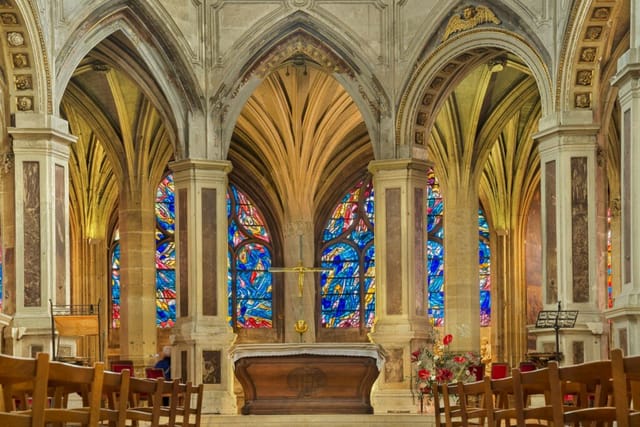
2. Saint-Séverin Church
Just a few streets from Notre-Dame, you’ll find Saint-Séverin, one of the oldest churches on the Left Bank. Built between the 11th and 15th centuries, it’s a perfect example of flamboyant Gothic. Admire the pointed arches, gargoyles, and, inside, the twisted column in the choir—a rare feature in Paris. The city’s oldest bell, cast in 1412, still rings here. This neighborhood has always been home to students and intellectuals, and Saint-Séverin witnessed the medieval debates of nearby Sorbonne. On the south side, check out the modern stained glass by Jean Bazaine (1966) among the medieval windows.
- Access :
- Exterior and interior free access, except during services.
- Tip :
- Church is open during the day, free entry, silence inside recommended.
Walking to the next stop : From Saint-Séverin, walk west across the Seine via Pont Saint-Michel, then straight ahead to Pont Neuf in under 10 minutes.
 3
MuffinLand · Pexels
3
MuffinLand · Pexels
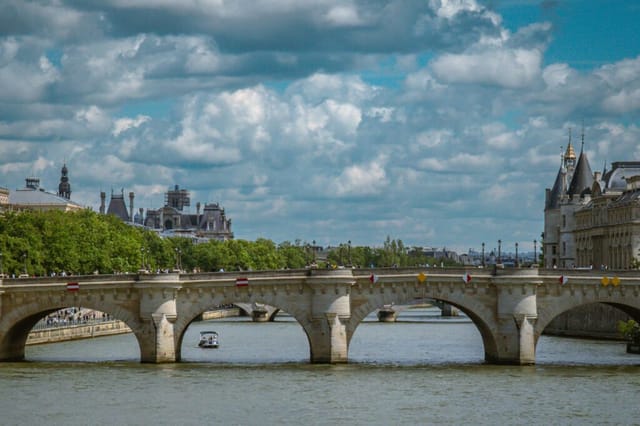
3. Pont Neuf
Despite its name, Pont Neuf is the oldest standing bridge in Paris, opened in 1607 under Henry IV. It links the Île de la Cité to both banks of the Seine. Admire its broad sidewalks and the sculpted mascarons (grotesque heads) watching over passersby for 400 years. Here, Henry IV chose to erect the first equestrian statue of a king in Paris in 1614. Notice the small triangular square in the middle, Square du Vert-Galant, a green oasis on the water, named after Henry IV’s nickname. Watch out for souvenir sellers and love locks sometimes covering the railings.
- Access :
- Bridge and square freely accessible.
- Tip :
- Don’t leave anything unattended on the benches, beware of pickpockets.
Walking to the next stop : Cross Pont Neuf and continue straight; La Samaritaine is just ahead, a few steps away.
This walk, narrated in your headphones
The CityGuide Paris audio guide starts by itself at every stop. You walk, it tells the story.
Full audio guide
$21.90 $39.90
★ 4.8/5 · 15 reviews
30-day money-back guarantee
 4
Lewis Bedar · Pexels
4
Lewis Bedar · Pexels
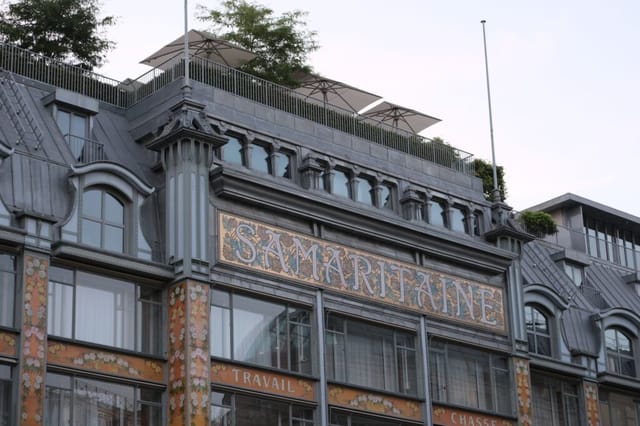
4. La Samaritaine
On your right is La Samaritaine, an iconic department store opened in 1910. Its Art Nouveau façade, with wrought iron and mosaics, was recently restored. Once the temple of Paris shopping, famous for the slogan “You find everything at La Samaritaine.” The name comes from a 17th-century water pump here, decorated with a biblical scene: Christ meeting the Samaritan woman. Today, the store mixes luxury boutiques and a rooftop with Seine views (rooftop is paid). Take a look at the details: the colored enamel frieze and the big glass roof, remnants of Belle Époque Paris.
- Access :
- Façade and store entrance are free to access. Rooftop is paid.
- Tip :
- The rooftop is paid, but the exterior is worth a photo.
Walking to the next stop : From La Samaritaine, walk south towards the Seine, then follow quai François Mitterrand to the Louvre Pyramid, about 10 minutes on foot.
 5
Michael Fousert · Unsplash
5
Michael Fousert · Unsplash
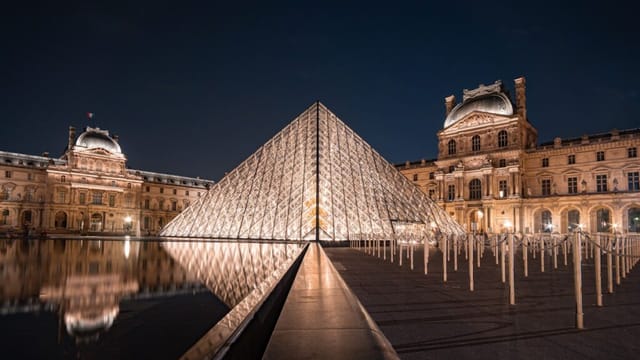
5. Louvre Pyramid
Here’s the famous glass pyramid, designed by architect Ieoh Ming Pei and opened in 1989. Standing 21.6 meters tall, it’s the main entrance to the Louvre Museum. Its glass-and-metal structure was controversial at first, but it’s now a symbol of modern Paris. The contrast with the palace’s classical façades is striking. Look closely: the pyramid is surrounded by three smaller ones, creating a geometric composition. At noon, the reflections make a spectacular light show. Beneath you, the underground Carrousel gallery links several museum wings (gallery access is free, museum is paid).
- Access :
- Square and exteriors are free to access. Museum entry is paid.
- Tip :
- Lots of pickpockets and shell-game scammers operate here, keep an eye on your belongings.
Walking to the next stop : From the Louvre Pyramid, walk straight ahead to enter the Louvre Palace, just behind the pyramid.
 6
6
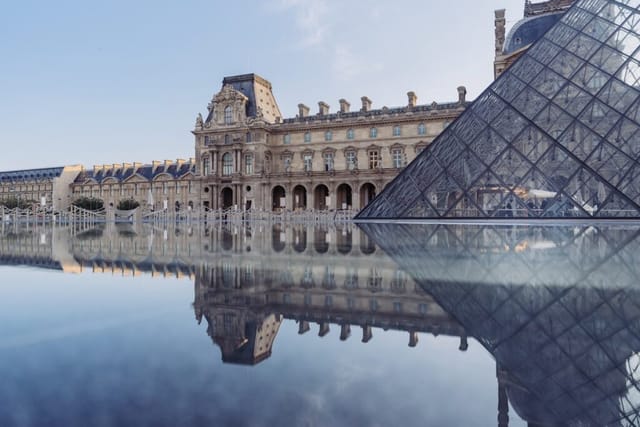
6. Louvre Palace
In front of you, the Louvre Palace, former royal residence since Philip Augustus (12th century), and a museum since 1793. The Cour Carrée, Pierre Lescot’s Renaissance façade, and the Richelieu wing show eight centuries of history. Francis I brought Leonardo da Vinci here, Louis XIV lived here before moving to Versailles. Notice the mix of styles, from medieval to classic. On the north wing, look for the winged female sculptures, symbols of victory. To the east, Perrault’s colonnade, a classicist masterpiece, is perfectly symmetrical. The Mona Lisa is displayed inside (museum is paid), but even the outside walk is a trip through time.
- Access :
- Courtyards and exteriors are free to access. Museum entry is paid.
- Tip :
- Museum is paid, courtyard and exteriors are free.
Walking to the next stop : Exit the Louvre Palace on the west side and head straight into the Tuileries Garden, just a minute away.
 7
Vinícius Vieira ft · Pexels
7
Vinícius Vieira ft · Pexels
7. Tuileries Garden
The Tuileries Garden, designed by André Le Nôtre in 1664, stretches from the Louvre to Concorde. It used to be the garden of the Tuileries Palace, which disappeared in 1871. Notice the statue-lined paths, round ponds with toy sailboats, and the green chairs everywhere. Monet, Manet, and Proust used to stroll here. In spring, the flower beds are gorgeous. Near the Seine-side terrace, spot the modern sculptures by Maillol. In the center, the big pond draws families and tourists. It’s the oldest public garden in Paris, still one of the best places to relax in the sun.
- Access :
- Park is entirely free, open daily.
- Tip :
- The garden closes at dusk. Public toilets (free or paid depending on area).
Walking to the next stop : Walk west through the Tuileries Garden to reach Place de la Concorde, about 10 minutes on foot.
This walk, narrated in your headphones
The CityGuide Paris audio guide starts by itself at every stop. You walk, it tells the story.
Full audio guide
$21.90 $39.90
★ 4.8/5 · 15 reviews
30-day money-back guarantee
 8
Cristian Bortes from Cluj-Napoca, Romania · CC BY 2.0 · Wikimedia Commons
8
Cristian Bortes from Cluj-Napoca, Romania · CC BY 2.0 · Wikimedia Commons
8. Place de la Concorde
You’ve reached Paris’s largest square, created in 1772 and a witness to the drama of the Revolution. In the center stands the Luxor Obelisk, a gift from Egypt in 1836, over 3,000 years old. Notice the monumental fountains and allegorical statues around the square, each representing a French city. This is where the guillotine stood in 1793: Louis XVI and Marie-Antoinette were executed here. Today, the square marks the transition between the Seine, Tuileries, and Champs-Élysées. The gilded gates and lampposts recall the splendor of 19th-century Paris.
- Access :
- Square and obelisk are free to access.
- Tip :
- Heavy traffic—only cross at the pedestrian crossings.
Walking to the next stop : From Place de la Concorde, take rue Royale north to reach the Church of La Madeleine in under 10 minutes.
 9
Efrem Efre · Pexels
9
Efrem Efre · Pexels
9. La Madeleine Church
In front of you, La Madeleine Church looks more like an ancient temple than a church. Construction began in 1764, but it wasn’t finished until 1842 after much debate—Napoleon wanted it as a temple to his army’s glory. Admire the 52 Corinthian columns, inspired by ancient Rome. La Madeleine has hosted Chopin’s funeral and many others. Between the steps and the main door, check the sculpted reliefs telling the story of Mary Magdalene’s conversion. The interior is monumental and free to enter outside services.
- Access :
- Exterior and interior are free, except during special events.
- Tip :
- Free entry outside of mass times. Paid concerts—check schedule.
Walking to the next stop : From La Madeleine, take rue de la Paix east and you’ll reach Place Vendôme in a few minutes.
 10
Kirandeep Singh Walia · Pexels
10
Kirandeep Singh Walia · Pexels
10. Place Vendôme
Place Vendôme, designed by Jules Hardouin-Mansart in 1699, is the symbol of Parisian luxury. It’s instantly recognizable thanks to its perfect octagonal shape, lined with mansions with matching façades. In the center, the Vendôme Column, inspired by Rome’s Trajan’s Column, was erected by Napoleon in 1810, cast from bronze taken from enemy cannons at Austerlitz. Around the square are top jewelry houses and the Ritz Hotel, once frequented by Coco Chanel and Hemingway. Look for details: the mascarons on the doors, the regular balconies. During the Revolution, Louis XIV’s statue was toppled right here.
- Access :
- Free access to the square and surroundings.
- Tip :
- The center of the square is pedestrian. Note: very closely monitored area.
What next : Now you’re at Place Vendôme, famous for its luxury boutiques and Vendôme Column—take time to admire the architecture or do some window shopping.
Free walking tour Paris: guided or solo?
Not sure whether to join a guided free walking tour or do this route solo? Here are the pros and cons of each option.
Price (and tip)
Guided free tour
Donation expected at the end (usually €10-20)
The same route on your own
Free from start to finish
Schedule & pace
Guided free tour
Set times, group pace, fixed breaks
The same route on your own
Whenever you want, at your own pace, breaks as you like
Language
Guided free tour
French, English, or Spanish depending on the guide
The same route on your own
In your own language, with or without audio
Group size
Guided free tour
Up to 30 people, sometimes more
The same route on your own
Alone, as a couple or with friends: never crowded
Content depth
Guided free tour
Lively stories, answers to questions, direct interaction
The same route on your own
Solid content but no live Q&A
Practical info and tips for this free walking tour
Safety and tourist traps
Near the Louvre and on bridges, watch out for pickpockets, shell-game scammers, and unofficial souvenir sellers. Don’t sign petitions in the street—they’re often scams.
When to do the route?
Every day, ideally in the morning or early afternoon. Avoid at night to make the most of open monuments and gardens.
Wheelchair accessibility
The route is flat and accessible for those with reduced mobility, except for a few cobbled streets around Île de la Cité.
Need an audio guide?
The CityGuide app offers this route in audio version, with automatic playback at each stop.
— Frequently asked questions
Frequently asked questions about the Paris free walking tour
Yes, the whole itinerary is on public streets or in free-access sites. Only museums or specific interiors require paid tickets.
No, you can start wherever and whenever you want, with no booking or registration needed.
Yes, you can use the CityGuide app for an audio-guided version of the same route.
Allow about 2.5 hours on foot, including breaks, to cover all 10 stops.
You can visit inside Notre-Dame (once reopened), Saint-Séverin, and La Madeleine for free. Museums and places like the Louvre require tickets.
— Go further
Visit Paris at your own pace with CityGuide
Try the CityGuide audio route in Paris for free: GPS, stories, automatic playback at each stop, no registration needed.
Discover the CityGuide audio tour