

— TRAVEL TIPS · FLORENCE
Things to do in Florence: the highlights and the right pace
Florence is tiny — you can cross the historic centre on foot in twenty minutes. That is its strength and its trap: everything looks reachable, so you keep moving, and end up looking without seeing. The city rewards the opposite approach: fewer places, properly understood.
Sophie Dorval, Italy specialist · September 5, 2026 · 9 min read

Florence works in three blocks: the religious and civic core around the Duomo and Piazza della Signoria, the great museums — Uffizi and Accademia — and the Oltrarno, the left bank, quieter and still full of working craftsmen.
Two full days cover the essentials without rushing. Three let you add another museum and a trip into Tuscany. Beyond that you move into the detail, which is no bad thing in a city this dense.
The real constraint is not time but booking: the Uffizi, the Accademia and the climb up the dome all run on timed slots, and they sell out days ahead in high season.
What to know before you go
The historic centre is small and almost entirely pedestrian: there is no reason to take any transport. Bring proper soles instead — the paving stones are uneven.
Many state museums close on Mondays, and churches keep short hours, often with a midday break. A badly placed Monday can empty a whole day.
Florence takes in more visitors per square metre than it has residents. Going out early — before nine — completely changes the Duomo and the Ponte Vecchio.
The highlights of Florence
What to see, with what makes each one interesting rather than merely famous.
The cathedral and Brunelleschi's dome
The dome was raised without centring, a feat nobody had managed since antiquity. The climb is 463 steps and needs a timed slot; the cathedral itself is free, but the queue is long.
The Baptistery and the Gates of Paradise
The gilded panels you see outside are copies: Ghiberti's originals are in the Museo dell'Opera del Duomo just behind. The mosaic ceiling inside the Baptistery, though, is the real thing.
The Uffizi Gallery
The largest collection of Renaissance painting anywhere. Botticelli's Birth of Venus and Primavera share one room — that is where the crowd concentrates, and the rest of the route breathes far more easily.
The Accademia and the David
The original David has been here since 1873; the one on Piazza della Signoria is a copy. The hall of Michelangelo's unfinished Prisoners, just before it, is worth the visit on its own.
Piazza della Signoria and Palazzo Vecchio
Florentine power in the open air: the Loggia dei Lanzi displays major sculpture with no ticket and no glass. Palazzo Vecchio can be visited, and its tower gives a view far less busy than the dome.
The Ponte Vecchio
The only bridge spared in 1944. Butchers were pushed off it in the sixteenth century in favour of goldsmiths, for the smell: the Vasari Corridor runs right above, and the Medici used it to cross unseen.
The Oltrarno and Santo Spirito
The left bank, where Florence goes back to being a city that works: restorers, gilders, cabinetmakers. Santo Spirito's blank façade hides one of Brunelleschi's finest naves.
Piazzale Michelangelo
The postcard view, twenty minutes uphill from the Ponte Vecchio. Keep climbing to San Miniato al Monte, a hundred metres higher: the church is Romanesque, magnificent, and almost empty.
Alongside those: Santa Croce and its tombs — Michelangelo, Galileo, Machiavelli — the Medici Chapels, and the Brancacci Chapel, whose Masaccio frescoes reinvented perspective. Florence holds more masterpieces per square kilometre than any other city in Europe.
How to plan your days
Book three things, no more
The Uffizi, the Accademia and the dome. They are the only places where queuing can cost you two hours. Everything else can be improvised on the day.
Alternate indoors and outdoors
Two great museums in one day is a wasted day — visual fatigue is real. One museum in the morning, the city in the afternoon.
Save the Oltrarno for late afternoon
The workshops open after lunch, the squares fill at dusk, and the left bank is far better once the groups have gone.
One day trip, not three
Siena, San Gimignano, Pisa, Fiesole: each takes half a day to a full day. Stacking several means crossing Tuscany without seeing it.
Understanding what you are looking at
In Florence more than anywhere, the gap between seeing a work and understanding it is enormous. A fifteenth-century Annunciation says nothing to someone who does not know what it depicts, and Italian museum labels stay famously terse.
A paper guidebook
Excellent in the evening, back at the hotel. Far less practical standing in an Uffizi room where the line has to keep moving.
A guided tour
Solid on the major museums, but fixed times, in a group, and it leaves out everything not on the itinerary — which is most of the city.
A location-aware audio guide
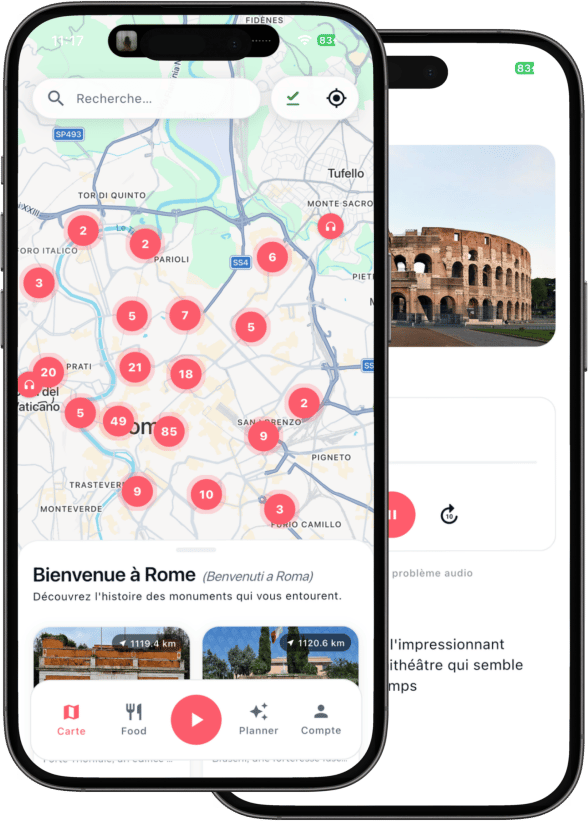
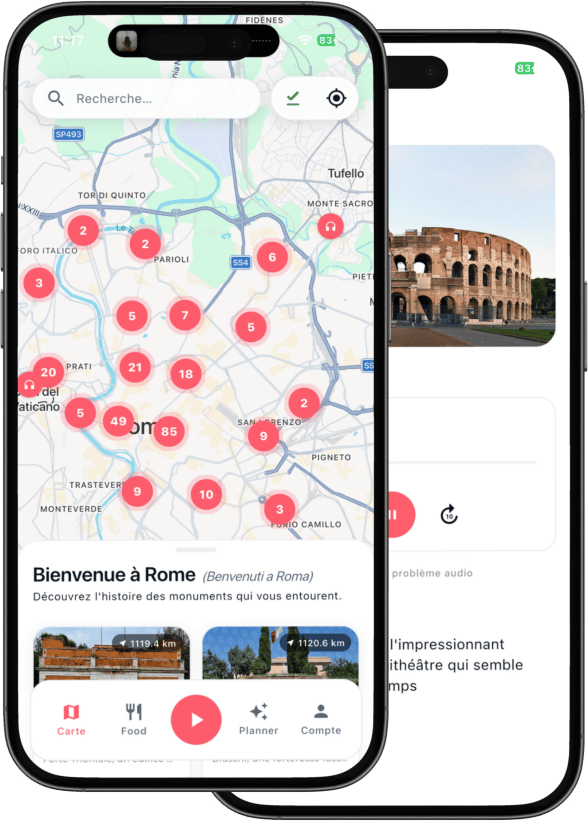
The commentary starts on its own at each church, palace and square — including the ones no tour stops at. You walk at your own pace, and it all works offline.
What to do in Florence depending on how long you have
Three itineraries that build on each other, from shortest to fullest.
The Duomo and Baptistery early, Piazza della Signoria, the Ponte Vecchio, then the Uffizi in the afternoon on a booked slot. End the day at Piazzale Michelangelo.
Add the Accademia on the second morning, Santa Croce, then the Oltrarno in the afternoon — Santo Spirito, the workshops, the Brancacci Chapel. This is the format that gives the truest picture of the city.
Palazzo Pitti and the Boboli Gardens, the Medici Chapels, the Bargello for sculpture. Or a day trip: Siena is ninety minutes away by bus.
Fiesole, twenty minutes above the city by bus: Etruscan and Roman ruins, and the best view over the Arno valley. Far quieter than the Piazzale.
An aperitivo in the Oltrarno, then cross the Arno at sunset. That is the moment Florence turns back into a city rather than a museum.
— Questions fréquentes
Things to do in Florence: your questions
Two full days cover the highlights without rushing. Three let you add another museum or a trip into Tuscany. A single day is possible, but forces a choice between the Uffizi and the Accademia.
In high season, effectively yes: slots go days ahead and walk-up queues regularly pass two hours. Off season, a ticket bought the day before is usually enough.
The cathedral itself, the Loggia dei Lanzi and its sculptures, most churches outside their paying chapels, the Ponte Vecchio, Piazzale Michelangelo and San Miniato al Monte. State museums are free on certain Sundays — the dates change each year.
No, it is a copy installed in 1910. The original was moved to the Accademia in 1873 to protect it from the weather. A third copy, in bronze, stands over Piazzale Michelangelo.
Only if you run through five or six paying museums in three days, which is an exhausting pace. For a normal trip, separate tickets cost less.
April-May and September-October: soft light, bearable temperatures, and crowds you can live with, unlike July and August when the city is saturated and the heat between noon and four is punishing.
— Pour aller plus loin
The audio guide that tells you Florence as you walk
CityGuide starts the commentary on its own at the Duomo, the Ponte Vecchio, every church and every palace — with nothing to look up. It all works offline, and one purchase covers everyone travelling with you.
See the Florence audio guide