

Free self-guided audio tour in Rome
Free walking tour Rome: the full route to do solo (and for free)
Discover the best of Rome on foot, from Piazza Navona to the Colosseum, with no guide and no fees: follow this detailed route and experience the Eternal City just like on a real free tour.
CityGuide Editorial Team · September 7, 2026 · 15 min
 Free
Magda Ehlers · Pexels
Free
Magda Ehlers · Pexels
Free walking tour Rome
- Duration
- 2h25
- Distance
- 5.7 km
- Difficulty
- Easy
- Start
- Trevi Fountain
- Finish
- Basilica of San Clemente al Laterano
- Best time
- Morning or early evening to avoid the crowds
no guide, no booking, no tipping
Want to explore Rome like a free walking tour, but at your own pace and for free? Here’s the detailed route of the classic tour used by guides, so you can wander solo through the iconic streets and monuments of the Italian capital.
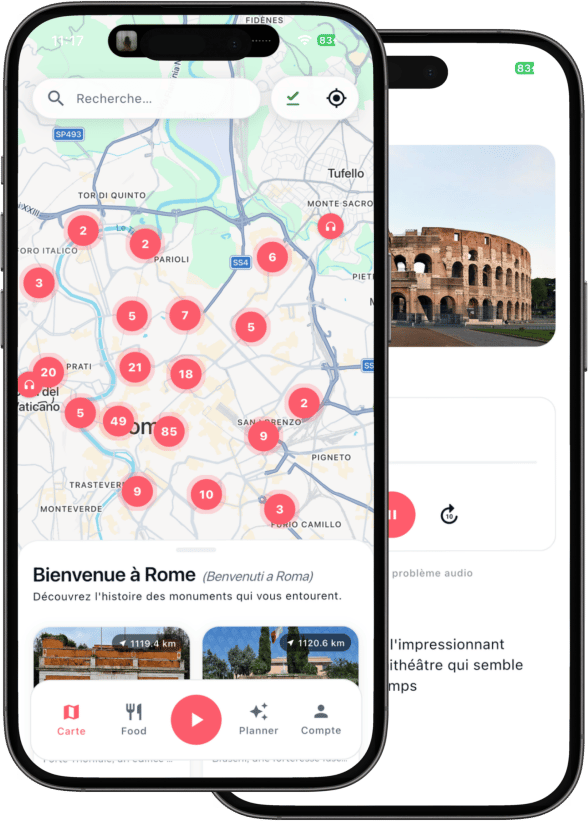
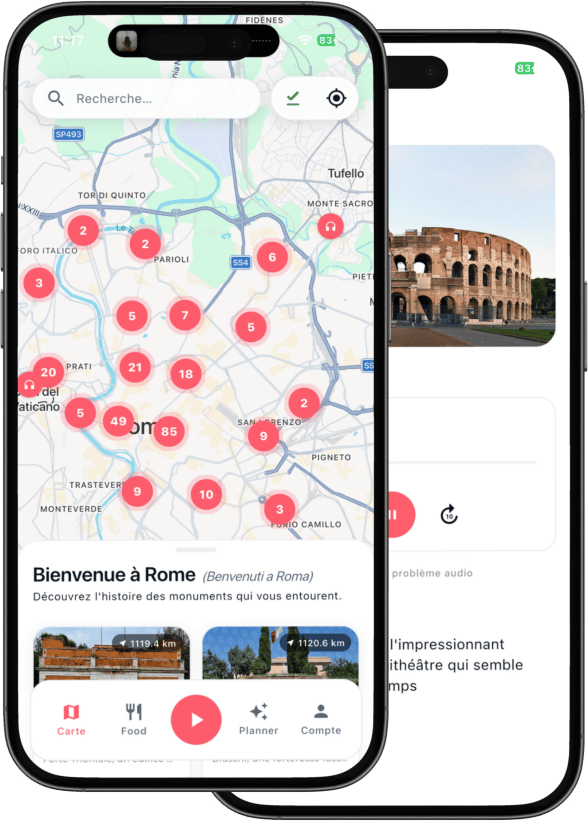
This itinerary is also available as an audio and GPS-guided version on the CityGuide app, so you can be guided automatically as you walk.
The route
 1
Magda Ehlers · Pexels
1
Magda Ehlers · Pexels
1. Trevi Fountain
In front of you is Rome’s most famous fountain, completed in 1762 to plans by Nicola Salvi. This monumental Baroque masterpiece celebrates water, with Neptune in the center, taming the sea on his chariot pulled by horses. The fountain marks the end of the Aqua Virgo aqueduct, built in 19 BC by Agrippa. According to tradition, tossing a coin over your right shoulder guarantees a return to Rome. Few notice, on the left of the fountain, a small basin: the "Fontanina degli Innamorati," once used by couples to prove their fidelity. The fountain is stunning at night, but gets very crowded during the day.
- Access :
- Free access 24/7 to the outdoor fountain.
- Tip :
- Come early or late to enjoy the fountain in peace. Watch out for pickpockets.
Walking to the next stop : From Trevi Fountain, take Via delle Muratte and go straight to the Pantheon, about a 10-minute walk.
 2
AXP Photography
2
AXP Photography
2. Pantheon
You’re facing one of the best-preserved monuments of Antiquity: the Pantheon, built under Emperor Hadrian. Its dome—the largest of the ancient world (43.3 m in diameter)—still amazes architects. Originally a temple for all gods, it was converted into a Christian church in the 7th century. Inside rest the painter Raphael and several Italian kings. The dome’s central oculus is the only source of natural light, still fascinating architects and engineers. A little-known detail: rainwater drains away through a clever system of holes in the floor. Since 2023, entry is paid, but the façade and square remain open to all.
- Access :
- Free access outside. Paid entry inside.
- Tip :
- Arrive early in the morning to skip the line inside and enjoy the view of the piazza.
Walking to the next stop : From the Pantheon, head to Piazza Navona then turn left to reach the Bramante Cloister in 5 minutes.
 3
3
3. Bramante Cloister
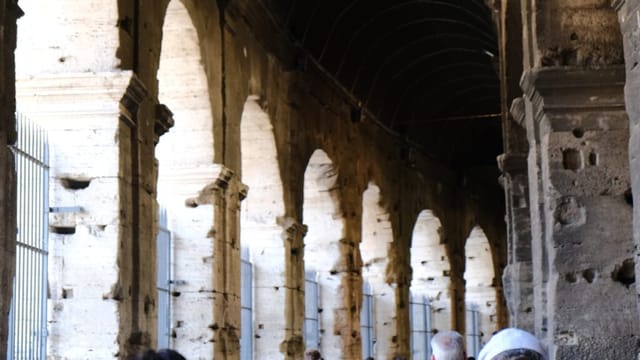
Here’s one of the most peaceful spots in the historic center: the Bramante Cloister, a Renaissance masterpiece built in the early 16th century. Surrounded by elegant columns, it was a place of meditation for the monks of Santa Maria della Pace. Architect Donato Bramante, who also designed the new St. Peter’s Basilica, sought perfect harmony of space, light, and proportion here. Few visitors spot the sundial drawn on the walls—a testament to the scientific precision of the era. The cloister sometimes hosts (paid) exhibitions, but access to the courtyard is always free. Note the refined capitals and imagine this place alive with 16th-century humanist debate.
- Access :
- Free outdoor courtyard. Paid exhibitions inside.
- Tip :
- For a quiet coffee, the cloister terrace is ideal. Access to the courtyard is free, exhibitions are paid.
Walking to the next stop : From the Bramante Cloister, exit onto Via della Pace, turn right, and walk south to the Largo di Torre Argentina archaeological area, about 7 minutes.
This walk, narrated in your headphones
The CityGuide Rome audio guide starts by itself at every stop. You walk, it tells the story.
Full audio guide
$21.90 $39.90
★ 4.8/5 · 15 reviews
30-day money-back guarantee
 4
Luciano Tronati · CC BY-SA 4.0 · Wikimedia Commons
4
Luciano Tronati · CC BY-SA 4.0 · Wikimedia Commons
4. Largo di Torre Argentina Sacred Area
You’re at an archaeological site in the middle of the city: the sacred area of Largo di Torre Argentina. Here you see four Roman temples from the Republican era, discovered during construction in 1927. They’re among the oldest in Rome. Behind the ruins, legend says Julius Caesar was assassinated nearby in 44 BC, though the exact spot is debated. A fun fact: the site is now famous for its protected colony of stray cats, often seen among the ruins. The temples can be viewed freely from the street, so you get a glimpse of Roman history in the open air at no cost.
- Access :
- Free exterior view from the street. Paid access inside (check for updates).
- Tip :
- Look closely among the stones—you’ll probably spot some Roman cats!
Walking to the next stop : From Largo di Torre Argentina, head straight to Piazza Venezia where you'll find the Altare della Patria, about 8 minutes.
 5
Lajos Kristóf Kántor · Pexels
5
Lajos Kristóf Kántor · Pexels
5. Altare della Patria (Piazza Venezia)
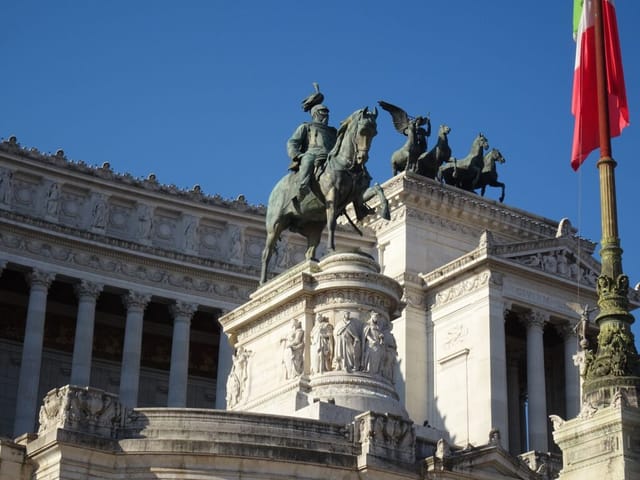
You’re in front of the huge white monument dominating Piazza Venezia: the Altare della Patria (Vittoriano), built from 1885 to 1935 in honor of Victor Emmanuel II, first king of unified Italy. Its neoclassical architecture is often debated by locals, who call it "the typewriter." On the steps, the eternal flame of the Unknown Soldier has burned since 1921, always guarded. The monument offers a panoramic view (paid terrace) and houses museums (paid). Tip: check out the massive bronze equestrian statues and bas-reliefs illustrating Italy’s unification.
- Access :
- Free access to the square and monument base. Museums and terrace are paid.
- Tip :
- Don’t climb the central steps—they’re reserved for official ceremonies.
Walking to the next stop : From the Altare della Patria, follow Via dei Fori Imperiali to Trajan’s Forum in 3 minutes.
 6
Gabriella Clare Marino · Unsplash
6
Gabriella Clare Marino · Unsplash
6. Trajan’s Forum
On your left is Trajan’s Forum, inaugurated in 112 AD and considered one of the greatest imperial forums. Funded by the spoils of the Dacian wars, it was designed by architect Apollodorus of Damascus. Trajan’s Column, 30 meters high, is wrapped with about 200 meters of spiral bas-reliefs telling the emperor’s victories. Few know: an inner staircase leads to the top of the column, but it’s closed to the public. The forum also included a huge basilica and markets, with impressive remains still visible from the street.
- Access :
- Free exterior view from the street. Paid entry inside.
- Tip :
- The ruins are best seen by crossing to Via Alessandrina.
Walking to the next stop : From Trajan’s Forum, continue on Via dei Fori Imperiali to the exterior view of the Roman Forum in 5 minutes.
 7
Patricia Bozan · Pexels
7
Patricia Bozan · Pexels
7. Roman Forum (exterior view)
Here you see the political, religious, and commercial heart of ancient Rome: the Roman Forum. From Via dei Fori Imperiali, you can spot the columns of the Temple of Saturn, the Arch of Septimius Severus, and the Basilica Julia. The Forum, developed from the 7th century BC, was the scene of famous speeches, triumphal processions, and daily Roman life. Behind the fences, note the different archaeological layers, evidence of the site’s long history. Many don’t know that Via dei Fori Imperiali was built under Mussolini, destroying ancient ruins to connect the Colosseum to Piazza Venezia.
- Access :
- Free exterior view from Via dei Fori Imperiali. Paid entry inside.
- Tip :
- For better photos, climb a few steps toward the Capitoline Hill.
Walking to the next stop : From the Roman Forum (exterior view), continue on Via dei Fori Imperiali to the Arch of Constantine, about 7 minutes.
This walk, narrated in your headphones
The CityGuide Rome audio guide starts by itself at every stop. You walk, it tells the story.
Full audio guide
$21.90 $39.90
★ 4.8/5 · 15 reviews
30-day money-back guarantee
 8
Anton Volnuhin · Unsplash
8
Anton Volnuhin · Unsplash
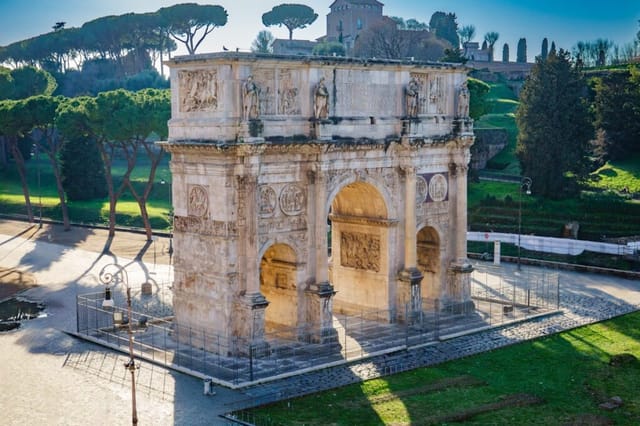
8. Arch of Constantine
Here’s Rome’s best-preserved triumphal arch, built in 315 to celebrate Constantine’s victory over Maxentius. Standing 21 meters tall, it’s decorated with reliefs repurposed from earlier monuments—a true artistic patchwork. The arch marked the entry of victorious emperors into the city’s parades. Look at the round medallions at the top: they’re from a monument to Hadrian, while other sculptures are from the Flavian period. Few notice the contrast between the rougher lower section and the refined upper parts, showing the different origins of the sculpted fragments.
- Access :
- Free access outside and under the arch. Interior closed to the public.
- Tip :
- Walk under the arch to see the details of the bas-reliefs (free access).
Walking to the next stop : From the Arch of Constantine, walk straight to the Colosseum (exterior), it’s right next door, just 2 minutes away.
 9
성두 홍
9
성두 홍
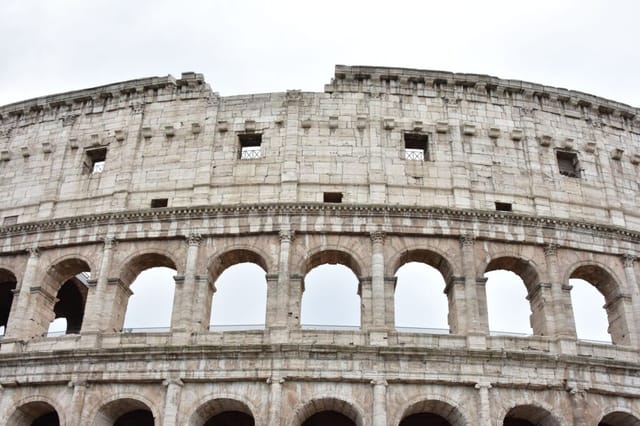
9. Colosseum (exterior)
In front of you stands the Flavian Amphitheater, better known as the Colosseum, inaugurated in 80 AD by Emperor Titus. It could host up to 50,000 spectators for gladiator fights, hunts, and shows. Its three-tiered façade, once clad in marble, remains Rome’s most iconic symbol. Historical detail: in the Middle Ages, the Colosseum was partly turned into a fortress and later a stone quarry. Notice the cross inside, a more recent addition, honoring Christian martyrs. Entry inside is paid, but you can freely walk the exterior and enjoy the view over the Colosseum valley.
- Access :
- Free exterior walk. Paid entry inside.
- Tip :
- Beware of fake centurions asking for tips for photos.
Walking to the next stop : From the Colosseum (exterior), take Via Labicana east, then continue on Via di San Giovanni in Laterano to reach the Basilica of San Clemente al Laterano in 12 minutes.
 10
10
10. Basilica of San Clemente al Laterano
Just steps from the Colosseum is the Basilica of San Clemente, a hidden gem. Built in the 12th century, it stands atop two older churches, including a Roman house and a Mithraic temple. The upper church, free to enter, features stunning Byzantine mosaics in the apse, made around 1130. The underground levels (paid) reveal layers of Roman history. A curiosity: listen carefully and you might hear a mass sung in Slavonic, a tradition from Saint Cyril, whose relics rest here. The contrast between the plain exterior and the rich interior decorations is always striking.
- Access :
- Upper church free. Underground area paid.
- Tip :
- Entry to the upper church is free. Underground area is paid. Closed at midday (check times).
What next : You’ve arrived at the Basilica of San Clemente al Laterano, where you can visit its unique interior and discover its beautiful mosaics.
Guided free tour or self-guided in Rome: which to choose?
Not sure whether to join a guided free walking tour or follow this route solo? Here’s what sets them apart, so you can pick what suits you best.
Price and tips
Guided free tour
Free, but the guide expects a tip (usually €10–15).
The same route on your own
Totally free, no tip or booking needed.
Schedule and pace
Guided free tour
Set start times, group pace.
The same route on your own
Your own pace, pause and detour as much as you want.
Language
Guided free tour
In French, English, or Spanish depending on the guide.
The same route on your own
In any language you want, with your app or guidebook.
Group size
Guided free tour
Often 20–40 people, sometimes more.
The same route on your own
Solo or with friends, no crowds.
Depth of content
Guided free tour
Live explanations, anecdotes, and answers to your questions.
The same route on your own
Less interactive but more freedom—you choose your level of detail.
Practical info for making the most of your free walking tour in Rome
Trevi Fountain: Expect crowds
The fountain is very crowded between 10am and 8pm. Go early or late to enjoy it without the masses.
Centurions near the Colosseum
Fake centurions offer paid photo ops near the Colosseum. Politely decline if you don’t want to pay.
Restaurants around Piazza Navona
Restaurants around Piazza Navona are often pricey and touristy. Head a bit further into side streets for better options.
Following the route with CityGuide
You can do this route for free with audio guidance on the CityGuide app, which automatically plays commentary at each stop.
— Frequently asked questions
Frequently asked questions about the free walking tour Rome
Yes, you can follow the whole route for free from the street, with no guide or tip required. Only interior visits to some monuments cost extra.
Plan about 2.5 to 3 hours for the full itinerary, without lingering too long at each stop.
Yes, the route is easy, mostly pedestrian, and you can pause at each square. Just wear comfortable shoes.
Yes, you can find this route for free on the CityGuide app, with audio commentary triggered automatically as you walk.
Watch out for fake guides or costumed performers asking for tips, especially near the Colosseum. Keep an eye on your belongings in very touristy areas.
— Go further
Want a free audio guide for this route?
Find this same itinerary on the CityGuide app: audio commentary plays automatically at each stop for a stress-free, self-guided visit.
Download CityGuide – it’s free!