

— GUIDED TOURS · ROME
10 unmissable guided tours in Rome (free)
Ten walking routes through Rome you can do at your own pace, with no guide to pay and nothing to book. Streets, squares, viewpoints and churches you can simply walk into: each entry gives the length, the distance, the starting point and, plainly, what still costs money if you want to go inside.
Helen Marsden, Italy specialist · September 6, 2026 · 9 min read
Rome works remarkably well without a ticket. Most of what makes the city — the baroque squares, the lanes of Trastevere, the hills, the fountains, the basilicas — is open to anyone willing to walk. We picked ten routes that do not overlap: one for antiquity, one for churches, one for viewpoints, one for the market, one for sunset, and one for a district almost no visitor sees. Each fits comfortably into half a day at most.
Every walk gives you a precise starting point, four to six stops in walking order, a realistic duration including pauses, and one practical tip. Do them all or just one. If you want commentary while you walk, the CityGuide app offers a paid audio guide that plays on its own as you get near each place. None of that is required to follow the routes below.
Prefer one single route, step by step?
Free walking tour Rome: the full route to do solo (and for free) →
Read the full itinerary
10 tours · ranked from the most unmissable
No booking · no tipping
 #1
Magda Ehlers · Pexels
#1
Magda Ehlers · Pexels
1. The historic centre in one loop
From the Spanish Steps to Campo de' Fiori, via Trevi
- 1h40
- 2.6 km · Moderate
- 5 stops
- Optional audio: EN · FR · ES · DE
This is the walk that joins up the images you already have in your head. The Trevi Fountain is built against the Palazzo Poli and fed by the Acqua Vergine, an ancient aqueduct still in service. Further on, Piazza Navona traces the exact shape of the Stadium of Domitian that stood on the site: the oval you walk around is the old running track. Finish among the stalls of Campo de' Fiori.
- Route :
- Piazza di Spagna → Trevi Fountain → Pantheon (exterior) → Piazza Navona → Campo de' Fiori
- Start :
- Piazza di Spagna, at the foot of the Spanish Steps
- Access :
- Streets, squares and fountains free. The Pantheon has charged admission since 2023; entry optional.
- Tip :
- Set off before nine. Trevi and the Pantheon are still breathable, and the low light is far kinder than midday glare.
Free
self-guided, at your own pace
 #2
Anton Volnuhin · Unsplash
#2
Anton Volnuhin · Unsplash
2. Ancient Rome: the heart of the empire
Colosseum, imperial forums and the Capitol, seen from the street
- 1h30
- 2.2 km · Easy
- 5 stops
- Optional audio: EN · FR · ES · DE
You can walk past two thousand years of history without buying a single ticket. The Arch of Constantine stands right there in the open, free to inspect up close. Via dei Fori Imperiali runs above the forums of Caesar, Augustus and Nerva: from the railings you look down into them, which is often better than being among them. Trajan's Column unwinds its carved account along nearly two hundred metres of spiral frieze.
- Route :
- Arch of Constantine → Colosseum (exterior) → Via dei Fori Imperiali → Trajan's Column → Piazza del Campidoglio
- Start :
- Colosseo metro exit, on Piazza del Colosseo
- Access :
- Exteriors, street and square free. Colosseum and Forum-Palatine ticketed, entry optional.
- Tip :
- Walk from the Colosseum towards the Capitol, so you climb the Cordonata ramp facing the monument rather than with your back to it.
Free
self-guided, at your own pace
 #3
Marcelo Aut · Pexels
#3
Marcelo Aut · Pexels
3. Trastevere, the other bank
Lanes, squares and two basilicas of old Trastevere
- 1h30
- 2.3 km · Easy
- 6 stops
- Optional audio: EN · FR · ES · DE
Cross the Tiber and the tempo changes: uneven cobbles, laundry at the windows, workshops. Santa Maria in Trastevere carries a mosaic across its façade that you can study from the square, free, before you even go in. A little further down, Santa Cecilia stands on the site of a Roman house. End at Piazza San Cosimato, where the neighbourhood market runs in the morning, well away from the tourist terraces.
- Route :
- Piazza Trilussa → Via del Moro → Piazza di Santa Maria in Trastevere → Basilica of Santa Maria in Trastevere → Basilica of Santa Cecilia → Piazza San Cosimato
- Start :
- Piazza Trilussa, at the end of Ponte Sisto
- Access :
- Lanes, squares and basilicas free. Small charge for the Cavallini fresco, optional.
- Tip :
- Skip Saturday night, when it fills up. On a weekday morning the lanes around Via della Lungaretta are almost empty.
Free
self-guided, at your own pace
These 10 tours, narrated in audio
The CityGuide Rome audio guide starts by itself in front of each place. You walk, it tells the story.
Full audio guide
$21.90 $39.90
★ 4.8/5 · 15 reviews
30-day money-back guarantee
 #4
Amir Arsalan Shamsabadi · Unsplash
#4
Amir Arsalan Shamsabadi · Unsplash
4. The Janiculum, Rome's viewpoint hill
A climb out of Trastevere, over rooftops and domes
- 1h50
- 3.2 km · Challenging
- 6 stops
- Optional audio: EN · FR · ES · DE
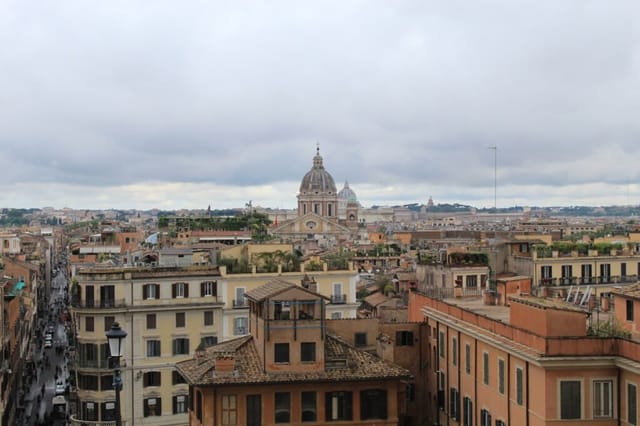
The best free view in Rome has to be earned: Via Garibaldi climbs hard. At the top, the Acqua Paola Fountain pours into a monumental basin, and Piazzale Garibaldi opens onto the whole city, from the domes out to Monte Mario. A cannon is fired here every day at noon, a tradition kept up to give the bell towers of Rome their time signal.
- Route :
- Porta Settimiana → San Pietro in Montorio and the Tempietto → Acqua Paola Fountain → Piazzale Garibaldi → Monument to Anita Garibaldi → Sant'Onofrio al Gianicolo
- Start :
- Porta Settimiana, at the northern edge of Trastevere
- Access :
- Climb, terraces and fountain free. Churches free to enter, opening hours vary.
- Tip :
- Climb in late afternoon and come back down the Janiculum promenade: the light keeps turning on the façades all the way down.
Free
self-guided, at your own pace
 #5
Fatih Turan · Pexels
#5
Fatih Turan · Pexels
5. Five basilicas, one walk
From Santa Maria Maggiore to San Clemente across the Esquiline
- 1h40
- 1.9 km · Easy
- 5 stops
- Optional audio: EN · FR · ES · DE
In Rome the churches are the city's largest free museum. Santa Prassede, tiny and easy to walk past, keeps a side chapel lined floor to ceiling in mosaic. Two streets on, San Pietro in Vincoli holds Michelangelo's Moses, visible without a ticket. San Clemente stacks three levels from three different eras on top of one another, including an underground sanctuary.
- Route :
- Basilica of Santa Maria Maggiore → Basilica of Santa Prassede → San Martino ai Monti → San Pietro in Vincoli → Basilica of San Clemente
- Start :
- Piazza di Santa Maria Maggiore, in front of the main façade
- Access :
- Church entry free. The lower levels of San Clemente are ticketed; visiting them is optional.
- Tip :
- Many churches shut between midday and four. Start at nine, or pick the walk up again in the late afternoon.
Free
self-guided, at your own pace
 #6
Jovan Vasiljević · Pexels
#6
Jovan Vasiljević · Pexels
6. Villa Borghese and the Pincio terrace
From Piazza del Popolo to the lake, the centre's green lung
- 1h50
- 3.5 km · Moderate
- 6 stops
- Optional audio: EN · FR · ES · DE
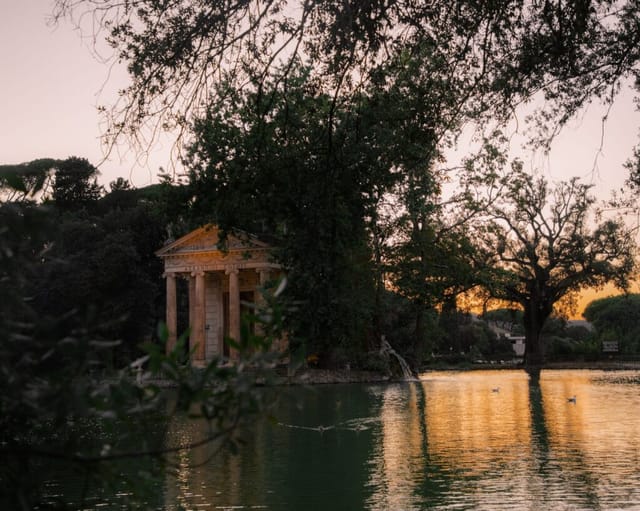
The ramp leaving Piazza del Popolo brings you up to the Pincio terrace in a few minutes, looking out over the rooftops as far as St Peter's. Behind it, Villa Borghese begins: avenues of umbrella pines, the small lake with its neoclassical temple to Asclepius, then Piazza di Siena, an oval dirt arena among the trees. You come out beside the gallery.
- Route :
- Piazza del Popolo → Pincio terrace → Casina Valadier → The lake and the Temple of Asclepius → Piazza di Siena → Galleria Borghese (exterior)
- Start :
- Piazza del Popolo, at the foot of the Pincio ramp
- Access :
- Park, terraces and avenues free. Galleria Borghese ticketed and booked ahead, entry optional.
- Tip :
- Take the ramp rather than the steps from Piazza del Popolo: it is longer, but the view opens gradually instead of all at once.
Free
self-guided, at your own pace
 #7
#7
7. Testaccio, working-class Rome
Covered market, ancient pyramid and a hill of pot shards
- 1h30
- 2.4 km · Easy
- 5 stops
- Optional audio: EN · FR · ES · DE
Testaccio is Rome at work. You start in front of a genuine Roman pyramid, the tomb of a magistrate, wedged into the city walls. Then the covered market, its counters and street-food stalls. Just behind rises Monte dei Cocci: an entirely man-made hill built from the stacked shards of ancient amphorae unloaded at the river port next door.
- Route :
- Pyramid of Cestius → Non-Catholic Cemetery → Testaccio Market → Monte dei Cocci → Ex-Mattatoio
- Start :
- Piramide metro, in front of the Pyramid of Cestius
- Access :
- Streets, market and district free. Non-Catholic Cemetery by donation; tastings at your own cost.
- Tip :
- The market closes in the early afternoon and all day Sunday. Come between ten and one to see it actually working.
Free
self-guided, at your own pace
These 10 tours, narrated in audio
The CityGuide Rome audio guide starts by itself in front of each place. You walk, it tells the story.
Full audio guide
$21.90 $39.90
★ 4.8/5 · 15 reviews
30-day money-back guarantee
 #8
Efe Ersoy · Pexels
#8
Efe Ersoy · Pexels
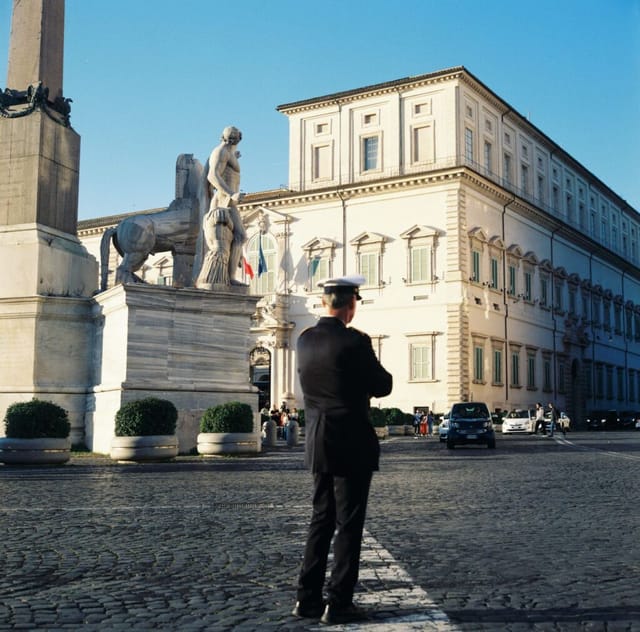
8. Fountains and façades of the Quirinal
Open-air baroque, from Barberini down to Via del Corso
- 1h25
- 2.1 km · Moderate
- 6 stops
- Optional audio: EN · FR · ES · DE
A whole architecture walk with no ticket desk in it. At the Quattro Fontane crossroads, four reclining figures occupy the corners; turn on the spot and you can pick out three obelisks lined up down three different streets. Lower down, Piazza del Quirinale gives one of the widest views over the city. Galleria Sciarra, a covered courtyard painted from floor to ceiling, is free to walk through.
- Route :
- Triton Fountain → Fountain of the Bees → Quattro Fontane → Sant'Andrea al Quirinale → Piazza del Quirinale and the Dioscuri fountain → Galleria Sciarra
- Start :
- Piazza Barberini, at the metro exit
- Access :
- Streets, squares and fountains free. Quirinal Palace ticketed and booked ahead, optional.
- Tip :
- Galleria Sciarra is a private passage open on working days: save it for a weekday rather than a Sunday.
Free
self-guided, at your own pace
 #9
Gabriella Clare Marino · Unsplash
#9
Gabriella Clare Marino · Unsplash
9. The Aventine at sunset
Circus Maximus, the Orange Garden and the keyhole
- 1h35
- 2.6 km · Moderate
- 6 stops
- Optional audio: EN · FR · ES · DE
The Aventine is Rome's quiet hill, and it is where the day ends best. The Orange Garden, laid out on top of an old fortress, faces due west over the Tiber towards St Peter's. A few steps away, the gate of the Priory of Malta hides a curiosity: through the keyhole, the dome of St Peter's appears framed at the end of an avenue of trees clipped for the purpose.
- Route :
- Circus Maximus → Orange Garden → Basilica of Santa Sabina → Knights of Malta keyhole → Aventine belvedere → Ponte Palatino
- Start :
- Circus Maximus, on the Via del Circo Massimo side
- Access :
- Garden, square, basilica and viewpoints free. No paid admission anywhere on this route.
- Tip :
- Reach the Orange Garden forty minutes before sunset. The keyhole often has a short queue, so do that part first.
Free
self-guided, at your own pace
 #10
Alexandr Lipov · Pexels
#10
Alexandr Lipov · Pexels
10. EUR, the Rome of the 1930s
Marble, arcades and a big lake, twenty minutes from the centre
- 1h45
- 3.4 km · Moderate
- 5 stops
- Optional audio: EN · FR · ES · DE
A district almost no visitor sees, four metro stops from the centre. EUR was designed in the 1930s for a world's fair that never took place. What remains is oversized avenues, white travertine and the Palace of Italian Civilisation, nicknamed the Square Colosseum for its six storeys of identical arcades. The route finishes on the shore of the artificial lake.
- Route :
- Palace of Italian Civilisation → Basilica of Saints Peter and Paul → Viale Europa → Palazzo dei Congressi → EUR lake
- Start :
- EUR Magliana metro, below the Palace of Italian Civilisation
- Access :
- District, avenues, lake and exteriors free. EUR museums ticketed, visits optional.
- Tip :
- Go in the morning: the sun hits the arcades of the Palace of Italian Civilisation head-on, which is when they read best.
Free
self-guided, at your own pace
How to do these walks for free (without missing anything)
1. Choose by the clock, not by the map
Rome runs on time slots. Churches open early and often close between midday and four. Markets wind down in the early afternoon. The Janiculum and Aventine viewpoints are at their best late in the day. The historic centre is twice as pleasant before nine. Build your day around those constraints rather than around distances, which are modest everywhere here.
2. Prepare for the walking, not the culture
Roman cobbles, the sampietrini, are uneven and slick in the rain, so wear closed shoes with a flexible sole. Bring a bottle and refill it at the nasoni, the cast-iron street fountains running constantly all over the city; the water is drinkable and free. The Janiculum and Aventine climbs are gentle but real, so allow fifteen minutes more than your phone suggests.
3. Add the commentary if you want context
Walking alone is enough to see things; not always to understand what you are looking at. The CityGuide app offers a paid Rome audio guide that starts playing by itself as you approach a place, with nothing to tap, and works offline once the city is downloaded. It is an optional extra: every route above works with nothing installed.
— Frequently asked questions
Free guided tours in Rome: your questions
Yes. They are walking routes you follow yourself: streets, squares, gardens, viewpoints and churches you can simply enter. No guide to pay, no tip expected, nothing to book. The only possible costs are the optional admissions flagged in each entry, such as the Pantheon or the Colosseum, and whatever you eat or drink along the way.
A free tour is led by a guide who lives on the tip collected at the end: the price is not displayed, but it exists. Here there is nobody to pay and nobody to wait for. You leave when you like, stop where you like, and can cut a route in half if your legs give out earlier than planned.
Two is comfortable, three is already a lot. Each route takes an hour and a half to two hours of actual walking, before you add stops. A good pairing is one walk in the morning, a long lunch, then an end-of-day route such as the Aventine or the Janiculum, both of which are far better at sunset.
No. Each route is described here with its starting point and its stops in order, which is all you need to walk it. CityGuide is a paid audio guide that adds spoken commentary as you go: it starts on its own near each place and works offline. It is an extra comfort, not a condition.
Spring and autumn are the most pleasant. In July and August the afternoon heat makes long walks punishing: shift the routes to early morning or after six in the evening, and favour shaded ones such as Villa Borghese. Winter days are short, but the sites are noticeably quieter and the light is excellent.
— Go further
Walk Rome, the audio starts on its own
The CityGuide audio guide to Rome talks you through each place as you approach it, with nothing to search for and nothing to tap. Once the city is downloaded it all works offline, with no data plan needed. The ten routes above stay free and perfectly doable without it.
Explore the Rome audio guide