

Guide and Commentary
Free Colosseum Audio Guide: The Complete Written Commentary
Looking for a free audio guide for the Colosseum? Here is the full historical commentary to read on-site, an audio sample, and practical facts to prepare your visit.
The CityGuide Team · September 8, 2026 · 8 min read

On this page, we provide the complete Colosseum commentary to read for free, written as if a private guide were walking with you beneath the arches. You can also listen to a twenty-second audio sample to get a feel for our tone and voice. To be clear, however, our full audio guide for the entire city of Rome is a paid app. We do not claim to offer the complete audio for free, but we give you all the essential knowledge needed here to understand this stone giant without spending a single cent.
The Colosseum is Rome's most famous monument, drawing massive crowds every single day. Between deceptive online offers, fake tickets, and unexpected surcharges, it is easy to get confused. Take a few minutes to read our six-part guide before passing through security or admiring the structure from the street.
Listen to an Audio Guide Sample
Listen to this twenty-second sample to discover the voice behind our tour. The full audio commentary for the city of Rome is available in our paid app.
Play a sample
Rome > Colosseum
20-second sample. The full city audio guide is paid.
What Is Free at the Colosseum and What Isn't
Scams and confusion are common around the Colosseum. Here is the exact breakdown of ticket prices and access.
Free
Outer perimeter, arches, and Arch of Constantine
You can admire the entire exterior facade, walk around the monument, and view the Arch of Constantine from the street free of charge.
Free
Complete written commentary on this page
The detailed six-part historical text and the short audio sample are completely accessible without paying anything.
Paid
Entry inside the amphitheatre
Access inside the arena and seating tiers requires a paid combination ticket; check the official website for current rates.
Paid
Official on-site audio guide device
Renting the official handheld device at the ticket desks inside is a paid option; check the official website for current rates.
The Complete Colosseum Commentary to Read On-Site
Here is exactly what a passionate guide would tell you at the foot of the Flavian Amphitheatre.
1. What lies before your eyes
Take a close look at the facade rising before you. What you see is a colossal ellipse nearly fifty metres high, built from travertine and tuff. Originally, this immense travertine shell already gleamed with a dazzling white brilliance. Take the time to observe the first three tiers of superimposed arches. The Romans followed a strict architectural rule by alternating styles on each level. At ground level, you will find Tuscan Doric columns, understated and sturdy. On the second tier, the columns become Ionic with their elegant volutes. On the third level, they are adorned with Corinthian acanthus leaves. Finally, the fourth level forms a solid wall pierced with small square windows. This is where the masts supporting the velarium were attached—a gigantic canvas awning operated by sailors to shield spectators from the blazing sun. Even with its southern half missing, the monument still commands immediate reverence.
2. Construction and the Flavian dynasty
This stone behemoth is officially named the Flavian Amphitheatre. Emperor Vespasian launched construction around seventy AD, in the wake of a violent civil war. His political calculation was brilliant and cunning. He chose to drain the artificial lake of the Domus Aurea, the sprawling palace of the tyrant Nero, to return the land to the Roman people. Where the private luxury of a reviled emperor once stood, he erected an immense public entertainment arena for the Empire. Work progressed at an astonishing pace thanks to the wealth and captives brought back from the sack of Jerusalem. Vespasian died before the project was completed. It was his eldest son, Titus, who inaugurated the structure in eighty AD with one hundred days of lavish spectacles and ritual slaughter. Later, his younger son Domitian added the uppermost tier as well as the underground galleries. In barely a decade, the new dynasty gifted Rome the eternal symbol of its absolute power.
3. A defining chapter: the inauguration and the blood
Imagine the tiered seating packed with fifty thousand shouting spectators at the break of dawn. In the year eighty AD, Titus was eager to make a lasting impression and assert his authority following difficult months marked by the eruption of Mount Vesuvius. For one hundred consecutive days, fights unfolded non-stop across the arena's sand. Mornings always began with the venatio, hunts of exotic animals brought from the far reaches of the known world. Thousands of wild beasts—African lions, bears, and elephants—were slaughtered before an ecstatic crowd. Midday brought the public execution of convicts, often thrown defenseless to predators. The afternoon was the most eagerly awaited spectacle: professional gladiators entered the arena. Contrary to popular belief, they did not systematically die in every bout. These elite athletes were extremely costly for their trainers. Yet the tension was overwhelming, blood flowed freely, and the emperor had the final say on the fate of the defeated.
The full Rome audio guide
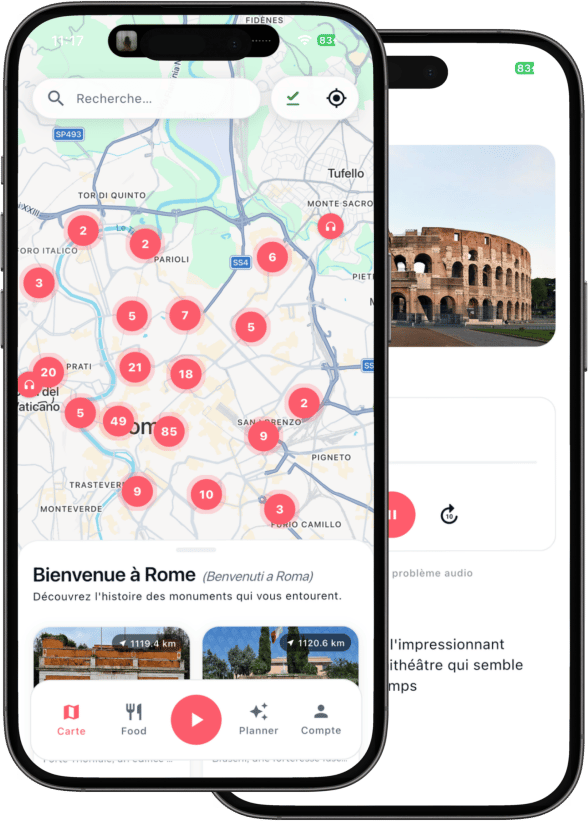
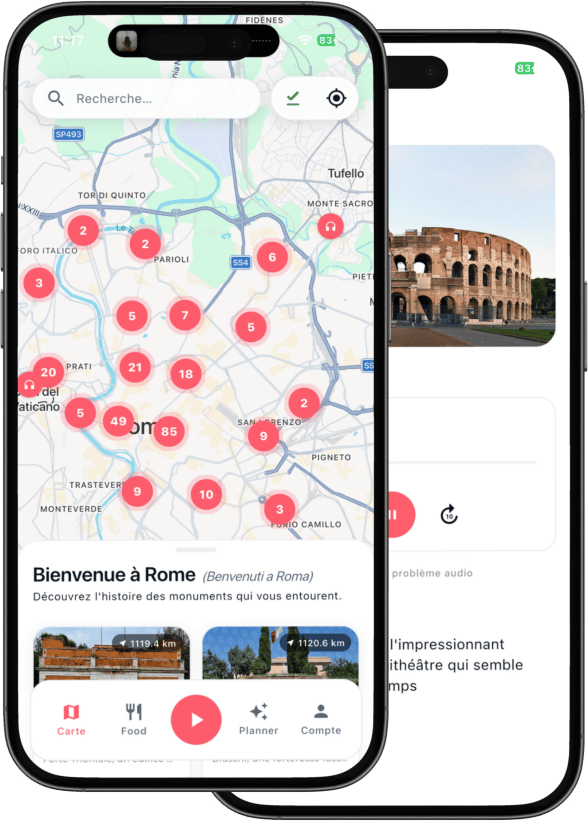
The commentary on this page is part of the CityGuide audio guide, which starts by itself in front of every place in the city.
Full audio guide
$21.90 $39.90
★ 4.8/5 · 15 reviews
30-day money-back guarantee
4. The detail no one notices: the holes in the stone
Step closer to the outer facade and look up at the stone blocks. You will quickly notice that the walls are pocked with hundreds of deep holes, as if they had weathered an artillery bombardment. Many visitors assume this is natural erosion or the toll of earthquakes. The reality is quite different and reveals the building's medieval history. During construction, Roman engineers did not use mortar to bond these massive, precision-cut travertine blocks. Instead, they drilled into the stone to insert heavy iron and bronze clamps, sealed with molten lead to stabilize the framework. In the Middle Ages, when metal became scarce and highly valuable, locals systematically chiseled out every joint to extract these metal fasteners and melt them down. Every hole visible today marks the spot of a stolen clamp salvaged to forge weapons or everyday tools.
5. The dark side: the hypogeum and the backstage of death
Beneath the arena floor, now vanished, lies an intricate subterranean network called the hypogeum. This backstage realm was a veritable inferno of sweat, smoke, and cries of agony. In a suffocating gloom lit only by torches, hundreds of enslaved workers toiled relentlessly to keep the spectacle running on the level above. The mechanical engineering was extraordinary for its era. An elaborate system of pulleys, counterweights, and wooden capstans hoisted entire sets or wild animal cages. Multiple lifts operated at once to propel beasts through trapdoors, surprising the spectators above. A foul stench of excrement, terrified animals, and dried blood hung over these damp corridors. Gladiators waited for their turn amidst a deafening roar, aware that a single blow could end their lives. This invisible labyrinth was the logistical factory powering imperial brutality.
6. What remains today: quarries and survival
Following the fall of the Roman Empire, the final beast hunts ceased in the sixth century. The Colosseum lost its primary purpose and slid into centuries of abandonment. For nearly a thousand years, the monument served as a feudal stronghold, makeshift housing, and above all, an open-air quarry. A vast amount of its travertine blocks and marble revetments were stripped away to build Renaissance palaces and Roman churches, including St. Peter's Basilica. The monument was spared total destruction only in the eighteenth century, when the popes consecrated the site in memory of Christian martyrs. Even its modern name stems from legend: it derives from the colossal statue of Nero that once stood nearby, rather than its size. Restored today, the Colosseum endures as a universal icon, the most striking testament to Rome's architectural mastery and boundless ambition.
How to Get an Audio Commentary for the Colosseum
Three main options exist to tour the monument with explanations.
The official on-site audio guide
You can rent a handheld device or video guide at the interior desks during your visit. It is an official option with verified facts, but it comes at an extra cost and requires waiting in additional queues to pick up and return the gear.
Free online videos and apps
Documentary videos or amateur podcasts can be found on media platforms. They cost nothing, but sound quality is often mediocre, facts are occasionally unverified, and they do not synchronize with your footsteps.
The CityGuide mobile app
Our paid app for the city of Rome features engaging stories that play automatically using your GPS location as you walk. Keep your smartphone in your pocket and simply enjoy the sights.
Practical Tips for Your Visit to the Colosseum
Mandatory reservations and combined tickets
Do not show up at the Colosseum expecting to buy a ticket on the day. Queues without advance bookings are endless, and entries are frequently sold out days in advance. The entrance ticket is paid and generally includes access to the Roman Forum and Palatine Hill; check the official website for rates.
Beware of fake centurions
Around the square and near the Arch of Constantine, men dressed as Roman soldiers approach passersby aggressively. Posing for a photo with them is by no means free. They will demand steep sums of cash right after. Politely decline and keep walking to avoid confrontations.
Street views are accessible without a ticket
If your budget does not allow for entry or if you could not find an available ticket, do not worry. Walking around the monument, along Via dei Fori Imperiali, or viewing it from the Oppian Hill offers a breathtaking sight that is completely free to enjoy, day or night.
Strict security and screening
Entering the interior requires passing through airport-style security scanners. Large backpacks, suitcases, sharp items, and glass containers are strictly prohibited, and there is no cloakroom on-site. Travel light to clear the checkpoints without hassle.
— Frequently asked questions
Frequently Asked Questions about the Colosseum and Audio Guides
No, there is no official free audio guide available on-site or for download. The monument charges a rental fee for its devices. On our website, we provide the complete historical commentary text to read and a short audio sample for free, while our full Rome audio guide is paid.
Yes, the standard admission ticket is a bundle that also grants entry to the Roman Forum ruins and Palatine Hill. Conditions and pricing should be verified on the official booking website.
Absolutely. The square surrounding the Colosseum, the view of the Arch of Constantine, and the outer facades along Via dei Fori Imperiali are in public space and can be viewed freely.
Expect to spend about one to one and a half hours inside the Colosseum to tour the two accessible levels, plus queueing time for security. If you also plan to visit the Forum and Palatine Hill, allow half a day in total.
The only reliable method is to purchase a named ticket with a scheduled time slot in advance through the official channel. Visitors arriving without a reservation risk waiting for hours or being turned away if capacity is reached.
These holes were chiselled out in the Middle Ages by Rome's residents. They wanted to extract the iron and bronze metal clamps that bound the stone blocks together, salvaging the metal to forge tools and weapons.
— Go further
Explore Rome with the CityGuide Audio Guide
Don't miss Rome's hidden wonders. Our mobile app triggers stories automatically as you stroll through the city.
Discover the Rome App